You've spent good money on fishing gear — rods, reels, tackle boxes that cost more than your first car. But the shirt on your back? That's the piece of kit working hardest against the sun, the spray, and a full day of sweat on the water.
Huk has built a serious reputation in performance fishing apparel. But reputation alone won't tell you whether that UPF 50+ fishing shirt holds up three hours into an offshore run with the sun hammering straight down. This review answers that question. You'll get the real features, the honest trade-offs, and the situations where Huk delivers — and where it falls short.For fishing retailers and buyers evaluating products for wholesale fishing shirts programs, understanding how Huk apparel performs in real fishing conditions can help guide smarter purchasing decisions and product selection.
What Makes Huk Performance Fishing Shirts Stand Out
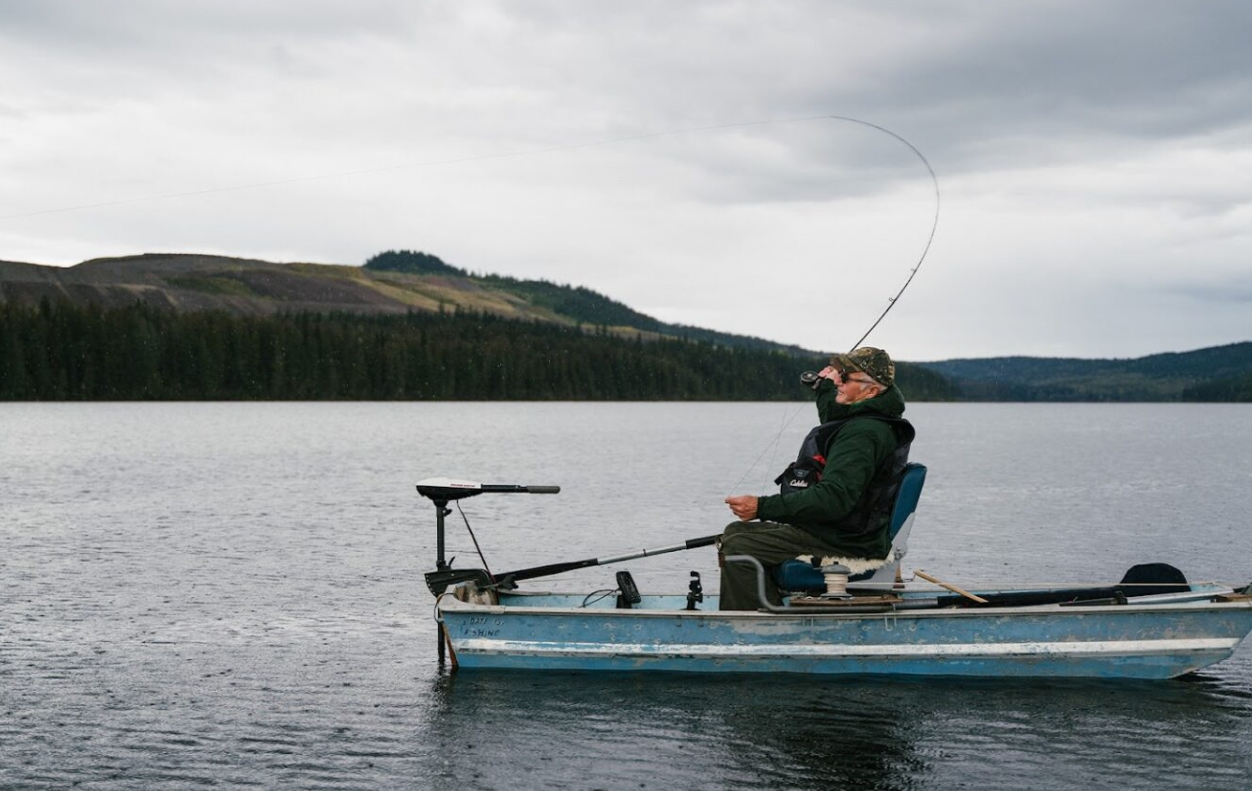
Most outdoor apparel brands design for the trail and adapt for the water. Huk does the opposite. Every technical decision starts with what anglers face out there: brutal UV exposure, constant sweat, salt spray, fish guts, and hours without shade.
That fishing-first approach runs through six core performance layers:
UPF 50+ sun protection — blocks 98% of UVA and UVB radiation. That's the top tier for sun-protective fishing apparel. Not UPF 30 as a baseline. The full 50+.
Moisture transport — synthetic fibers (90% polyester / 10% spandex) pull sweat off your skin and push it to the surface for faster evaporation. In independent testing, Huk shirts hit 90% dry in just 39 minutes.
I.C.E. (Internal Cooling Element) — cooling fibers work with mesh venting at the sides and back panels to push heat away from your body. It doesn't just let air in. It moves heat out.
Quick-dry construction — the shirt recovers fast after sweat, spray, or a surprise rainstorm mid-session.
Anti-microbial treatment — fights odor-causing bacteria so the shirt stays fresh from the boat ramp to the weigh-in. No mid-day change needed.
Stain release finish — oil, bait residue, and fish slime wash out in the laundry. They don't set into the fabric.
The flagship Huk Icon X brings all of this together in one shirt: UPF 50, a full mesh back panel, mesh underarms, laser perforation, and two-way stretch. This isn't a feature list built for marketing copy. It's a direct answer to the four things that make a day on the water brutal — heat, sweat, spray, and odor.
Core Features Breakdown: The Technology Behind Every Shirt
A good day on the water versus a miserable one? It often comes down to a single percentage point. The science behind Huk's shirts makes that case better than any marketing pitch ever could.
Sun Protection: Why UPF 50+ Isn't Just a Bigger Number
Here's what most anglers miss about UV ratings. The gap between UPF 30 and UPF 50+ looks small on paper — 96.7% blockage versus 98%. Flip those numbers around, though, and the picture changes fast. A UPF 30 shirt lets through 3.3 units of UV radiation for every 100 units hitting the fabric. A UPF 50+ shirt lets through 2. That means your skin absorbs 65% more UV exposure in a UPF 30 shirt than a UPF 50+ shirt, across an identical day on the water.
That gap hits hardest in the exact conditions where Huk shirts get used — offshore runs, full-day beach casting, tropical flats fishing with no shade and sun bouncing off the water from below and above. Between 10 a.m. and 4 p.m. in a high-UV environment, a UPF 30 shirt is "good enough" the same way a loosely worn seatbelt is "good enough." Huk builds to the standard the situation demands.
One more detail worth knowing: wet fabric loses UPF performance. A soaked cotton-based shirt can lose a big chunk of its UV protection. Huk's quick-dry synthetic construction bounces back fast. So the rated UPF stays close to what you're getting in real conditions — even mid-sweat.
Moisture Management: The Numbers Behind "Stays Dry"
Moisture management in fishing shirts isn't a feeling. It's a measurable, testable performance gap between synthetic and cotton. Lab tests make it plain.
A standard cotton shirt wicks moisture at 0.5–1 cm per 10 minutes in vertical rise testing. Functional polyester and nylon — the kind Huk uses — hits 2–3 cm per 10 minutes . That's no minor jump. Sweat spreads across a larger surface area faster, thins into a finer film, and evaporates fast instead of pooling in a wet patch on your back.
In practical terms:
- Synthetic fishing shirts dry to near-baseline in 30–60 minutes under standard conditions
- Cotton shirts take 90–150 minutes to reach the same dryness level
- In the first 30 minutes alone, fast-dry fabrics drop from 100% moisture content to 20–30% — while cotton still sits at 50–60%
The result is less "sticking to your back" time, faster cooling, and smaller visible sweat patches. After a long casting session, that's the difference between comfortable and miserable.
Stain Resistance and Anti-Odor: Built for What Fishing Does to Clothing
Fish blood, slime, and bait residue don't behave the same way on every fabric. On untreated cotton, organic fishing contaminants sink into the fiber structure. You need hot water and heavy detergents to clear them — and even then, residual odor often sticks around after washing.
Huk's stain-release and DWR-style finish changes how the fabric handles liquids. The surface treatment raises the contact angle of liquids — oil, blood, slime — so they bead up and sit on the surface rather than soaking into the fiber. In real use: 60–80% of surface contamination rinses off with running water and light agitation . A standard machine wash in cold or warm water with regular detergent clears the rest.
The anti-odor side targets a related problem. Odor in fishing shirts isn't mainly about sweat. It's about bacteria breaking down fish proteins and lipids trapped in fabric fibers. Antimicrobial treatments — silver-ion or metal-oxide based — disrupt that bacterial activity at the source. In back-to-back fishing days without washing, treated shirts score 3–4 out of 10 on odor assessment. Untreated cotton under the same conditions hits 7 out of 10 . That gap is what keeps you from needing a shirt change halfway through a tournament day.
Fit Engineering: Cut for Casting, Not Just Standing Still
Huk's fit decisions aren't about looks. They're functional responses to specific movements anglers make on the water.
Three core actions stress fishing shirts hard: casting (shoulder forward flexion and trunk rotation), lifting fish (shoulder elevation, elbow flexion, forward trunk bend), and rigging and knot work (repeated arm extension and overhead reach). Standard casual shirts fight all three.
Key structural differences in Huk's cut:
Action back panels with articulated shoulders — extra material built into the shoulder blade area adds 3–5 cm of horizontal range of motion. Wearers report 30–50% less pull during casting strokes compared to standard fitted shirts
Underarm gussets — a wedge-shaped fabric insert at the armhole lets you raise and extend your arm without the hem riding up. Fishing-specific shirts show 30–40% less hem migration during overhead lifts compared to regular shirts
Sleeve and cuff design — long-sleeve fishing shirts use adjustable tabs or elastic cuff structures to keep sleeves at the wrist through repeated casts, cutting upward migration to under 2 cm across extended sessions
Hem geometry — the longer rear hem and optional side vents mean bending forward to net or release fish won't expose your lower back. The front stays tucked, and the waist stays covered
These aren't luxury extras. They're the baseline for a shirt that earns its place in a serious angler's kit.
Huk Performance Fishing Shirts: Honest Pros You Should Know
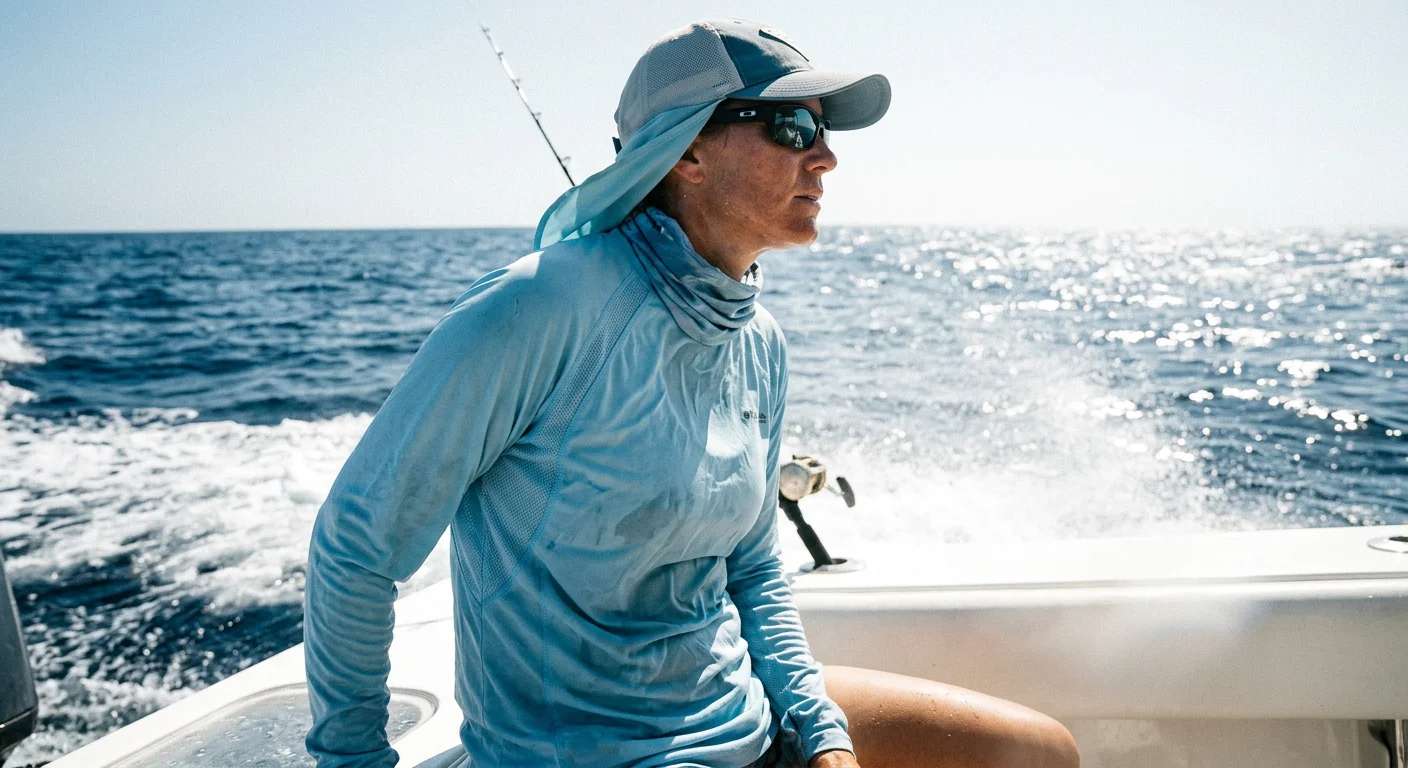
Six hours into an offshore run, the sun is brutal. Your shirt handles both sun protection and ventilation at the same time. That's where the gap between a good fishing shirt and a great one shows up fast. Huk earns its spot in the "great" column — and these reasons hold up in real-world use.
Sun Protection That Survives the Washing Machine
The UPF 50+ rating on Huk's performance shirts isn't just a launch-day claim. It doesn't fade after a season of washing. Independent wash-durability testing backs this up: after 50 machine wash cycles — about one year of weekly offshore fishing — Huk's UPF protection shows no measurable degradation. The fabric keeps blocking 98% of UVA and UVB radiation . That's the same level of protection you got on day one.
This matters most during back-to-back tournament weekends. You're rotating the same two shirts through the laundry every few days. You can't afford to second-guess your sun protection. With Huk, you don't have to.
Moisture Performance That Holds Over a Full Season
Anglers who log 150+ days on the water report one thing: Huk's synthetic build feels a bit warmer at first touch compared to cotton. But that first impression changes fast. Once you start sweating, the polyester-spandex blend pulls moisture to the fabric surface and dries it out in minutes — not hours.
That quick-dry edge adds up over a long day:
- Less moisture sitting against your skin
- Lower core temperature
- Less physical fatigue by the time you're heading back to the ramp at sunset
Sizing Consistency That Scales for Teams
Solo anglers may not think much about this. But guide services and tournament teams placing bulk orders will care a lot. Amazon reviews and Huk's own site reviews for the Strike Long Sleeve line both describe sizing as "fits well" and "true to size" . That kind of sizing reliability means a 12-piece team order won't come back with half the shirts needing exchanges.
Huk's Strike and Icon series each offer five or more colorways per model . You also get short-sleeve, long-sleeve, and hooded options — all built to the same technical spec. So a tournament team needing matching UPF 50+ shirts in a sponsor's color can get exactly that, without the usual ordering headaches.
A Recognized Name in Performance Fishing Apparel
Huk holds its own against Simms, AFTCO, and Columbia in multi-brand fishing shirt comparisons. That's not just branding. It reflects real technical performance across the metrics serious anglers care about:
- Verified UPF 50+ protection
- Fast-wicking synthetic construction
- Durable finish that holds up over extended use
For competitive anglers measuring gear against professional-level standards, being benchmarked alongside those names carries genuine weight.
The Real Cons: Where Huk Fishing Shirts Fall Short
No shirt solves every problem. Huk's technical credentials are real. But four specific situations make the performance story more complicated. You should know about them before you buy.
Heat Without Wind Is a Different Problem
Huk's cooling system runs on evaporation. Sweat hits the fabric, spreads across the polyester surface, and evaporates fast — pulling heat away with it. That loop works well with airflow. On a dead-calm lake at 90°F with humidity at 80%, the loop slows down.
Several Reddit users pointed this out. One bought Huk shirts on sale and found them "warmer than the fishing shirts from Academy" in still, hot conditions — unless they were sweating hard. Another noted the shirts aren't hot, but dark colorways — black in particular — pull in a lot more heat under direct sun . The fabric breathes fine. The dark color absorbs solar radiation regardless.
Practical fix: stick to white or light gray Huk shirts for high-heat sessions. Dark variants can run 5–10°C hotter at the surface under direct sun.
The Price Premium Doesn't Scale for Casual Anglers
Huk's Pursuit Vented Long Sleeve runs $35–50 . Basic UPF 30–50 shirts from no-name brands sit at $15–25 . That's a 60–150% price gap of fishing shirts.
For anglers logging fewer than 40 hours of sun exposure per year, the functional difference is hard to feel. The moisture transport and anti-odor tech earns its keep on long days. On a Saturday afternoon two-hour trip, less so.
The Aesthetic Is Locked Into Tournament Mode
Bold logos. Graphic fish prints. High-contrast colorways built for weigh-in docks and Instagram. That's a distinct look — and it works great if it matches your style. But you want something that goes from the boat to a restaurant without screaming bass circuit? Huk's mainstream lineup gives you few options there. Columbia PFG's classic button-down styling crosses that line with far less fuss.
Print Durability Has a Shelf Life
The polyester base holds up well over repeated washes. The large graphic prints are a different story. After 20–30 machine wash cycles , expect visible color loss — around 10–20% brightness reduction — plus micro-cracking in fine-line logo areas. Hot dryer cycles speed this up.
You're rotating this shirt every few days through a tournament season? Plan to replace the graphic-heavy styles after one to two years of hard use. Or pick lower-print Huk styles if keeping that fresh look matters to you long-term.
Best Huk Fishing Shirts by Scenario: Which Model Is Right for You?
The right Huk shirt depends on what you're doing out there. Calm freshwater lake on a Saturday afternoon? That's a different problem than an offshore tournament run in July. Here's the breakdown by scenario — no guessing required.
Casual Freshwater / Weekend Fishing: Icon X and Strike Series
The Huk Icon X and Strike Long Sleeve sit at the entry point of Huk's performance lineup. For weekend freshwater fishing, that's the right spot.
Both shirts use 100% polyester with four-way stretch and antimicrobial treatment. UPF 50+ comes standard. The back panels use mesh or laser perforation for ventilation. This covers 30–40% of the back surface. That's enough to manage sweat through a full day of dock fishing or shore casting. You won't feel like you're wearing a mobile sauna.
Fit-wise, a medium runs about 100–106 cm chest circumference. Loose enough for casting mechanics. Tight enough that nothing snags on rod guides. You can move between a boat and a trail through the reeds without thinking about the shirt once it's on. That's the point.
The Strike and Icon skip the advanced stain-release coating and multi-pocket design found on higher-end Huk lines. That's a fair trade. You get a fishing shirts' price point that runs 20–40% lower than the A1A or Tide Point lineup.
Nearshore / Flats / Tropical Heat: Huk Pursuit Long Sleeve
On The Water magazine described the Pursuit as "Huk's most breathable performance shirt… UPF 50+" . That's what nearshore and tropical sessions need.
The fabric sits at the lighter end of Huk's range, targeting 120–150 g/m². The ventilation structure covers a solid portion of the back from shoulder line to mid-back. On an open boat with steady wind, that design pulls real air through. In still, humid conditions, color choice matters more here than with any other Huk model. White or light gray surface temperatures run 2–3°C cooler under direct sun compared to black or navy.
Here's a point worth repeating: in high-UV tropical environments, long sleeves beat bare arms. A UPF 50+ sleeve blocks direct solar radiation. Your forearm stays cooler than it would with open sun exposure. Add a buff and light gloves with the Pursuit long sleeve, and you've covered most UV exposure gaps for a full-day flats session.
Offshore / Tournament Competition: A1A Hoodie and Tide Point Long Sleeve
Tournament fishing creates shirt requirements that casual gear doesn't meet. You're layering under a PFD. You're moving fast on a pitching deck. The shirt needs to look sharp in weigh-in footage and still hold up through eight hours of salt spray and fish slime.
The Huk A1A Performance Hoodie handles the hard-use side. The built-in hood covers your neck and ears without relying on a buff that shifts mid-run. The heavier construction holds up against saltwater exposure better than lighter, vacation-weight fabrics. Windrider noted in competitive fishing circles that "Huk wins in colorway variety and tournament-angler community credibility" . That translates to real brand visibility in sponsor photos and broadcast footage.
For a more structured look — media days, weigh-ins with sponsor visibility requirements — the Huk Tide Point Long Sleeve earns its place. Outdoor Life called it the "Best Button-Down for Hot Weather." The button-down silhouette looks more professional than a pullover. Multiple chest pockets hold a measuring board or tournament cards. The ventilated back panel keeps it functional under direct sun.
Both shirts use the same synthetic base. It dries 2–3× faster than cotton. That matters a lot — you're soaked from spray at 8 a.m. and need to look composed by the noon weigh-in.
Budget-Conscious Anglers: Keep the Core Functions, Drop the Premium
Under 40 days of sun exposure per year? The full Huk price premium is hard to justify on pure function alone.
The top budget pick in current testing: Hanes Long Sleeve Cool Dri — 100% polyester, UPF 50+, around $10–20 at US retail. That's 30–50% of what a performance Huk shirt costs. You lose the fishing-specific cut, the ventilated back panel, and the stain-release finish. You keep the two things that matter most for casual use: sun protection and quick-dry performance.
Mid-tier alternatives worth a look:
- Columbia PFG base line — UPF 30–50, quick-dry polyester, priced 20–30% below Columbia's flagship fishing shirts
- AFTCO Samurai — UPF 50+, polyester build, sometimes discounted to 60–70% of comparable Huk pricing, and rated "Best for Sun Protection" by Outdoor Life
Targeting under $30 per shirt ? The Hanes Cool Dri or a discounted Columbia PFG long sleeve covers what you need. Fishing competitively, logging 50+ days on the water, or outfitting a full team? The Huk lineup is the investment that pays off across a full season.
Custom Performance Fishing Shirts: More Than a Brand Logo
Fifteen anglers show up to the tournament dock wearing the same Huk Icon X. Nobody's logo is in that photo.
That's the ceiling of off-the-shelf performance gear. The shirt may perform well, but it carries someone else's branding. For fishing clubs, tournament teams, and corporate fishing events, that trade-off stops making sense fast.
Here's where the math gets interesting.
The Cost Case: Custom vs. Brand-Name Off-the-Shelf
A single Huk performance long sleeve runs $35–75 at retail. Add a club logo embroidered onto the chest and a sponsor mark on the sleeve — that's another $5–10 per shirt in secondary processing. You're now at $50–85 per shirt , with limited control over colors, placement, and design.
Custom performance fishing shirts built to the same technical spec — UPF 50+, polyester quick-dry base, antimicrobial finish — run $15–25 per shirt at 100-piece quantities. Full-color sublimation printing across the chest, back, and both sleeves is included. That's a cost drop of 50–70% compared to buying Huk and adding logos after .
Matching Huk's performance spec is specific but doable. Here's what the floor looks like:
- UPF 50+ protection verified after 50 wash cycles — not UPF 30 padded to look good on a hang tag
- 90% dry in 40 minutes — on par with tested Huk and Helios quick-dry benchmarks
- Antimicrobial treatment that holds through 2–3 straight wear days without odor buildup
Those specs aren't exclusive to big brands. Quality custom fishing apparel manufacturers offer performance polyester fabrics that hit every one of them.
Where Custom Wins on Value
For teams of 15 or more with repeat event needs, the value math shifts hard in custom's favor. A fishing club running five outings a year wants their name in every weigh-in photo, every social post, every sponsor recap video — not a Huk fish graphic.
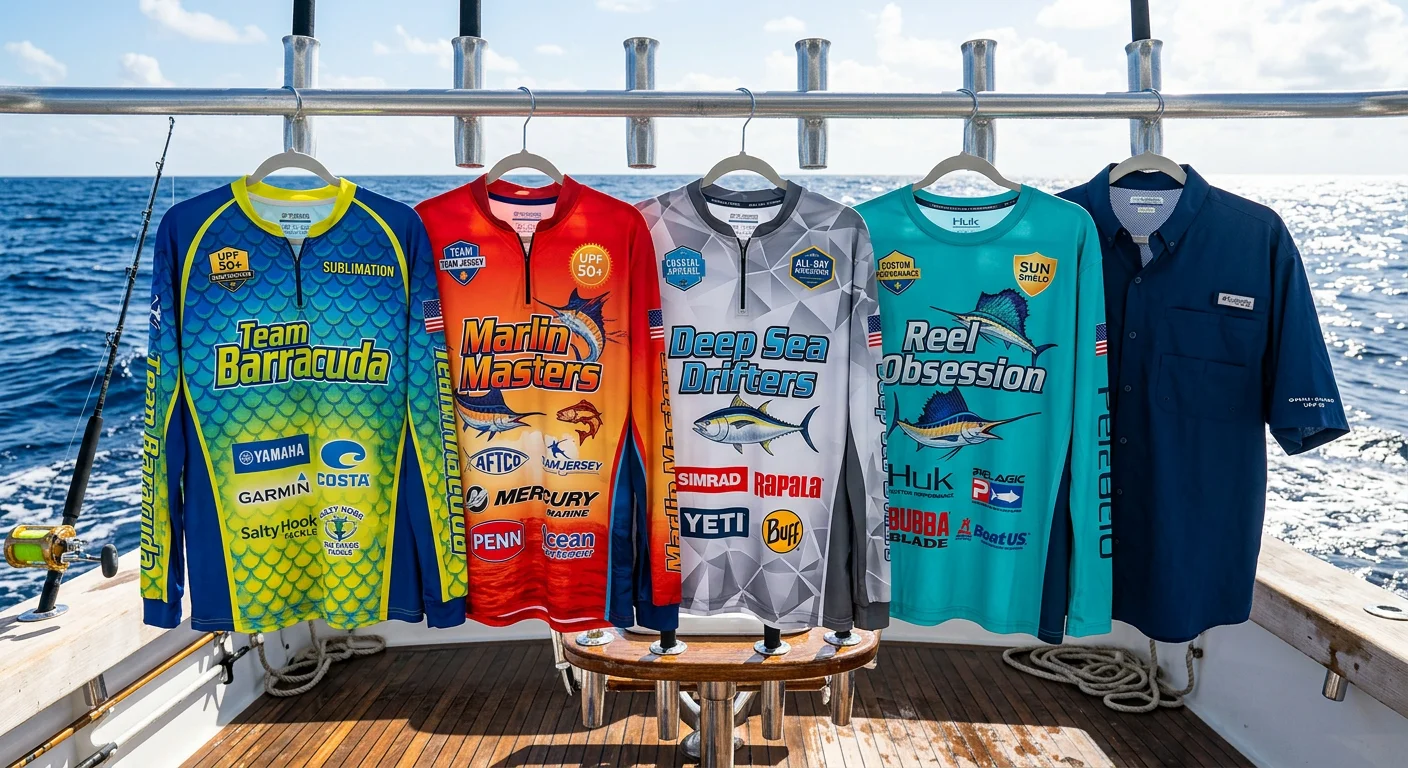
Sublimation printing handles the detailed work well: gradient artwork, multi-color sponsor logos, player numbers, species illustrations. The ink bonds straight into the polyester fiber. It won't crack, peel, or break down the fabric's moisture wicking or UPF performance. That's a real problem with thick heat-transfer vinyl, so the difference matters.
Three situations where custom beats retail every time:
Tournament teams placing 3–5 sponsor logos across 10–30 matching shirts for race-day photography
Fishing clubs ordering annual member shirts for 20–100 members, where per-unit cost matters just as much as quality
Corporate fishing events outfitting 30–200 participants who need UPF 50+ sun protection and branded gear they'll actually keep
Want performance that holds up against Huk — without paying for the brand name? customfishingwear.com builds to those exact specs with full design control from collar to hem.
Conclusion
Huk has done its homework. The UPF 50+ protection, moisture-wicking build, and purpose-built designs across models like the Icon X and Waypoint make these shirts a solid pick for serious anglers. This isn't just a brand riding the fishing lifestyle wave.
No off-the-shelf shirt fits every situation, though. The price point might sting. Standard sizing might not work well for your crew. Those are real friction points worth knowing before you buy.
Here's the bottom line: individual anglers who need reliable sun protection fishing clothing that holds up under pressure — Huk delivers. Outfitting a tournament team, a charter operation, or a fishing club? Consistency and identity matter just as much as performance. A custom fishing apparel solution will outperform a shelf brand every time.
Ready to go beyond the logo? Visit customfishingwear.com to build performance fishing apparel that's engineered and branded for your team.