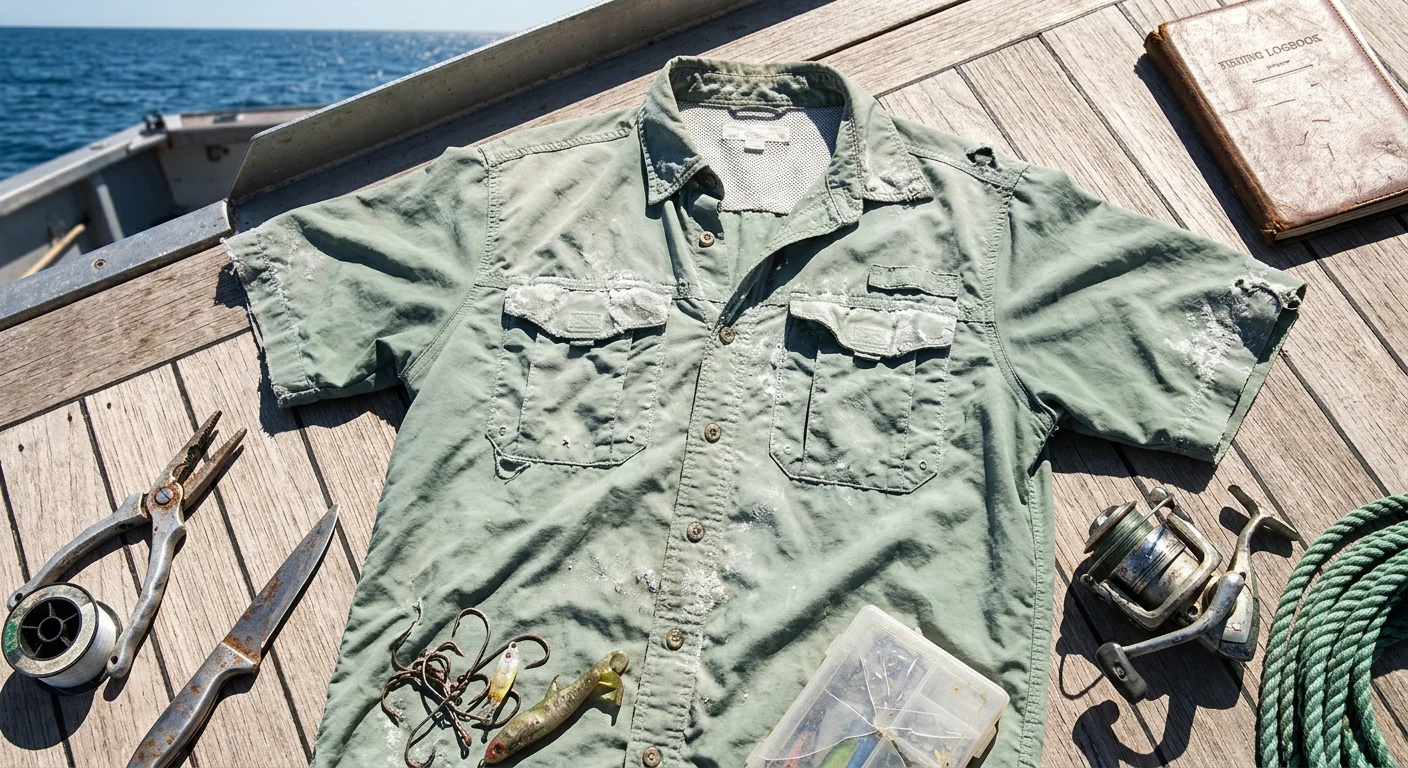
The supplier you choose can make or break your professional image and your budget. I've seen charter operators burn through three different manufacturers before finding one that actually delivers moisture wicking fishing shirts custom-printed to survive saltwater, sun exposure, and a full season on the water without fading or fraying at the seams.
That's why I put together this breakdown of the top custom fishing apparel suppliers in the USA for teams, charters and fishing brands. Whether you need sublimated jerseys for a tournament roster, bulk fishing shirts printing for your retail line, or a low-MOQ partner to test your first logo run, you'll find real production capabilities, pricing ranges, and turnaround times here—not marketing fluff. Let's get you matched with a supplier that fits your actual needs.
Ocean Blue Graphics(Florida)—The Preferred Supplier of Tournament Uniforms
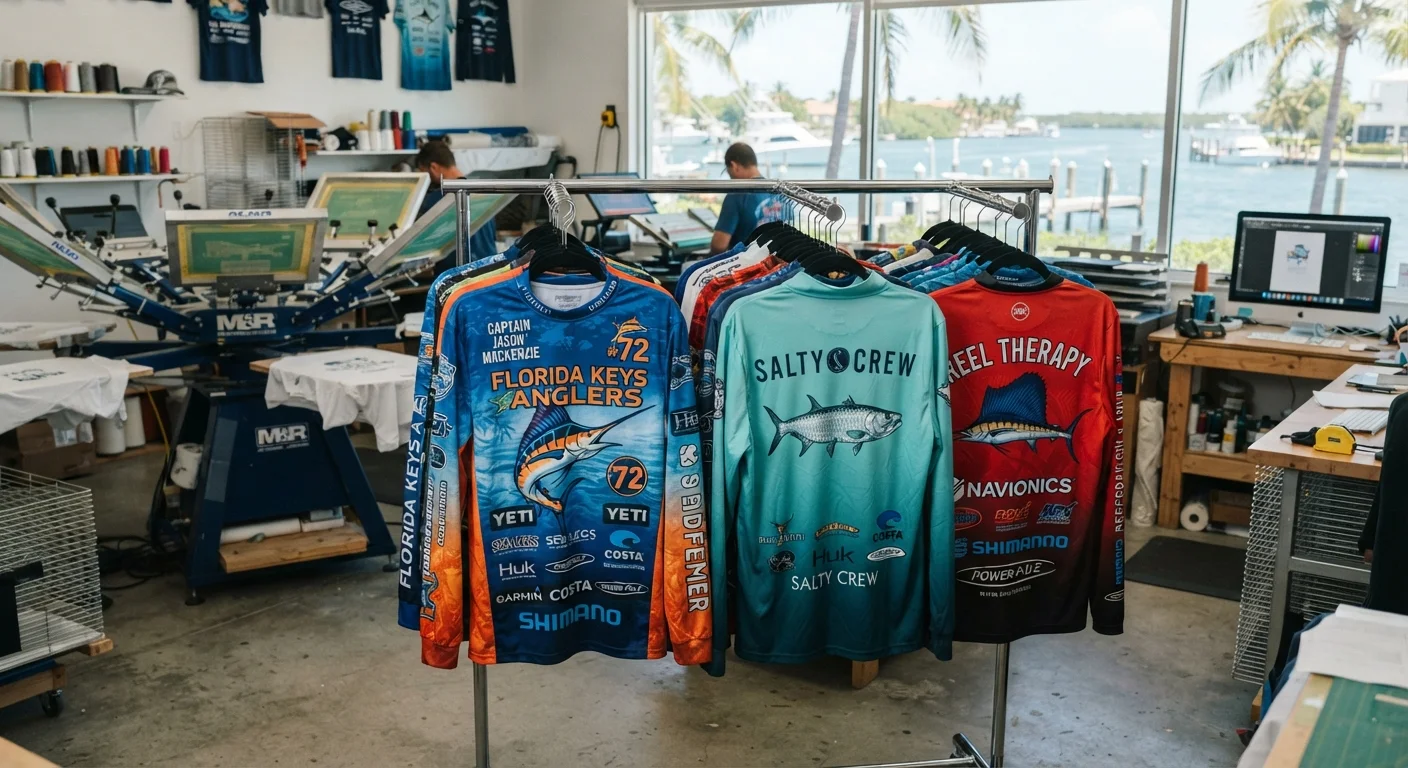
Tucked away in Riviera Beach, Florida, is a family-owned business that’s been in operation for nearly 20 years—Ocean Blue Graphics. Their Facebook page states plainly: “Designer & Screen Printer for some of the most prestigious sportfishing tournaments and teams in the world,” accompanied by photos of team uniforms captured on-site at various tournaments. This isn’t just marketing hype; it’s an accurate reflection of their client base.
Why Do Tournament Teams Choose Them?
Ocean Blue Graphics operates an 8,000-square-foot in-house facility where they handle all four production processes—screen printing, dye sublimation, DTF direct-to-fabric printing, and computerized embroidery—entirely in-house, without outsourcing. This means that on a single custom fishing hoodie or shirt, you can feature: a sublimated fish design as the main motif, a sponsor logo printed on the back, a 3D embroidered team crest on the chest, and personalized player names and numbers using DTF printing. This combination of techniques is precisely what sets championship team uniforms apart from standard apparel.
MOQ and Price Range
Industry reviews list this company as a low-MOQ partner. Typical minimum order quantities range from 12 to 24 pieces per design, making it suitable for club teams of 10–30 people or single-boat team uniforms of 8–20 sets. Pricing-wise, standard screen-printed T-shirts (1–2 colors, 24–50 pieces) range from $8 to $15 per piece; full-print sublimation fishing shirts (including sponsor logos, small batches of 12–24 pieces) range from $25 to $45 per piece; and DTF personalized names and numbers incur an additional charge of approximately $3–8 per placement.
How to Schedule Delivery
Design confirmation and the first prototype typically take 5–10 business days; small-batch production (up to 50 pieces) takes 10–21 business days. The total lead time from order placement to shipment is kept within 3–5 weeks, which generally covers the preparation period for most championships. Before placing an order, we recommend emailing [email protected] to specify the number of team members and your target delivery date. Having all design files (team crest, sponsor logos, boat name and number) ready in one go will save a lot of back-and-forth communication.
customfishingwear.com——OEM/ODM Contract Manufacturer of Offshore Fishing Apparel
Offshore fishing apparel requires technical fabrics that can withstand 8 hours of intense sunlight, salt spray corrosion, and frequent immersion in water. These requirements align with the niche market of OEM/ODM custom fishing apparel manufacturers, and customfishingwear.com is a contract manufacturer in this category.
Check the UPF 50+ Report First—Don’t Trust Marketing Claims
If any factory claims to offer “sun-protective fishing apparel,” first request a third-party laboratory report. The standard must be clearly specified—whether it’s AATCC 183 or AS/NZS 4399—and the values must be specific (UPF 50, UPF 100). Don’t let them get away with simply writing “UPF 50+.” Qualified fabrics must block ≥98% of UV radiation, and the report date should ideally be within the last 12–24 months.
Fabric Traceability
Reputable contract manufacturers can provide a fabric composition chart (e.g., 92% polyester + 8% spandex), weight-per-square-meter data (typically 130–150 g/m² for deep-sea fishing shirts), and BSCI or Sedex audit reports. When signing the contract, be sure to specify that changing fabric suppliers requires written notification and the resubmission of an UPF report.
MOQ and Price Range
The MOQ for printed fishing shirts made from performance fabrics is generally 200–300 pieces per style/color. The FOB price starts at approximately $8–10 per piece for orders of 300 pieces or more, and can be negotiated down to $7–9 per piece for orders of 500–1,000 pieces. For waterproof fishing jackets, the MOQ increases to 300–500 pieces; the price for 300 pieces is $18–25, and for orders of 1,000 pieces or more, the price can be negotiated down to $15–22.
Full Private Label Support
We offer private label services including logo embroidery, custom fishing clothing hangtags, care labels, brand story cards, and logo-printed OPP bags and cartons. Hangtag design and printing cost approximately $0.05–0.12 per piece, and heat-transfer logos cost approximately $0.08–0.15 per location.
True Differentiation
A good factory lets the data speak for itself. Our proprietary ceramic micro-particle UV-protective coating achieves a measured UPF of 100+, with performance degradation controlled to within 10% even after multiple washes; the antimicrobial finish achieves a 99% bacterial inhibition rate; quick-dry testing shows a wet spot spread time of <5 minutes. Laser-cut ventilation holes (1–3 mm in diameter) at the shoulders and underarms can reduce localized heat and moisture buildup by 10–20%. These parameters are far more worthy of inclusion in contract appendices than the mere phrase “high-quality fabric.”
Lead times are generally 45–60 days; top-tier factories maintain an on-time delivery rate of over 95%, and their ability to handle rush orders during peak seasons is also a key indicator of their value for long-term partnerships.
USA Clothing Manufacturers——Multi-category athletic apparel factories in the United States
Not every company that bills itself as a U.S. fishing apparel manufacturer” actually has a factory where clothes are sewn. Alanic Activewear is a prime example—headquartered in Beverly Hills, California, it appears on several “Top Sportswear Manufacturers in the USA” lists alongside established companies like Augusta Sportswear and Badger Sportswear. However, many of the companies on these lists are actually “integrated global partners” or “private label platforms,” which essentially means they are brands that outsource production rather than operating their own single factory.
How to Tell if It’s a Real Factory or a Middleman
Alanic lists a factory in Stratford, CT, but it isn’t listed separately in public manufacturer rankings. To verify its authenticity, here are a few practical steps you can take: Check the California and Connecticut business registration systems to see if the Beverly Hills address is registered as manufacturing (NAICS 315) or wholesale trade; Next, ask the factory for the number of sewing machines—small U.S. sportswear factories typically have between 40 and 120 machines, with a daily production capacity of 800–3,000 T-shirts and only 300–1,000 for technical items like fishing shirts. A company is considered a true manufacturer only if 70% or more of the cutting and sewing processes are completed locally; otherwise, it’s most likely a contract printer and private-label fishing apparel manufacturer.
How to Quote for Small Batches of 30–150 Pieces
This range is intended for guide groups and small clubs with limited budgets. For basic solid-color printed polyester T-shirts, the unit price for 30–50 pieces is $9–14; increasing the order to 100–150 pieces can bring the price down to $7–11. Specialized fishing shirts (multi-pocket, UV-protective, mesh) typically range from $22 to $35 for 30–50 pieces, dropping to $18–28 for 100–150 pieces. The MOQ is generally 30–50 pieces per style and color; orders below this quantity incur a 10–25% surcharge, and a separate pattern-making fee of $80–200 applies for very small batches.
Is Fishing Gear Just a “Side Project”?
This is the core issue. Consider these two figures: The proportion of fishing-related SKUs out of total sportswear SKUs can reach 25–40% at specialized factories; their share of total shipments can reach 20–35%, and even exceed 30% during peak season. If this proportion is below 5–10%, the manufacturer is essentially just renaming ordinary shirts as fishing shirts—and they’re highly unlikely to be able to provide technical specifications such as UPF reports or saltwater colorfastness.
Coastal Custom Sportswear——Factory Dedicated to High-Pressure Period Championships
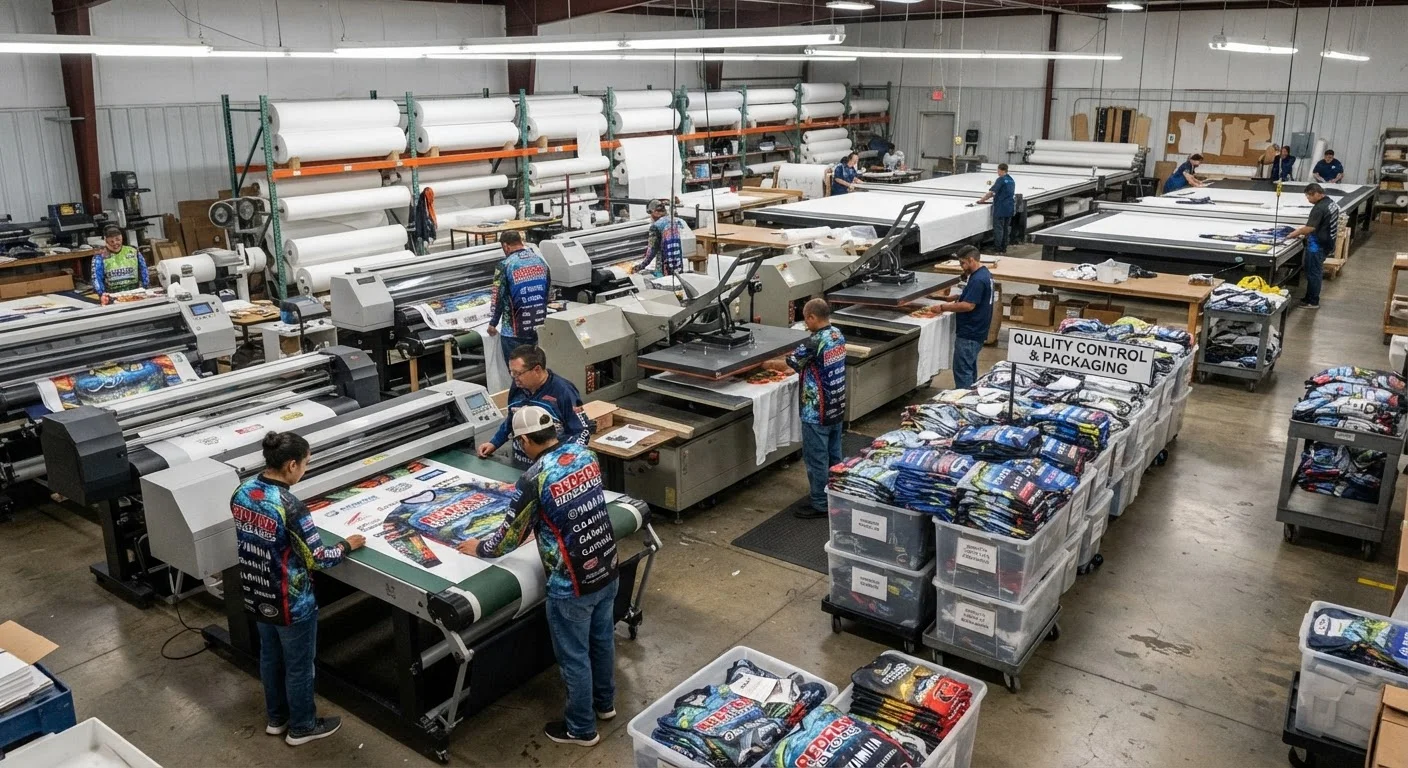
With the sponsor’s logo finalized just two weeks before the competition and 40 sets of team uniforms still to be assembled, most factories would shake their heads at the sight of such a “high-pressure” order. Coastal Custom Sportswear specializes in tackling these tough challenges, with a monthly production capacity of over 5,000 full-sublimation custom sports uniforms, focusing on the bulk delivery of fishing team uniforms.
The Technical Foundation of Full-Surface Sublimation
At 190–210°C, sublimation ink is heat-pressed for 35–60 seconds, allowing solid dyes to directly penetrate the pores of polyester fibers. Team emblems and sponsor logos aren’t applied as decals—they’re dyed directly into the fabric fibers. Under normal washing conditions, the print will hardly crack or peel off. The print resolution reaches 720–1,440 DPI, allowing for clear reproduction of complex fish designs and multi-layered logos. 3D pattern-making software is used to create patterns and preview the look of the entire team, while layout software optimizes fabric utilization to over 80–85%, directly translating to cost savings.
Are Rush Turnarounds a Real Capability or Just a Gimmick?
Laser cutting machines automatically cut pieces by reading black contour lines; a mid-sized machine can produce 500–800 sets in 8 hours. With a sewing line staffed by 5–8 people, daily production capacity is 150–300 sets. For a typical order handled by a team of 20–30 people, the entire process—from design and prototyping to production and logistics—takes 3–4 weeks. Once the design is finalized and payment and sizing details are confirmed in a timely manner, the turnaround time can be reduced to 7–10 days under rush mode.
To determine whether a factory is capable of handling rush orders, don’t just rely on marketing claims—ask directly about three key points: Does their pre-made pattern library contain at least 20 ready-to-use designs? Do they maintain a stock of raw fabric of at least 3,000–5,000 meters? Can their sublimation printers operate continuously for more than 20 hours during the night shift? Only when all three criteria are met does the factory truly deserve the label of “specialized supplier for peak periods.”
Side-by-Side Comparison Table of the Top 5 Suppliers
With the five quotes laid out side by side, the numbers speak louder than the sales pitches. This table breaks down the five suppliers we discussed earlier into six categories, making it easy for you to scan them at a glance and find the one that best matches your order volume and budget
Supplier | Best For / Positioning | MOQ | Price Range | Core Processes | Lead Time |
|---|---|---|---|---|---|
Ocean Blue Graphics | Tournament jerseys, multi-technique customization | 12–24 pcs/style | $8–45/pc | Screen printing + Dye sublimation + DTF + Embroidery | 3–5 weeks |
customfishingwear.com | OEM/ODM private label brands, sun-protection technical fabrics | 200–300 pcs/style | $7–25/pc | UPF50+ coating, antibacterial finishing, laser ventilation | 45–60 days |
USA Clothing Manufacturers (Alanic) | Small-batch guide/team groups, production capacity needs verification | 30–50 pcs/style | $7–35/pc | Basic printing + Multi-pocket sun protection designs | Not publicly disclosed; on-site verification recommended |
Coastal Custom Sportswear | Urgent tournament orders during peak seasons | Not specified (based on team size) | Not publicly disclosed | Full-print sublimation, laser cutting | 3–4 weeks, expedited 7–10 days |
Great Lakes Tournament Apparel | Misleading positioning, use with caution | — | Industry benchmark: $35–80/pc | Unable to verify | — |
When looking at this table, don’t just focus on the price. MOQs and lead times are often the real deal-breakers—if your budget is sufficient but you can’t wait 45 days, OEM factories like customfishingwear.com are immediately ruled out. Conversely, for rush orders, it’s more realistic to turn to Ocean Blue Graphics or Coastal Custom Sportswear. The “Great Lakes” row has been left in the table as a reminder: if a supplier’s business registration information can’t be verified, treat even the most attractive quote with skepticism.
Key Purchasing Criteria for Selecting a Custom Fishing Apparel Supplier
Numbers don’t lie. The key to determining whether a custom logo fishing apparel manufacturer is reliable lies in whether it can provide verifiable, concrete metrics.
Fabric Performance: Let the Numbers Speak
UPF is the baseline. UPF 30+ is considered acceptable. For strong sun protection, UPF 50+ is required, and there must be a third-party test report specifying whether it is based on AATCC 183 or AS/NZS 4399. Skip any supplier that simply lists “UPF 50+.”
For water resistance, look at the static water column rating. 5,000 mm is sufficient for light rain, while 10,000 mm+ is required for heavy wading or torrential rain. Breathability should be at least 5,000 g/m²/24hr moisture vapor transmission rate—this is the baseline for comfort.
Durability is in the details. Taped seams (including fully taped seams) must be properly applied, and zippers and fasteners must be YKK or equivalent. Fabrics with a denier of 70D or 100D nylon are typically more abrasion-resistant. Before mass production, obtain physical samples and focus on testing seam strength, colorfastness, and hardware durability. Renderings cannot replace actual testing.
Printing Techniques: Select Based on Order Type
Sublimation printing is suitable for team uniforms, full-print designs, and applications requiring visual consistency. Screen printing is ideal for logos and small-area customization; it offers better value for small, single-color orders. Embroidery is suitable for chest and sleeve patches, offering excellent durability, but may not be appropriate for lightweight sun-protective garments.
Be sure to clarify the risk of peeling in areas subject to high-frequency friction.
MOQ, Lead Time, and Matching Your Role
The typical MOQ for sample runs is 500–1,000 pieces. Some small-batch suppliers may accept orders of fewer than 500 pieces, but the unit price will be higher. Require an on-time delivery rate of ≥98% and a response time of ≤3 hours. Teams and clubs should look for suppliers offering low-to-medium MOQs and rapid prototyping. Charter fleet operators should prioritize high UPF ratings and consistent reorder capabilities. Brand retailers are best served by large-scale factories with ISO 9001, BSCI, and Sedex certifications.
First, verify certifications; then review performance specifications; next, match production processes; followed by assessing production capacity; and finally, conduct a trial production run with a small order.
Frequently Asked Questions (FAQ: MOQ, Customization Lead Time, Logo Design, Options for Starting a Brand)
The more specific your questions are, the more useful the answers will be. Below are the questions most frequently asked by club managers, charter boat owners, and new brand entrepreneurs.
Q1: What should the minimum order quantity (MOQ) be?
Keep this number in mind: Keep your MOQ under 500 pieces. As a beginner, don’t aim too high for your first order—a quantity that covers 100 to 200 orders is enough to test the market. For example, 20 to 40 pieces per size, totaling 120 to 240 pieces. For basic T-shirts and embroidered items, the MOQ is typically 100 to 200 pieces per style and color. Full-print sublimation fishing team uniforms are more flexible; you can start with 30 to 100 pieces per style and design, making them ideal for small tournament teams. For fishing gear accessories like soft rubber stickers and cap clips, the MOQ is typically 100 to 500 pieces per design. Metal badges require spreading the mold cost, so the MOQ usually falls between 300 and 500 pieces.
There are a few negotiation strategies you can use. Prioritize fishing apparel factories that list an MOQ of ≤500 for trial orders. For factories with a standard MOQ of 200 pieces, start by negotiating an initial order of 50 to 100 pieces, with a commitment to place a follow-up order of 300 to 500 pieces if the trial is successful. Alternatively, bundle multiple designs—50 pieces per design, totaling 200 pieces across four designs—to spread the risk across multiple designs. If you’re on a tight budget, place a single order for 300 pieces but have it delivered in 2 to 3 batches of 100 to 150 pieces each to reduce inventory pressure.
Q2: How long does the customization process typically take?
For standard T-shirts, hats, and hoodies, the process from prototyping to shipment takes 30 to 60 days: 5 to 10 days for prototype approval, 15 to 30 days for mass production, and 10 to 20 days for logistics. Factories specializing in tournament-oriented gear, such as fishing team uniforms, operate faster. Standard lead times are 25 to 35 days, but with a 10% to 30% premium, delivery can be expedited to 10 to 20 days. For ultra-urgent, world-championship-level orders, delivery can even be as fast as 7 to 10 days—but the factory will need to reserve capacity in advance and limit the number of design revisions. Once the event dates are confirmed, allow at least a 7-day buffer. Placing separate orders for the core team members’ “must-be-ready-before-the-tournament” batch and the fan apparel “post-tournament restock” batch will make the factory’s production scheduling much smoother.
Q3: How should I choose designs for logos and custom fishing apparel?
If your budget is limited, use an online design tool. Select a style, adjust colors, and upload your logo—you can get a draft design in 30 to 90 minutes. Image resolution must be at least 300 dpi; design fees typically range from $0 to $50, and production can begin the same day. If you’re building a long-term brand, opt for full-service design. A basic logo costs $100 to $300, while a full brand manual ranges from $300 to $800. A complete team uniform visual package (jersey, hoodie, and cap) costs $300 to $700 per team. Typically, 2 to 3 design concepts are provided, with 2 to 5 rounds of revisions per concept. The initial draft takes 3 to 7 days, and the final version takes 10 to 20 days.
Q4: How should a fledgling fishing brand choose its path?
There are two paths to choose from. Enter the market with ready-to-wear apparel: Start with 1–2 core jersey styles, plus 1 hoodie and 1 hat, with 50–100 pieces per style, for a total of 150–300 pieces. Use a simple text logo with a fish silhouette for the logo initially, and upgrade the visual system once the brand gains momentum. Take the team wholesale route: Take on 1 to 3 teams at a time, with 10 to 30 sets per team. Start with 10 to 50 sets per team for the first order, and you’ll quickly reach the factory’s minimum order quantity (MOQ) of 100 to 200 pieces. This approach is better suited for entrepreneurs who have access to boat fleets or club resources and want to focus on B2B group purchases rather than retail.
Conclusion
Your team's on-water performance means nothing if your gear looks amateur next to the competition. Whether you're outfitting a tournament roster, branding a charter fleet, or launching your own fishing apparel line, the five suppliers above give you real options.
The winners in this space all use durable moisture-wicking fabrics that survive salt and sun, sublimated fishing apparel that won't crack or fade after 50 washes, and MOQs flexible enough to fit your budget, whether that's 12 team shirts or 500 units.
Request fabric swatches and sample runs from at least two custom fishing apparel suppliers before committing to a bulk order. That's how you avoid the $3,000 mistake of receiving 200 shirts that peel after one charter trip.