Every serious tournament angler knows the feeling — standing in a tackle shop, or staring at a product page at midnight, asking one question: does that extra percentage of spandex matter during a 10-hour bass fishing tournament in July heat?
The short answer? It depends on what you're doing on the water. Pick the wrong fabric and you're stuck with a jersey that restricts your cast. Or one that bags out and fades after a single season.
Many clubs compare these fabrics before choosing a Tournament Fishing Jerseys manufacturer.This guide cuts through the fabric jargon. You'll get a straight, practical comparison of 100% polyester vs. polyester-spandex blend performance fishing apparel. We cover sublimation print quality, stretch and fit, and long-term durability — so your team steps on the boat wearing the right gear.
Head-to-Head Comparison: 8 Key Dimensions That Matter Most for Tournament Anglers
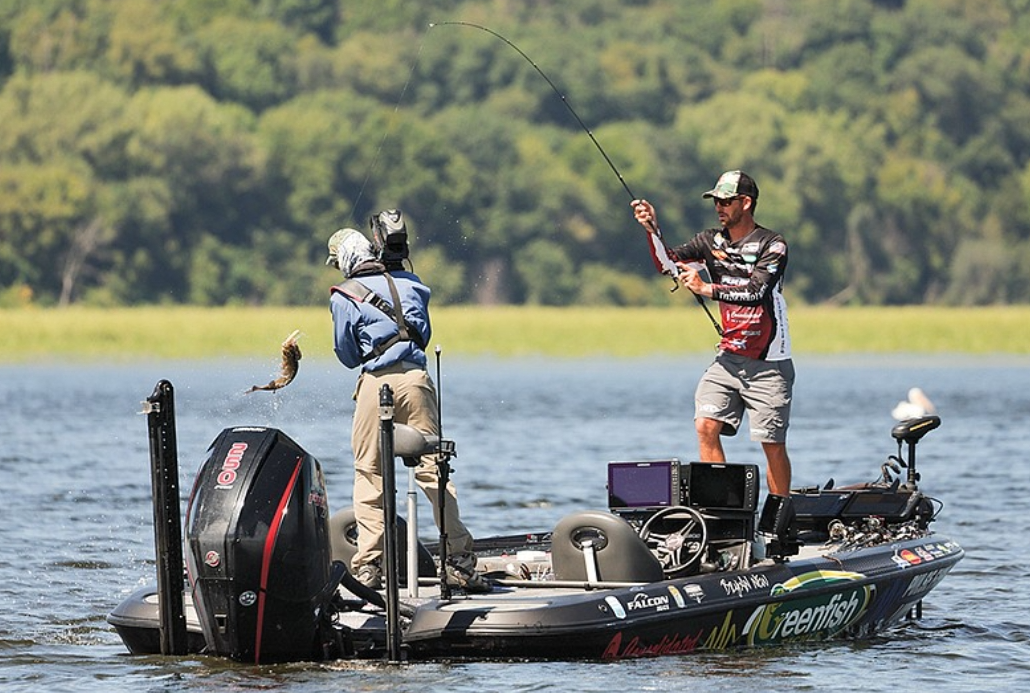
Fabric specs don't lie — but the numbers alone don't tell the full story. Here's what they mean eight hours into a July tournament on a boat with no shade.
We ran this comparison across eight dimensions that affect real performance on the water. These are the three fabric types you'll run into most when sourcing tournament jerseys:
Fabric A — 100% polyester functional fabric (mesh or micro-pore structure, standard fishing jersey)
Fabric B — Polyester/spandex blend, most often 90/10 or 92/8
Fabric C — Nylon/spandex blend, most often 85/15 or 88/12 (premium water sports category)
1. Stretch & Recovery
Fabric A gives you less than 5–8% four-way stretch . The fabric moves when the weave allows it — not because the fiber stretches. Do enough overhead casts or hard rod-set hooksets in a day, and that stiffness starts to wear on you.
Fabric B changes things. A 90/10 polyester-spandex blend delivers 15–25% stretch with a recovery rate above 95% . It snaps back without distorting the sublimated graphics across your chest and shoulders. No bagging. No print creasing mid-cast.
Fabric C pushes even further — 25–35% stretch , near- 98% recovery . It's the top performer on paper, but that much elasticity is more than most bass tournament jerseys need.
Winner: Fabric B for the balance. Fabric C wins on raw numbers, but the jump from A to B is where most anglers feel the real difference.
2. Moisture Wicking & Dry Time
Polyester absorbs less than 0.5% moisture by weight. A quality 100% polyester fishing jersey can reach full-dry in 30–60 minutes at room temperature. Surface moisture drops below 10% of initial saturation within the first hour.
Add spandex and drying slows down a bit. Fabric B runs 40–70 minutes dry time. A mesh-knit construction closes that gap, but it never fully eliminates it.
Fabric C (nylon/spandex) absorbs 4–8% moisture — that's the nylon doing it, not the spandex. In high-splash conditions — rough water, net handling, rain squalls — it holds onto that moisture longer. Dry time climbs to 60–90 minutes without a DWR treatment.
Winner: Fabric A. Get soaked at the weigh-in and 100% polyester dries out 30–40% faster than nylon-based alternatives. It's not close.
3. UPF Sun Protection
A well-built 100% polyester fishing jersey — dense weave, dark colorway, 150–180 g/m² — tests at UPF 40–50+ . That's the target most serious UPF 50+ fishing shirts aim for, and quality polyester hits it without extra treatment.
Fabric B can match that ceiling, but only with tight construction. The problem: many tournament jerseys use open-mesh panels for airflow. Those zones can drop UPF to 15–25 . No UV-inhibiting finish means no full-spectrum protection across the whole garment.
Fabric C without UV treatment? Often UPF 10–30 . Premium nylon/spandex water sports fabric can reach UPF 50+ , but that needs extra chemical finishing — which adds cost.
Winner: Fabric A for steady, structure-driven UV protection. No chemical treatments needed.
4. Sublimation Print Quality
This one isn't close.
Sublimation ink bonds to polyester at 190–210°C . On 100% polyester, color fastness reaches Grade 4–5 on ISO standards . After 50 wash cycles, color shift (ΔE) stays below 3 — the point where the human eye starts to detect a difference. The print doesn't crack. It doesn't peel.
On Fabric B, sublimation works — but spandex needs lower press temperatures ( 180–190°C ) or shorter dwell time to avoid yellowing. Over time, that heat constraint can cause 5–10% elasticity loss and slightly muted color saturation compared to pure polyester.
Fabric C doesn't work well with sublimation at all. Nylon needs screen printing or heat transfer instead. Both methods show more wear under real fishing conditions. Constant friction against rod guides, tackle bags, and boat gunwales breaks down the ink faster.
Winner: Fabric A. For a custom sublimated fishing team jersey where color accuracy and logo sharpness matter to sponsors, 100% polyester is the standard. No substitute.
5. Durability
Abrasion resistance testing (Martindale method) puts standard performance polyester at 20,000–30,000 cycles before fabric failure. For a bass fishing tournament shirt worn hard through a full season, that's enough — around 2–3 years of heavy use.
Fabric B holds similar numbers in most areas. But the spandex-heavy spots — elbows, shoulders — show faster fiber fatigue under ongoing tension. Real-world feedback shows noticeable looseness showing up around the 1–2 year mark in those stress zones.
Fabric C leads on durability: 40,000+ Martindale cycles , better tear resistance, and stronger snag resistance against dock pilings, tree branches, or aluminum boat edges.
Winner: Fabric C — but only in rough physical environments. For standard tournament fishing, the durability gap between A and C doesn't justify the higher price.
6. Breathability
100% polyester fishing jerseys with mesh construction test at 200–400 mm/s air permeability (ASTM D737, 38 Pa pressure differential). Standing on the deck at noon in August, that ventilation matters.
Fabric B in a form-fit construction drops to 50–150 mm/s . Go with a mesh-knit version and it recovers to 200–300 mm/s — but heat resistance still runs higher than pure polyester because of the denser fiber mix.
Fabric C sits at 30–120 mm/s . It's built for strength and water resistance. Heat management isn't its strength.
Winner: Fabric A — in open-mesh jersey construction. For hot-weather tournament fishing, it's the most heat-efficient choice you can make.
Quick-Reference Comparison Table
Dimension | 100% Polyester (A) | Polyester/Spandex (B) | Nylon/Spandex (C) |
|---|---|---|---|
Stretch | 5–8% | 15–25% | 25–35% |
Dry Time | 30–60 min | 40–70 min | 60–90 min |
UPF Rating | 40–50+ | 15–50+ (varies) | 10–50+ (varies) |
Sublimation Quality | ⭐⭐⭐⭐⭐ | ⭐⭐⭐⭐ | ⭐⭐ |
Durability (cycles) | 20,000–30,000 | 20,000–25,000 | 40,000+ |
Breathability | 200–400 mm/s | 50–300 mm/s | 30–120 mm/s |
Cost (bulk) | $ | $$ | $$$ |
The pattern is clear. For performance fishing apparel built around sublimation printing, UV protection, and hot-weather breathability, 100% polyester wins four of six technical categories. Polyester-spandex wins on stretch and fit — and that advantage adds up more than you'd expect over a 10-hour competition day. Nylon-spandex is the toughest fabric in this group, but it costs more and gives up too much in print quality and dry speed to make sense for most fishing jersey fabric applications.
Which Fabric Wins for Your Specific Fishing Tournament Scenario
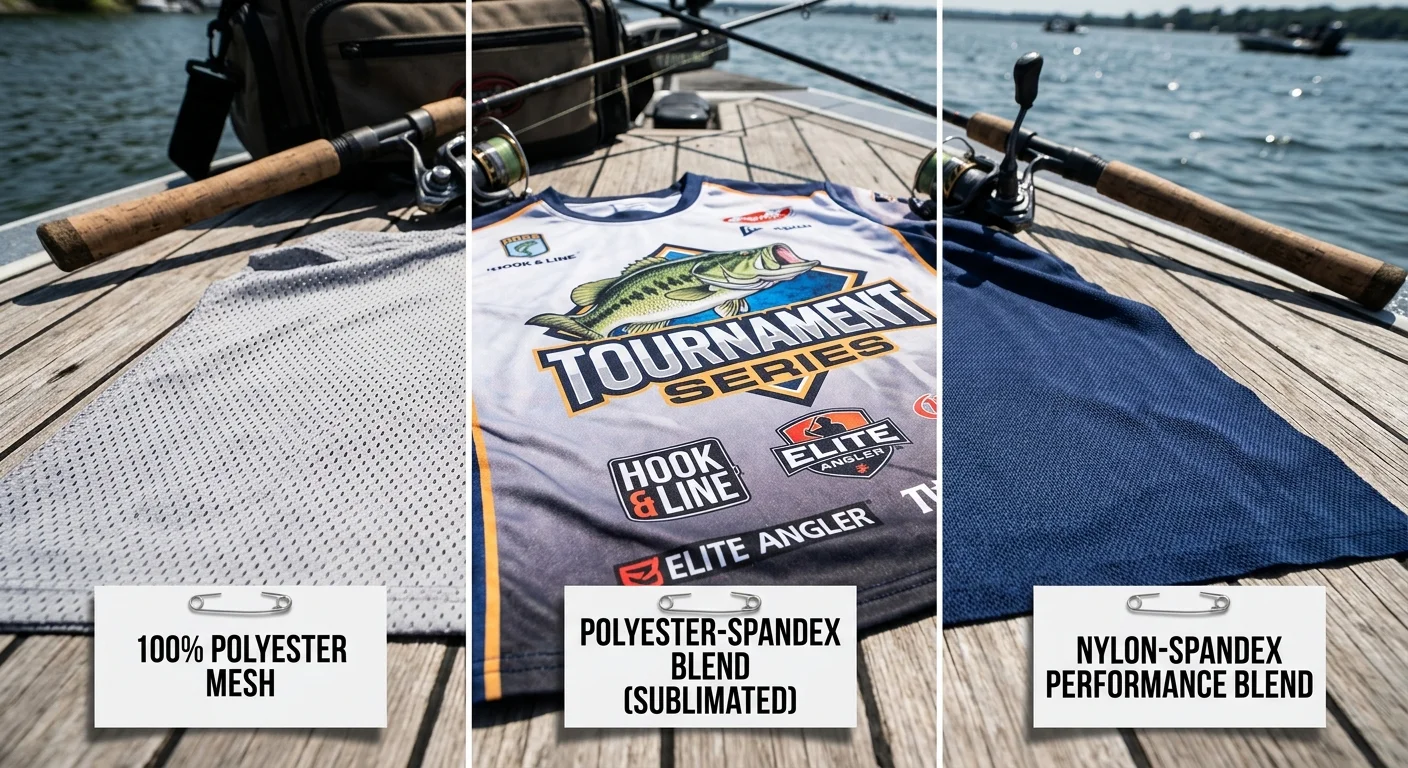
Tournament fishing isn't one sport. It's four or five different sports wearing the same name tag — and the right jersey fabric depends on which one you're competing in.
Here's how the two fabrics stack up across the scenarios that matter most.
Shore & Inshore Bass Tournaments: Heat Is Your Enemy
Stand on a bank or dock from 7 a.m. to 5 p.m. in July. You're not paddling. You're not ducking below a gunwale. You're standing in full sun, casting, sweating, and doing it again.
100% polyester wins here. A 130–150 gsm micro-fiber polyester jersey dries about 60% faster than cotton. In real-world testing, a soaked performance polyester shirt reaches 80% dry within 15 minutes. That matters when sweat management is the difference between sharp focus and heat fatigue by hour six.
The UPF 50+ protection in dense polyester weaves doesn't need chemical treatment to hold up. It's built into the fabric structure. So it doesn't wash out. Shore anglers also face abrasion — dock edges, rock ledges, brush. High-denier polyester handles all of that without adding weight or stiffness in the shoulders.
Running a custom sublimated fishing team jersey for a shore-based club or regional bass tournament? 100% polyester gives you the cleanest logo reproduction. Sponsor visibility stays sharp after a full season of sun and wash cycles.
Bass Boat & Offshore Tournaments: Movement Changes Everything
High-speed runs across open water. Overhead casts with heavy swimbaits. Hard hooksets at distance. Then a rain squall hits and everything is wet.
This is where polyester-spandex blend takes over.
A 92/8 polyester-spandex fabric at 130–150 gsm gives you 15–25% four-way stretch with recovery above 95%. In a boat tournament, that stretch isn't a comfort luxury — it shapes your casting arc and rod leverage. A jersey that pulls across your shoulders on a long cast builds micro-fatigue that adds up over ten hours. A 4-way stretch fishing shirt in a 92/8 blend cuts out that friction completely.
Salt and brackish offshore conditions are tough on fabric. Quality polyester-spandex blends hold over 90% of their original tear strength after 50 saltwater exposures. Color integrity — critical for bass fishing tournament shirts loaded with sponsor logos — stays at 85% or above after 75 combined salt and UV exposure cycles.
The tradeoff? Dry time runs 40–70 minutes versus polyester's 30–60. On a boat with wind, that gap closes fast.
Kayak Fishing Tournaments: The Stretch Argument Is Settled
Kayak tournament fishing makes the fabric question straightforward. The paddling motion — shoulder abduction, trunk rotation, constant forward lean — exposes every limitation of a low-stretch jersey within the first hour.
Polyester-spandex blend is the one sensible choice here. At least 8% spandex content is the threshold where anglers stop feeling the jersey resist their paddle stroke. Drop below that, and the fabric pulls at the armhole and shoulder seam on every extended reach. Raglan or set-in sleeve construction helps, but the fabric still needs to move.
A kayak tournament jersey should stretch no more than 25% of its initial length under a simulated 90-degree shoulder abduction. Past that point, resistance becomes noticeable and efficiency drops. The 92/8 blend hits that threshold without issue.
Wet performance matters just as much. Kayak anglers get splashed, soaked, and sit in residual water throughout the day. A moisture wicking fishing jersey in a polyester-spandex blend must stay soft and flexible when saturated — not stiffen up and lock down your torso rotation during a backwater flip cast.
Team & Sponsor Jerseys: When the Jersey Is Also a Billboard
For clubs ordering matching custom sublimated fishing team apparel , the decision comes down to one question: is brand visibility or athletic performance the primary driver?
Logo sharpness and print longevity come first for most sponsor-contract situations — and 100% polyester is the right call. Sublimation ink bonds to polyester at its ideal temperature range, producing color fastness that holds at Grade 4–5 on ISO standards. After 50 wash cycles, color shift stays below what the human eye can detect. No other fabric matches that.
The team competes in high-movement formats — offshore, kayak, or multi-day events with varied conditions? A 92/8 polyester-spandex blend delivers performance without giving up too much print quality. Lock down the fabric spec in your order: "92% polyester / 8% spandex, 130–150 gsm" — written out clearly. Vague terms like "polyester blend" leave room for substitutions that hurt both stretch and sublimation quality.
Ask for third-party UPF test reports, not factory self-certification. A UPF 50+ fishing shirt should hold 95% or more of its original UPF rating after 100 wash cycles. No data from the Tournament Fishing Jerseys supplier? The number on the hang tag means nothing.
The scenario summary:
Tournament Type | Recommended Fabric | Primary Reason |
|---|---|---|
Shore / Inshore Bass | 100% Polyester | Drying speed, UPF, print quality |
Bass Boat / Offshore | 92/8 Polyester-Spandex | Stretch, salt durability, wet flexibility |
Kayak Fishing | 92/8 Polyester-Spandex (≥8% spandex) | Full range of motion, wet comfort |
Team / Sponsor Jerseys (print-first) | 100% Polyester | Sublimation fidelity, color longevity |
Team / Sponsor Jerseys (performance-first) | 92/8 Polyester-Spandex | Movement + acceptable print quality |
The fabric debate doesn't have one winner. It has one right answer per scenario — and now you know which is which.
Sublimation Printing on Polyester vs Polyester-Spandex: What Tournament Teams Must Know
Sponsor logos don't lie — and neither does sublimation ink. A jersey that survives a full tournament season still looking sharp? That's chemistry doing its job. One that comes off washed-out and warped? That's the wrong fabric.
Here's what's happening at the molecular level. Sublimation printing runs between 180–210°C . At that temperature, dye converts from solid to gas. It drives into polyester fiber — not onto the surface, but into it. The result is an embedded color layer that doesn't crack, peel, or sit on top of the weave waiting to flake off at the first hard hookset.
The catch: polyester fiber accepts that bond. Spandex doesn't. Cotton doesn't. Every percentage point of non-polyester content in your fabric is a percentage point that won't hold ink.
Most commercial decorators work from this threshold: 65% polyester minimum for acceptable results, 80%+ for tournament-grade quality. Drop below 65%, and color saturation falls, edge definition blurs, and wash retention fades fast. That's a problem on a jersey going through the laundry twice a week from March through October.
Logo Distortion: The Risk Nobody Talks About at Order Time
Stretch creates a problem that's easy to miss until the jerseys arrive. A 90/10 polyester-spandex blend carries manageable risk for most chest and back placements. Those are the low-stretch zones where sponsor logos and numbers tend to sit. Push to 85/15 , and the margins tighten. Fine lettering, circular emblems, and tight geometric sponsor marks start showing edge distortion as the fabric moves through its stretch cycle.
The rule is straightforward: the higher the spandex content, the more distortion your printed graphics will show.
To control the risk on a custom sublimated fishing team jersey :
Place primary logos on low-stretch zones — center chest, upper back, outer sleeve. Keep them away from underarms, side panels, and elbow areas.
Run a stretch test before final approval. Pull the printed sample two inches in both directions. Clean recovery should happen within one second. Logo edges that look oval or fine lines that blur mean the fabric or placement needs to change.
Simplify graphics on stretch-heavy fabrics. Heavier line weights and cleaner shapes hold far better than intricate sponsor marks with thin strokes.
What the Numbers Look Like After a Full Season
100% polyester performance fishing apparel holds color fastness at ISO Grade 4–5 after 50 wash cycles. Color shift stays below what the human eye can detect. That's what sponsors are paying for — their brand on your chest, still looking clean at the end of the season.
A well-built 90/10 polyester-spandex blend — with 80%+ actual polyester content , confirmed by a lab report rather than a hangtag — can match that wash retention at 25 cycles. At 50 cycles, there's measurable decline, but nothing catastrophic.
Drop below 65% polyester and commercial sublimation stops holding well. Color goes flat. Logo edges go soft. The jersey looks like a second-season hand-me-down before the first season ends.
Finalize any team jersey order with four numbers confirmed in writing: actual polyester percentage, spandex percentage, stretch recovery time, and which print zones stay clear of high-elongation areas. Those four numbers decide whether your team's jerseys look professional at the weigh-in — or forgettable.
The Hidden Cost Factor: Long-Term Durability and Care Requirements
Buy a jersey in March. By October, it tells you everything — not through the tag, but through what's happened to the shoulders, the print, and the elastic at the hem.
Fabric cost per unit is the number everyone negotiates. Total cost of ownership is the number nobody tracks until the second season.
How Each Fabric Ages Under Real Tournament Conditions
100% polyester holds its structure longer — but UV and heat are the silent killers.
Standard performance polyester reaches 20,000–30,000 Martindale cycles before the fabric starts to break down. Under moderate use, that works out to 2–3 years before the structure gives way at high-friction zones: rod grip contact points, the inside of the elbow, anywhere a tackle bag strap sits against the fabric.
The real threat isn't abrasion. It's UV buildup over time. After 300–600 hours of direct summer sun, color fastness can drop 1–2 ISO grades. A team that fishes 50+ hours outdoors per season will start seeing visible fading and print breakdown around the 3-year mark . Not from washing. From standing on a boat deck at noon in August, tournament after tournament.
Polyester-spandex wears out faster — and in specific spots.
The polyester component holds up. The spandex doesn't. Spandex fiber is polyurethane-based. Polyurethane breaks down under three conditions tournament anglers can't avoid: heat, UV, and sunscreen residue.
Wash that 4-way stretch fishing shirt in 60°C water 20–30 times and elastic recovery drops by more than 20%. The jersey doesn't tear. It just stops snapping back. Shoulders go soft. The fit that made it worth buying becomes the reason you replace it.
Sunscreen makes it worse. High-SPF cream, combined with heat and UV exposure, breaks down spandex at the chemical level. Anglers running moisture wicking fishing jerseys with spandex content who put on heavy sunscreen and wash often should expect clear elastic fatigue within 6–12 months of hard use — sometimes sooner.
Care Requirements: Where the Hidden Cost Actually Lives
Care Factor | 100% Polyester | Polyester-Spandex Blend |
|---|---|---|
Safe wash temp | Cold–40°C (short 60°C OK) | ≤30°C is the safe limit |
Wash cycle | Standard / gentle | Gentle or hand-wash only |
Dryer use | Low heat or air-dry | No high heat; lay flat to dry |
Storage | Hang or fold; avoid direct sunlight | Fold flat; keep away from sunscreen-contaminated clothing |
The key difference here is how much each fabric forgives mistakes. Pure polyester handles a hot wash cycle. A spandex blend doesn't. Each high-heat wash chips away at elastic life. You won't notice — until you do.
Your team orders custom sublimated fishing team jerseys in bulk. That care gap matters right away. Fifty anglers doing their own laundry means fifty chances for someone to run a hot cycle. With 100% polyester, that's a small print-aging risk. With a spandex blend, it's elastic failure spreading across the whole team wardrobe.
The real-world durability gap:
A well-maintained 100% polyester bass fishing tournament shirt lasts 2–3 seasons before you need to replace it.
A polyester-spandex blend in the same conditions, washed at the right temperature, lasts 1.5–2 seasons before the stretch zones start to loosen.
Wash it wrong — hot water, machine dryer — and that drops to under a year.
For teams budgeting performance fishing apparel across multiple seasons, that gap adds up fast. The spandex premium at purchase is real. So is the shorter replacement cycle that comes with it.
Expert Recommendation: The Decision Framework for Tournament Fishing Apparel Buyers
Two axes. That's all this comes down to.
Sponsor visibility and sport-performance requirements . Plot your situation on those two axes. The right fabric choice becomes clear — not a guess, not a brand preference. Just the logical answer based on where you stand.
The Four-Quadrant Model
High Performance Need | Low Performance Need | |
|---|---|---|
High Sponsor Exposure | Competition jersey: large logo zones, sublimation-ready 100% polyester, broadcast-visible contrast | Brand-first wear: staff uniforms, club apparel, sponsor-heavy pieces where mobility is secondary |
Low Sponsor Exposure | Utility-first: verified UPF 40–50+, mobility cut, cooling fabric — no branding pressure | Casual layer: local outings, travel, training days where cost outweighs spec |
Most tournament anglers land in the top row. Once you know which column fits you, the fabric question answers itself.
Three Buyer Types, Three Clear Answers
Individual competitors should choose based on fit, casting mobility, UPF rating, odor control, and pocket placement. A yoked back opens up your shoulder range of motion. A high collar gives neck protection that a standard crew cut simply doesn't. These construction details matter at hour eight of a tournament.
Club purchasing managers need consistent sizing across the full size run — not just the medium. Lock down one competition jersey spec: 100% polyester, confirmed sublimation grade. Then source a separate lower-cost polyester-spandex layer for practice days. Two-tier ordering keeps costs under control. You don't sacrifice what shows up on camera.
Custom fishing apparel brand distributors need print area confirmation, fabric consistency across production runs, and written spec sheets — not verbal Tournament Fishing Jerseys factory claims. Ask for published gsm, stretch percentage, and UPF test documentation before you commit to volume.
The Mixed-Purchase Strategy Most Teams Overlook
Use 100% polyester for competition. Use polyester-spandex for everything else.
Competition jerseys are billboards first. Sublimation clarity, color longevity, and sponsor logo sharpness all favor 100% polyester. That doesn't change mid-season. For practice wear, travel days, and training sessions where no sponsor is watching, a 4-way stretch fishing shirt in a 92/8 blend gives you better movement and better comfort. The stakes are lower — your gear can reflect that.
The two-tier model takes cost pressure off your main competition garment. Spend where it's visible. Save where it isn't.
The Supplier Checklist Before You Sign Off
Before any bulk order for custom sublimated fishing team jerseys , get these confirmed in writing:
Fabric composition — exact polyester-to-spandex ratio, not "polyester blend"
UPF rating — target UPF 40–50+; ask for third-party test data, not hangtag claims
Stretch and recovery — percentage and recovery time under load
Colorfastness — ISO grade after 50 wash cycles minimum
Seam construction — flatlock reduces chafing on long tournament days; overlock doesn't
MOQ and reorder lead time — both sample and bulk timelines, confirmed before you commit
Logo placement template — define chest, sleeve, back, and shoulder zones before production starts, not after
A Tournament Fishing Jerseys supplier who can't answer these with real numbers? That's your answer right there.
FAQ: Tournament Anglers' Most Common Questions About Fishing Jersey Fabrics
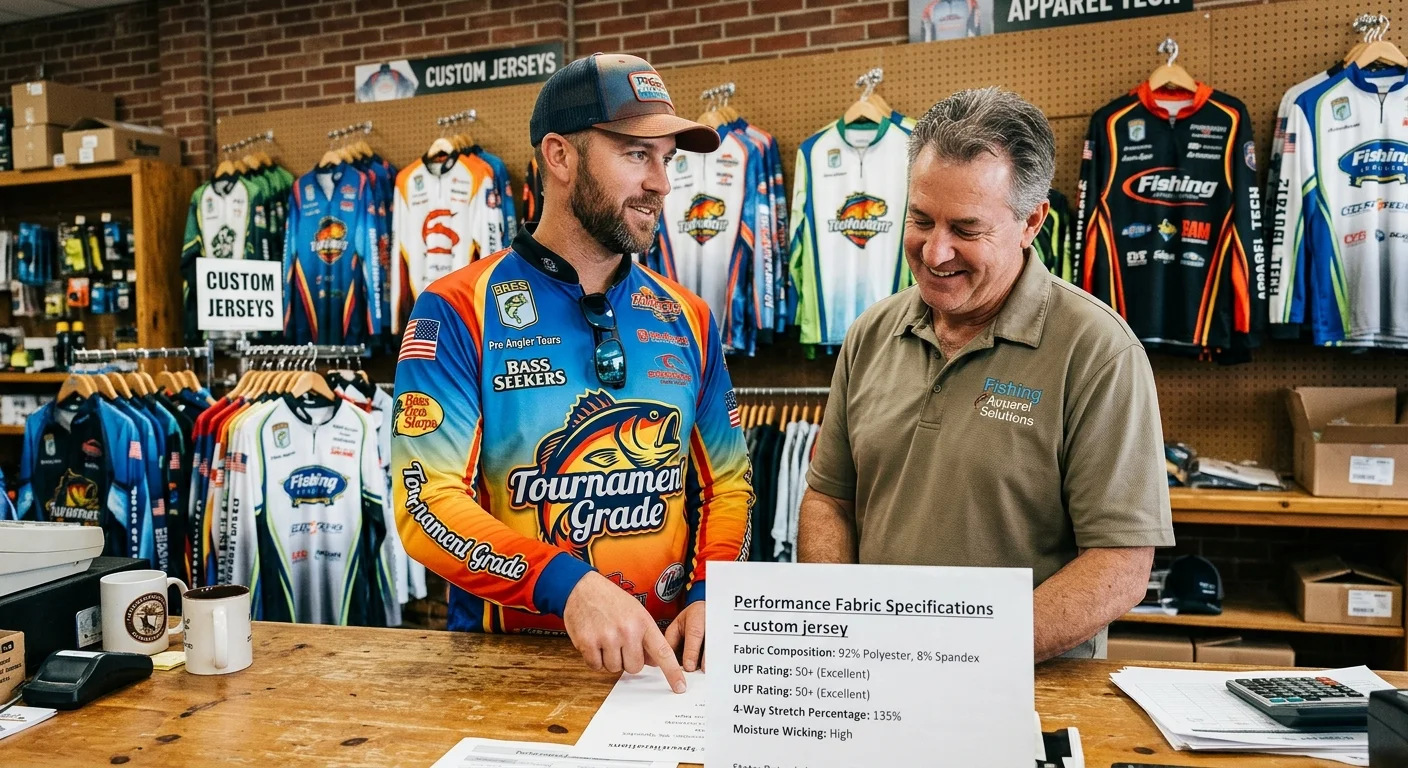
Ten questions come up again and again when tournament anglers order jerseys. Here are straight answers — no padding, no vague recommendations.
Q1: What fabric composition works for tournament jerseys?
The industry standard is 85–95% polyester or nylon + 5–10% spandex . That ratio wicks moisture about three times faster than cotton. It also dries 25–30% faster than nylon-only fabrics. Target 120–170 gsm for warm climates.
Q2: Does fabric affect how hot I feel on the water?
Yes — and the difference is clear. A quality performance fishing jersey runs ≈4°F cooler than cotton under direct sun. It also cuts sweat dry time by about 60%. Cotton holds moisture, gets heavy, and works against you by noon. It has no place in serious performance fishing apparel .
Q3: What GSM should I be ordering?
130–160 gsm for summer tournaments and tropical conditions — maximum breathability, fastest dry
180–220 gsm for shoulder-season events where mornings are cold
Q4: Is UPF 50+ necessary, or just marketing?
Non-negotiable for full tournament days. Look for inherent UPF 50+ — protection built into the fiber structure, not a topical treatment that washes out. Polyester holds UV protection better over time than nylon alternatives.
Q5: How do I tell if a jersey is sublimation-printed?
One quick test: scratch the logo with your fingernail. Feel raised ink? That's screen print — not sublimation. Full sublimation dye bonds into the polyester fiber itself. No layer sits on top. Nothing cracks, peels, or blocks airflow. Screen printing has no place on a moisture wicking fishing jersey .
Q6: Polyester vs. nylon — which wins for tournament use?
Polyester dries faster, holds UV protection longer, and handles sweat better. Nylon wins on abrasion and tensile strength in rough, rugged environments. For most bass fishing tournament shirts , polyester-dominant blends with some spandex hit the better balance.
Q7: What specs should I lock in writing before ordering custom jerseys?
Fabric: polyester microfiber or nylon/spandex performance knit
Composition: ≥85–90% synthetic + 5–10% elastane
UPF: 50+ inherent
Weight: 130–160 gsm for warm events
Print method: full sublimation — no screen print
Q8: What does a quality performance jersey cost?
Well-built sublimation fishing jerseys in solid polyester blends land under US$50 per unit. Premium nylon alternatives can reach US$120. UPF treatments and antimicrobial finishes add about 10–40% over untreated basics — but they pay off across a full tournament season.
Q9: Will colors hold up in saltwater tournaments over a full season?
Yes — but only if the dye sits inside the polymer fiber, not on the surface. Color-in-fiber construction improves color retention by ≈40% versus surface dyes under combined UV and salt exposure. Add an antimicrobial treatment on top of that. The jersey then resists both fading and the odor that builds up after multi-day events.
Q10: What are the absolute must-haves for serious tournament anglers?
Four things, no exceptions: UPF 50+ inherent protection , quick-dry synthetic knit, ≥85% polyester or nylon content , and a sublimation-compatible surface. Everything else is a nice-to-have.
Conclusion
The fabric debate ends here — and the answer isn't one-size-fits-all.
Your tournament needs maximum sublimation sharpness, budget predictability, and a clean professional silhouette under a life jacket? 100% polyester delivers . You're grinding long tournament days on the water where every cast, reach, and awkward boat-deck crouch counts? The polyester-spandex blend moves with you in ways pure poly can't match.
Smart teams don't guess. They match the fabric to the fishery, the format, and the hours they'll spend wearing it.
You've done the research. Now put it to work.
👉 Build your custom tournament fishing jersey today — choose your fabric, upload your design, and get your whole team dialed in before the next tournament season opens. [Start Customizing at CustomFishingWear.com ]
The angler who shows up prepared — right down to the moisture-wicking fishing jersey on their back — is already ahead before the first line hits the water.