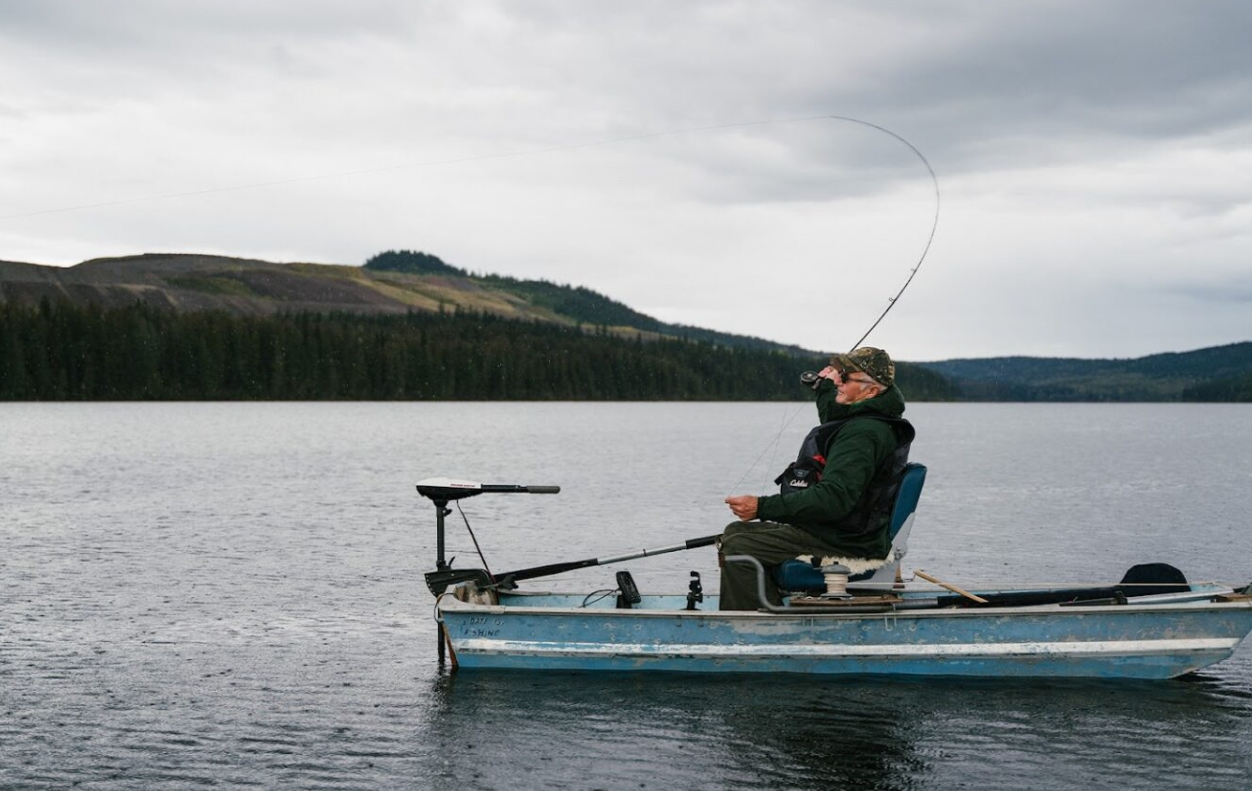
It's 9 a.m. The sun is already brutal. You're three hours into an offshore trip, sweat pooling under your collar, wearing a shirt that feels like it's fighting you. That fabric choice you ignored at checkout? It matters now.
Most anglers have a gut preference on polyester vs nylon for performance fishing shirts — but few understand what's happening at the fiber level as temperatures climb and the UV index spikes. Both fabrics promise moisture-wicking, quick-dry comfort and serious UPF 50 sun protection . Yet they perform in very different ways where it counts. Here's how to tell them apart — and which one earns a spot in your gear bag (or your next custom fishing team apparel order).
Head-to-Head Comparison: 6 Performance Factors That Matter Most on the Water
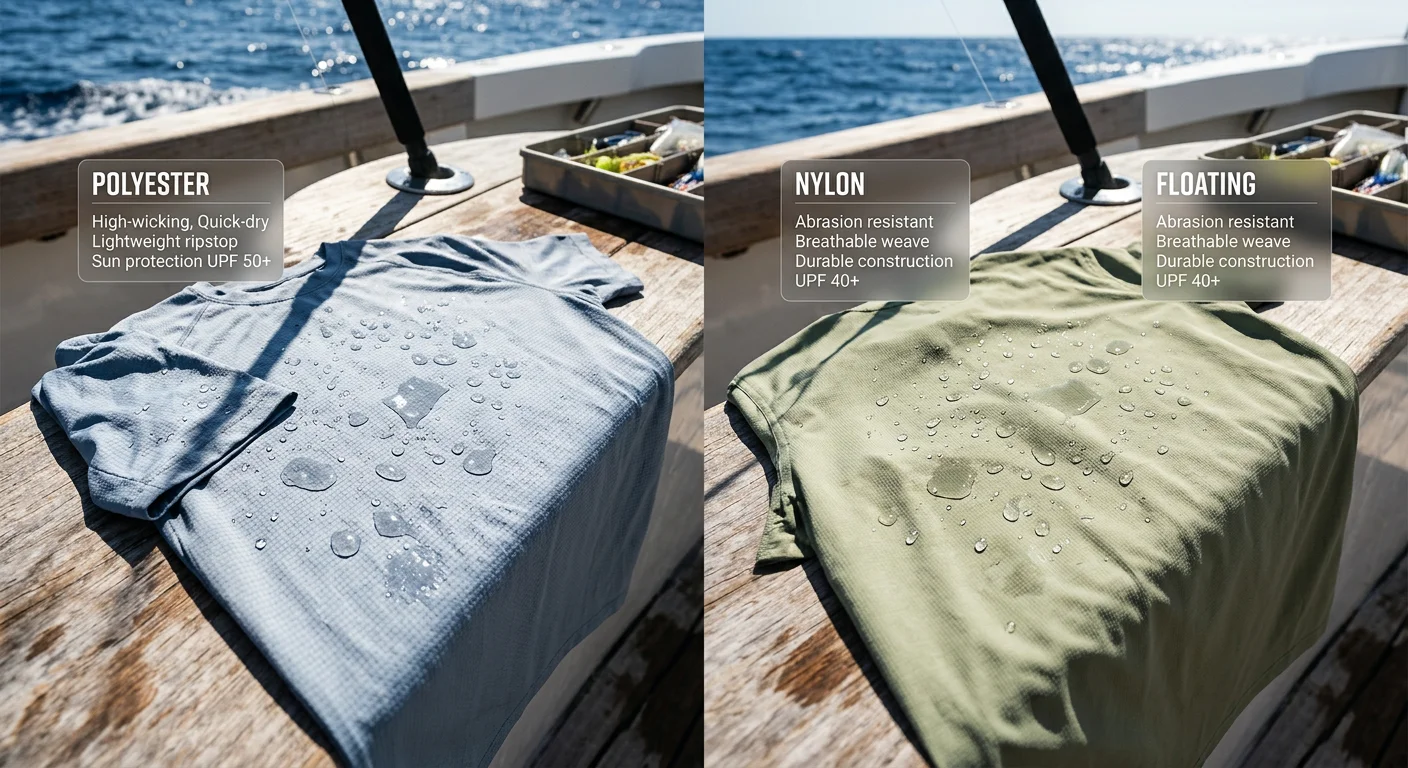
Six factors separate a shirt that works from one that just looks the part. Here's how polyester and nylon compare across the performance areas that define a long, hot day on the water.
1. Quick-Dry Speed
Polyester wins this round — and it's not close. Performance polyester fishing shirts dry to a comfortable level within 20–30 minutes under real-world conditions. Lightweight mesh constructions push that down to 10–20 minutes . Nylon absorbs more moisture into the fiber itself. Its drying time runs 20–30% longer than polyester in comparable builds. That gap feels invisible in the store. At hour five offshore, you'll notice it.
2. Moisture-Wicking Efficiency
Both fabrics wick. The difference is what happens after the sweat leaves your skin.
Polyester pushes moisture to the surface. Airflow can evaporate it fast. High-performance moisture wicking fishing apparel targets a vertical wicking height of ≥100–150 mm per 30 minutes . It returns to baseline moisture levels within ≤30 minutes at 30°C/65% humidity. Nylon wicks well too, but it holds more moisture inside the fiber. In heavy-sweat conditions, that means a heavier feel and slower recovery between bursts of effort.
3. UV Protection
This is where polyester pulls ahead for UV protection fishing shirts . Polyester fibers are UV-stable by nature. That's why most UPF 50 fishing shirts on the market use polyester. A true UPF 50+ rating blocks ≥98% of UV radiation — the gold standard for sun protection on the water.
Nylon can reach UPF 50+ too, but it needs extra dye treatments or UV-inhibitor finishes to get there. Without those treatments, nylon's UV resistance at the same fabric weight runs lower. For saltwater and offshore fishing — where the UV index climbs hard and stays high — polyester's built-in stability gives it a lasting edge.
4. Stretch and Mobility
Nylon takes this one. Nylon-spandex blends feel more fluid on the body. They're softer against the skin, and the fabric moves with your cast rather than against it. The industry standard for breathable fishing clothing with real range of motion calls for ≥8–10% elastane content . The sweet spot for active water sports sits at 15–20% . Both fabrics blend well with spandex, but nylon's natural fiber flexibility gives blended builds a softer, more responsive feel. Anglers who cast for hours or reach overhead will feel that difference.
5. Odor Control
Nylon absorbs water easily. That's what gives it a cool, soft feel at first. It's also what makes it more welcoming to odor-causing bacteria. In humid saltwater conditions, a nylon fishing jersey without antimicrobial treatment can build up noticeable odor after one or two heavy-sweat days. Polyester absorbs less at the fiber level, so it accumulates less odor over time. Both fabrics benefit from silver-ion or antimicrobial finishes. After a two-day tournament, odor control matters — so look for that finish no matter which fabric you choose.
6. Durability Against Saltwater, Sun, and Abrasion
Long-term data on knit water sports fabrics shows a clear pattern. Breaking strength drops after sustained saltwater and UV exposure , especially along the wale direction. Both fabrics degrade — the real question is how fast and how well they recover.
Polyester-spandex blends hold up better against chlorine and UV over time. They keep their color and shape longer than nylon-spandex equivalents. Nylon-spandex blends feel great at first but break down faster under repeated chemical stress. Saltwater, sunscreen, and UV together speed up elasticity loss and color fade. For anglers fishing multiple days a week — or brands building custom fishing wear for teams and tournaments — polyester's long-term toughness means a lower cost-per-wear across a full season.
At a Glance: Polyester vs. Nylon Performance Snapshot
Performance Factor | Polyester | Nylon |
|---|---|---|
Quick-Dry Speed | ✅ Faster (20–30 min) | ⚠️ Slower (+20–30%) |
Moisture Wicking | ✅ Strong surface wicking | ✅ Good, slightly heavier wet |
UPF 50+ Protection | ✅ UV-stable by nature | ⚠️ Requires UV treatment |
Stretch & Mobility | ✅ Good with spandex | ✅ Slightly softer hand feel |
Odor Resistance | ✅ Lower bacteria retention | ⚠️ Needs antimicrobial finish |
Long-Term Durability | ✅ Superior in saltwater/UV | ⚠️ Faster degradation over time |
Polyester vs Nylon for Specific Fishing Scenarios: A Practical Decision Guide
The right fabric depends on where you fish — and what you need your shirt to handle.
An offshore shirt built for eight hours on open water shares almost nothing with one made for wading a brushy creek. Each scenario calls for a different material. Here's how to match fiber to situation.
Offshore & Deep-Sea Fishing: All-Day Sun, Salt, and Exposure
For long days on open water, polyester-dominant fabrics (≥80% polyester) are the clear choice.
Polyester is hydrophobic — it pushes moisture away instead of soaking it in. Under saltwater spray and sweat all day, that's a big deal. Nylon absorbs 3–5% of its weight in water. Polyester absorbs none. You feel that gap at hour seven. Your shirt stays lighter, drier, and more comfortable.
Polyester also holds up better under UV over time. It keeps its color and strength under repeated sun exposure. Nylon needs chemical treatments to reach the same UPF rating. For offshore trips running 6–8+ hours, that built-in durability pays off.
What to look for in an offshore shirt:
- Fiber: 100% polyester or polyester-spandex (90–95% / 5–10%) for a bit of stretch
- Construction: Back and underarm mesh panels — polyester mesh can boost air flow by 20–40% versus solid knit at the same weight
- Seams: Flatlock or coverstitch at shoulders and side panels. Raised seams create friction points after hours of rod handling
- Thread: Polyester thread throughout — nylon thread breaks down faster under UV and salt
Freshwater Fishing: High Movement, Banks, Rocks, and Wading
Active freshwater fishing puts your gear through a different kind of stress. You're climbing banks, pushing through brush, and stepping between slick rocks. That movement puts more strain on your bottoms than your top — and that's where nylon earns its spot.
Nylon's elongation at break runs 15–25% versus polyester's 6–10% . That extra stretch, combined with nylon's stronger abrasion resistance, makes it the better choice for pants and shorts hitting hard surfaces all day. Nylon-spandex blends (88–92% nylon / 8–12% spandex) with ripstop or canvas weaves are built for this kind of abuse.
For your top, stick with polyester. It wicks faster, dries faster, and keeps your core cooler during high-output movement.
The freshwater combo that works:
- Bottoms: Nylon-spandex with 10–20% fabric stretch on the weft; ripstop weave for rocky terrain
- Tops: 100% polyester or polyester-spandex 90/10 with upper-back mesh yoke and side ventilation panels
- Patterning detail worth noting: Gusseted crotch and articulated knees add 15–25° of hip and knee flexion range. That's a real advantage scrambling up a steep bank
Tournament & Team Fishing: Brand, Print, and Repeated Wear
Tournament jerseys face a different kind of pressure. They need to look sharp after fifty washes, hold sublimated logos without fading, and survive a full competitive season of sweat, salt, and sun.
Polyester handles all of that better than nylon. Sublimation printing fuses ink straight into polyester fiber — logos stay sharp and vivid through 50+ wash cycles with minimal fade. On nylon, sublimation results break down faster. For team branding that still looks professional at the end of a long season, polyester isn't a preference — it's a requirement.
Tournament jersey specs that hold up:
- Fiber: Polyester-spandex (92–95% / 5–8%) for a fitted, performance silhouette
- Weight: 130–170 g/m² for sublimated long-sleeve jerseys — enough thickness for print quality without trapping heat
- Sleeves: Raglan cut adds 10–15° of shoulder mobility versus set-in sleeves. That matters for all-day casting
- Bottoms: Nylon-dominant for deck kneeling and contact with hardware, where abrasion resistance matters more than print quality
Casual & Half-Day Fishing: Comfort First
Not every outing is a tournament. A relaxed morning on the bank or a half-day charter with friends calls for a different priority — comfort moves to the top of the list.
Blended fabrics work best here. 80/20 polyester-nylon blends give you most of polyester's quick-dry and UV stability. The nylon's softer feel also takes the edge off the slightly rough texture that some pure polyester fabrics have. The tradeoff is small — adding 20% nylon slows drying a bit, but the shirt still dries far faster than cotton.
The casual fishing setup:
- Tops: Polyester-spandex (90/10) at 120–150 g/m² for warm weather; step up to 180–220 g/m² for cooler early mornings
- Bottoms: Nylon-spandex (88–92/8–12) shorts for softness and mobility
- Finish details: Tagless neck labels and flatlock seams at shoulders cut down on skin irritation during long, relaxed sits. Small details, but you'll notice them over a four-hour outing
Scenario-to-Fabric Quick Reference
Fishing Scenario | Top Recommendation | Bottom Recommendation |
|---|---|---|
Offshore / Deep-Sea | Polyester ≥80% + UPF 50+ | Polyester-spandex |
Freshwater / Active Wading | Polyester-spandex 90/10 | Nylon-spandex 88–92/8–12 |
Tournament / Team Jersey | Polyester-spandex 92–95/5–8 | Nylon-dominant |
Casual / Half-Day | Polyester or 80/20 poly-nylon blend | Nylon-spandex |
UPF 50+ Protection: How Polyester and Nylon Fishing Shirts Handle Sun Exposure
Sunburn doesn't announce itself. It builds slow — reflected off the water, stacked up by hours of open-sky exposure. By the time you feel it, the damage is done. That's why UPF rating isn't a marketing checkbox on a performance fishing shirt . It's the number standing between your skin and a UV index that doubles over open water.
Both polyester and nylon can reach UPF 50+ — the highest certifiable rating. At that level, the fabric blocks ≥98% of UV radiation. But the way each fabric gets there is not the same. That gap matters far more than the tag lets on.
Polyester: Built-In Protection That Holds
Polyester blocks UV at the fiber level. No chemical treatment needed. That structural strength means a high-density polyester fishing shirt holds its UPF rating through repeated washing, long sun exposure, and wet conditions.
The numbers back this up:
Quality polyester fabrics lose just 10–15% of their UPF rating in a soaked state
A dry-rated UPF 50 shirt stays in the UPF 42–48 range when wet
After 40 wash cycles, non-coated polyester holds 85–90% of its original UPF value
That's the kind of steady performance that counts across a full fishing season.
Nylon: Effective, But Dependent on Its Finish
Nylon's natural UV resistance is moderate. Most UPF 50 nylon fishing shirts reach that rating through UV-absorbing coatings or chemical finishes — not the fiber itself. That's a real distinction worth understanding.
Wet nylon is a problem. The fibers absorb water, the gaps between them open up, and more UV gets through. Uncoated nylon can shed 20–40% of its UPF rating in a soaked state. A dry UPF 30 shirt could drop to UPF 18–24 when wet. That puts it at — or below — the minimum threshold for safe sun exposure on the water.
Wash durability tells the same story:
Coated nylon fabrics hold 60–80% of their UPF rating after 20 wash cycles
After 30–40 washes with no rated finish, some products drop below UPF 30 entirely
The Bottom Line for Sun-Exposed Fishing
For offshore, open-water, or full-day sun protection fishing , polyester's built-in UV stability isn't a small edge — it's the deciding factor. A shirt that still delivers genuine UPF 50+ protection after saltwater spray, a full day of sweat, and fifty trips through the wash is a different product altogether from one that hits that number dry and new — then fades fast.
Choosing a nylon fishing jersey for its soft feel or stretch? Check the care label. Find out whether the UPF rating relies on a chemical finish. Also check whether the brand specifies how many wash cycles that finish holds up through. Without those details, the UPF 50+ on the tag may not match what you're wearing by mid-season.
Color matters too. Across both fabrics, darker and more saturated colors absorb more UV and give you higher base protection. Switching from a light to a dark colorway of the same fabric can push UPF up by one to two rating levels . Still, reaching UPF 50+ with any consistency takes high-density construction — color alone won't get you there.
Common Misconceptions About Fishing Shirt Fabrics (And What the Data Shows)
Fabric myths are stubborn. They spread from forum posts to tackle shop talk to the checkout page — and they cost anglers real comfort on hot days.
Here are three worth correcting before your next purchase.
"Nylon is more breathable, so it's better in the heat."
Breathability and moisture-wicking are not the same thing. In hot fishing conditions, what matters most is how fast a fabric moves sweat away from your skin. How much air passes through it is a separate issue. Hydrophobic polyester pushes moisture to the surface. Airflow then evaporates it fast. Cotton and some nylon builds absorb first, then release slow. That difference is what makes polyester-dominant moisture-wicking fishing apparel the top choice in the category — not a marketing preference.
The numbers back this up. Performance quick-dry fishing shirts dry up to 60% faster than cotton equivalents. They can also cut heat buildup by 4°F over a long day. Mesh ventilation panels add another 2–4°F of core temperature drop under direct sun.
"A higher price tag means better performance."
Not by default. What predicts a breathable fishing shirt's real-world performance is a specific checklist: UPF rating, dry time, fabric weight, stretch percentage, ventilation panels, and antimicrobial finish. A UPF 50+ fishing shirt blocks ≥98% of UV radiation. A standard cotton shirt lets 7–20% of UV through. That gap doesn't close because a shirt costs more — it closes because the construction earns it.
"Cotton feels more comfortable, so it's fine for hot days."
Cotton feels soft in the dressing room. Out on the water, wet cotton turns heavy, clingy, and slow to dry. In saltwater and high-sweat conditions, that feeling builds up by the hour. A lightweight polyester fishing shirt with UPF 50+ and mesh panels does more of what a hot-weather fishing shirt needs to do. It dries faster, protects longer, and stays comfortable against your skin through the full outing.
The practical fabric checklist, simplified:
✅ Polyester or polyester blend with confirmed UPF 50/50+
✅ Mesh ventilation panels, quick-dry finish, antimicrobial treatment
⚠️ High cotton content, no UPF label, no stated dry time — use caution
How to Choose the Right Fabric for Custom Performance Fishing Shirts
Ordering custom performance fishing shirts for a team or brand isn't just a branding decision — it's a gear decision. Pick the wrong fabric, and fifty jerseys that look great on a screen become fifty anglers sweating through uncomfortable shirts by noon.
For most custom performance fishing shirts orders, 100% polyester or high-polyester blends are the go-to choice — and the reason is simple. Polyester covers UV protection, moisture-wicking, quick-dry performance, and sublimation print compatibility better than any other fabric at scale. For team or tournament orders, those four factors work well together.
Match the Fabric to the Use Case
Not every order has the same priority. Here's how to think through it:
Hot, sunny, long-haul fishing: Go with lightweight polyester. Confirm UPF 50+ and a moisture-wicking finish. That's all you need.
High-sweat, active crews: Choose polyester or nylon with 4-way stretch , ventilation panels, and quick-dry performance.
Brand or team printing: Stick with 100% polyester . It's the one fabric that locks sublimation dye at the fiber level. Logos stay vivid after 50+ wash cycles — no cracking, no fading.
Comfort-first buyers: A 60/40 polyester-cotton blend softens the feel. Just know you're giving up some quick-dry and wicking performance. Cotton also struggles in hot, wet conditions.
The Supplier Checklist Before You Commit
Before placing a bulk order, get these specs confirmed in writing:
Fabric weight (GSM): For hot-weather performance tops, target 120–180 GSM
UPF rating: Ask for the actual test report — not just the tag claim
Moisture-wicking method: Is it a wicking finish, or a moisture-management yarn structure?
Wash durability: Request UPF retention and colorfastness data after repeated laundering
Stretch: Go with 4-way stretch if casting mobility matters
Sublimation compatibility: Make sure the fabric works for all-over printing
Stain resistance: Useful for fish slime, salt, and bait exposure
The bottom line: team printing + sun protection + bulk efficiency all point to the same answer. Polyester with UPF 50+, a lightweight GSM, and sublimation-ready construction handles everything. Anything else is a trade-off — sometimes the right call, but make that call with clear eyes.
FAQ: Quick Answers to Common Questions About Fishing Shirt Fabrics
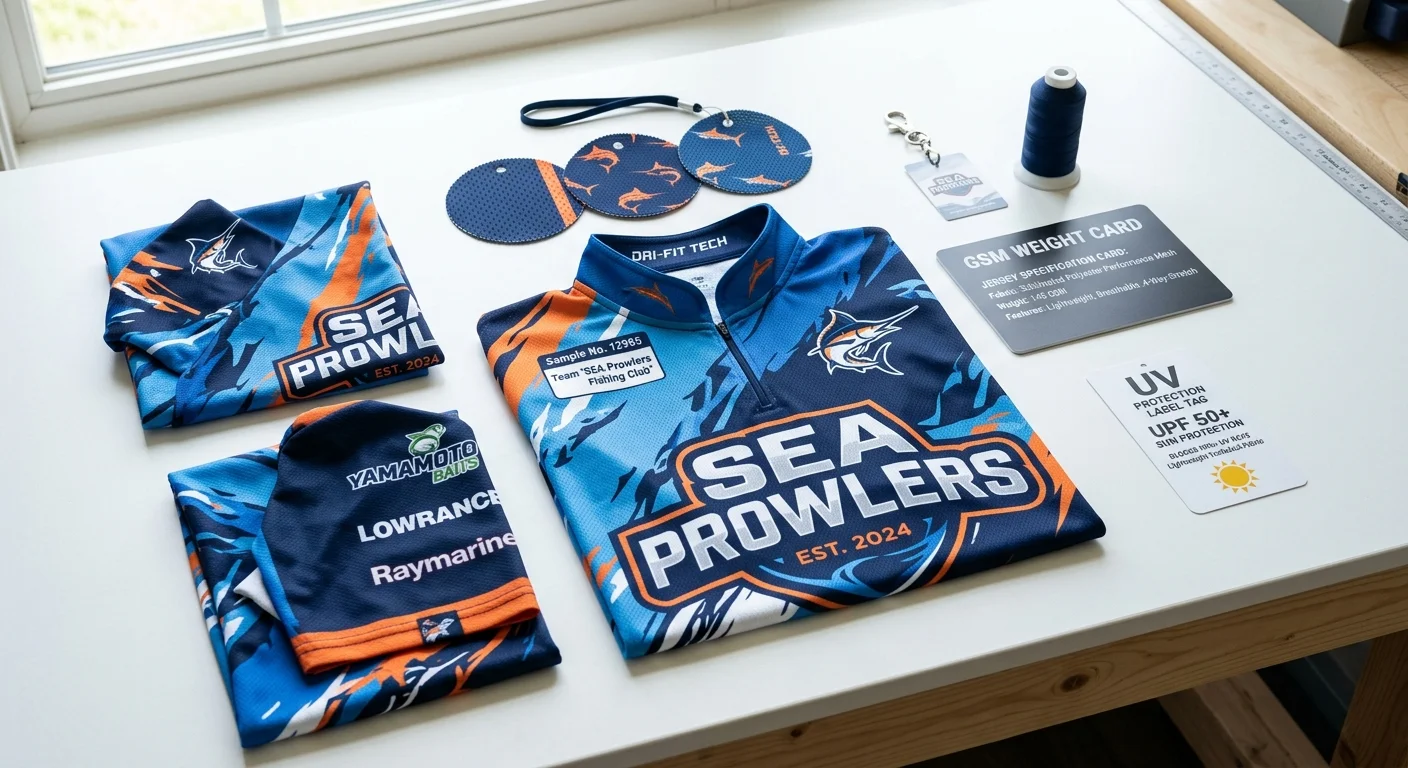
These questions come up all the time — in gear forums, tackle shops, and bulk order emails. Here are direct answers, no runaround.
Q: Is polyester or nylon better for sun protection?
Polyester. It blocks UV at the fiber level. No chemical finish needed. Most UPF 50+ fishing shirts on the market use polyester for this reason. Nylon can reach UPF 50+, but it needs tighter weaves, darker dyes, and UV-absorber coatings to get there. That's extra engineering just to match what polyester does on its own. For long days on open water, polyester's built-in stability is the safer, more consistent choice.
Q: Does nylon dry faster than polyester?
No — polyester dries faster. Polyester repels water instead of soaking it in. Nylon holds moisture inside the fiber. It dries much slower. You'll feel the difference after a splash or a sweaty afternoon offshore. Quick-dry polyester fishing shirts bounce back fast between soakings — whether you're wading flats or grinding it out all day on open water.
Q: Can both fabrics reach UPF 50+?
Yes — but they get there differently. Polyester hits UPF 50+ through tight construction alone. Nylon needs extra work: denser weaves, saturated colors, and UV-blocking finishes. Either way, ask for a lab-tested UPF certification (AATCC 183 or equivalent). Don't just take the tag's word for it.
Q: What specs should B2B buyers request for custom fishing shirts?
Pin these down before placing any bulk order:
Fiber: 100% polyester or polyester-spandex (90–95% / 5–10%) for performance tops
UPF: 50+ certified, with actual test report
Weight: 120–170 GSM (lighter for tropical heat, mid-range for durability)
Stretch: 4-way with ≥8% spandex content
Finishes: moisture-wicking, quick-dry, antimicrobial
Print compatibility: sublimation-ready for team logos
Q: Why do serious anglers avoid cotton?
A plain cotton tee often carries a UPF below 15. It soaks up sweat, dries slowly, and loses even more UV protection once wet. A lightweight moisture-wicking fishing shirt in polyester or nylon handles everything cotton can't. Plus, it holds that performance through a full season of hard use.
Conclusion
Here's the honest truth: there is no single "better" fabric. There's only the right fabric for your fishing conditions.
Battling relentless sun on open water? Polyester holds its color well and costs less over time. It's the dependable workhorse for long, sunny days. Fishing fast, layering up, or dealing with salt spray and real abrasion? Nylon's tough, smooth strength handles that well. It holds up where softer fabrics fall apart.
Stop guessing. Pick the right fabric and fish with confidence.
Solo angler or tournament team — the fabric choice you make today shapes how you feel six hours into a 95°F afternoon on the water. That's not a small thing. The wrong fabric leaves you drained and uncomfortable. The right one keeps you focused on the fish.
Ready to build a custom performance fishing shirt built for how and where you fish? Explore your custom fishing shirts options at CustomFishingWear.com — let's make something worth wearing.