You've heard the horror story before—maybe you've lived it. A Private Label Fishing Apparel factory sends a gorgeous sample, quotes a price that fits your budget, and three weeks later you're staring at 5,000 units with mismatched UPF ratings, seams that fray after two washes, and a delivery date that's slipped twice. When you're placing a bulk order for private label fishing apparel, "the sample looked great" isn't enough due diligence, and generic sourcing advice won't save you.
What follows is a checklist built for fishing gear: how to reverse-engineer a factory's real daily capacity from your order size and deadline, the exact technical specs (UPF certification, hook-snag resistance, anti-odor treatment) that separate a real performance fishing apparel factory from a T-shirt shop with a fishing label slapped on, and the trial-order protocol that catches problems before they become a 5,000-unit disaster.
Reverse-Engineering Factory Capacity from Your Order Volume and Deadline
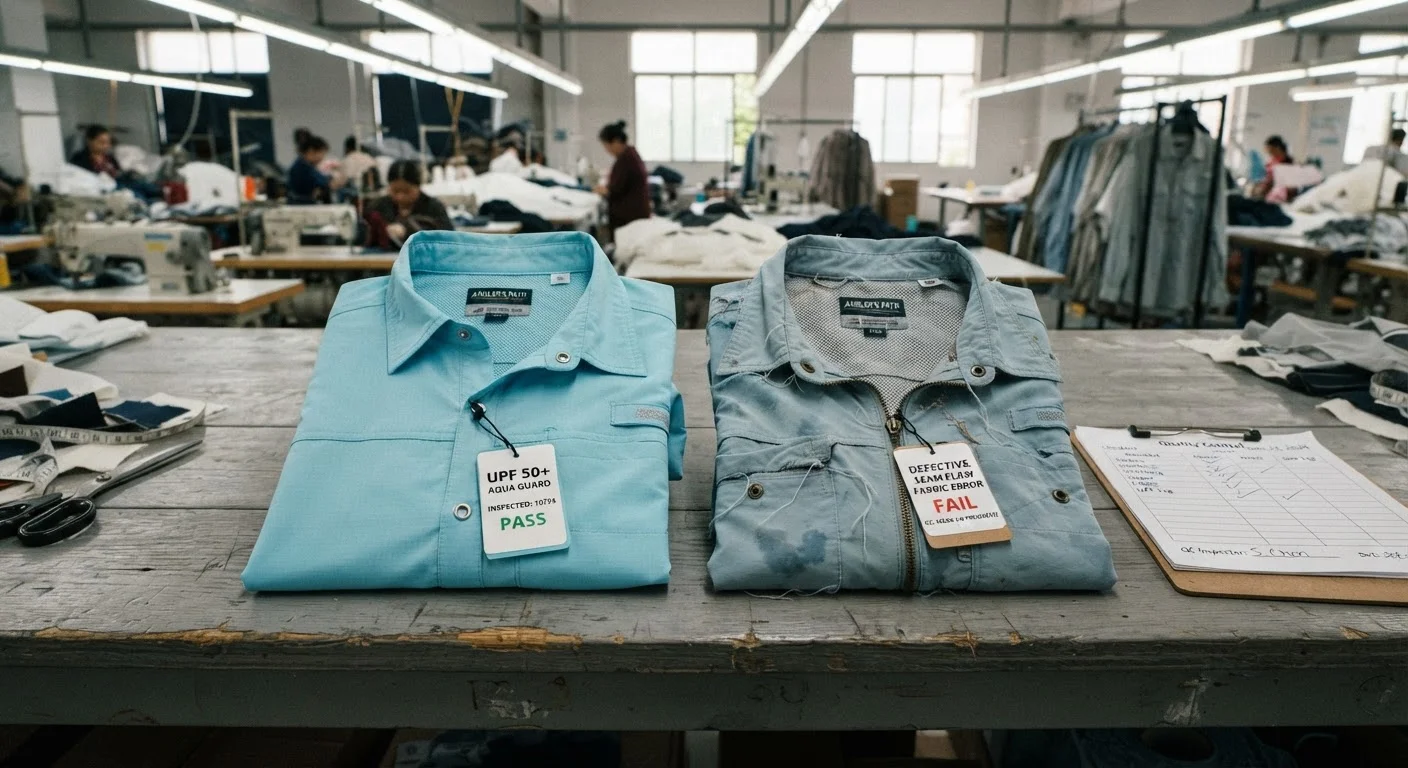
Most buyers skip this math. If a Private Label fishing gear factory can't tell you their daily output number in minutes, they don't actually know if they can hit your deadline. They're guessing. And guessing on a 5,000-unit fishing shirt order is how you end up with half your inventory arriving three weeks after your launch date.
You don't need an industrial engineering degree to check their math. You need one formula.
Daily Capacity = (Number of Workers × Working Minutes/Day × Line Efficiency%) ÷ SAM (Standard Allowed Minutes per garment)
Let's run real numbers. A factory has 40 workers, runs 480 working minutes a day (8-hour shift), operates at 80% line efficiency, and your fishing shirt has a SAM of 20 minutes. Fishing shirts with vented backs, roll-up sleeve tabs, and multiple pockets take longer than a basic tee.
Daily Capacity = (40 × 480 × 0.8) ÷ 20 = 768 shirts/day
Flip it around. Your order is 12,480 shirts and you need them in 26 working days. Your required daily output is 12,480 ÷ 26 = 480 shirts/day. Since 768 > 480, this factory has a buffer and the order is feasible. If required output came out higher than actual capacity, the factory is already telling you through numbers, not promises, that they'll be late.
You can also reverse this to check minimum staffing. For that same 480 shirts/day requirement, at 80% efficiency and 20-minute SAM:
Minimum Workers = (480 × 20) ÷ (480 × 0.8) ≈ 25 workers
If a factory claims they'll run your order with 15 people, the deadline is fiction.
Questions to ask before you sign:
"What's the SAM for a UPF-treated fishing shirt with mesh venting?"
"How many workers and lines will be dedicated to my style, not shared across other clients' orders?"
"What's your actual line efficiency on similar technical fabrics, not your theoretical target?"
"What other orders are already booked on those lines during my production window?"
If any answer feels vague, that's your red flag. Not the sample quality.
Fishing-Apparel Technical Verification Checklist for Bulk Production
That sample the factory sent you was probably hand-finished by their best operator. Bulk production runs through different hands, different machines, and different fabric rolls. If you haven't locked technical specs on paper before cutting starts, you're gambling, not manufacturing.
Fabric Specs to Lock Before Cutting
"Poly blend" isn't a fabric description. Get the exact fiber composition to 1% accuracy—92% polyester/8% spandex—written into the BOM, not promised verbally.
For a legitimate performance fishing apparel factory, weight standards matter:
Light performance tops: 120–180 GSM
Heavier fishing knits/hoodies: 180–250 GSM
Bulk tolerance: ±5 GSM per lot (target 210 GSM means 205–225 GSM is acceptable, nothing outside that range)
Confirm applied finishes with actual vendor codes: moisture-wicking, anti-pilling, DWR water-repellent coating, and UPF-rated UV treatment. "We use good fabric" is not a spec. A vendor code is.
Performance Benchmarks That Separate Real Fishing Apparel Factories
This is where a UPF fishing shirt manufacturer proves itself:
Colorfastness to washing: Grade 4–5 minimum (ISO/AATCC grey scale)
Pilling resistance: Grade ≥4
Stretch and recovery: fabric and seams stretch to 2x original width without cracking at elbows, shoulders, side body
Shrinkage: ≤3% in length and width after specified wash
Shade grouping: every fabric roll must sit within your approved shade band
Run pre-bulk fabric trials before a single yard gets cut: shrinkage test, GSM check per roll, shade mapping, 24-hour fabric relaxation on the table for knits. No QA sign-off, no cutting.
Sampling Stages Before Bulk Authorization
Four stages, each signed off:
Prototype: pocket placement for tackle, hood coverage, casting mobility with a rod in hand
Fit/size set (S–3XL): arm reach and torso twist simulating actual casting
PP sample: made with actual bulk fabric, trims, and decoration method; this becomes your QC calibration standard
TOP sample: pulled from the bulk cut line itself, not the sample room
Seam, Print, and Function Testing
Sew a 30–50cm test seam at actual bulk settings; pull-test to 2x width with no popped stitches. Confirm 10–12 SPI on knit seams. For sublimation printing, demand 20+ wash cycles with no cracking, plus position accuracy testing on chest and sleeve graphics. Test zipper pull force (90N benchmark) and 20-cycle durability on every fastener before authorizing fabric cut for full bulk.
Trial Order Protocol to De-Risk a Large Fishing Apparel Production
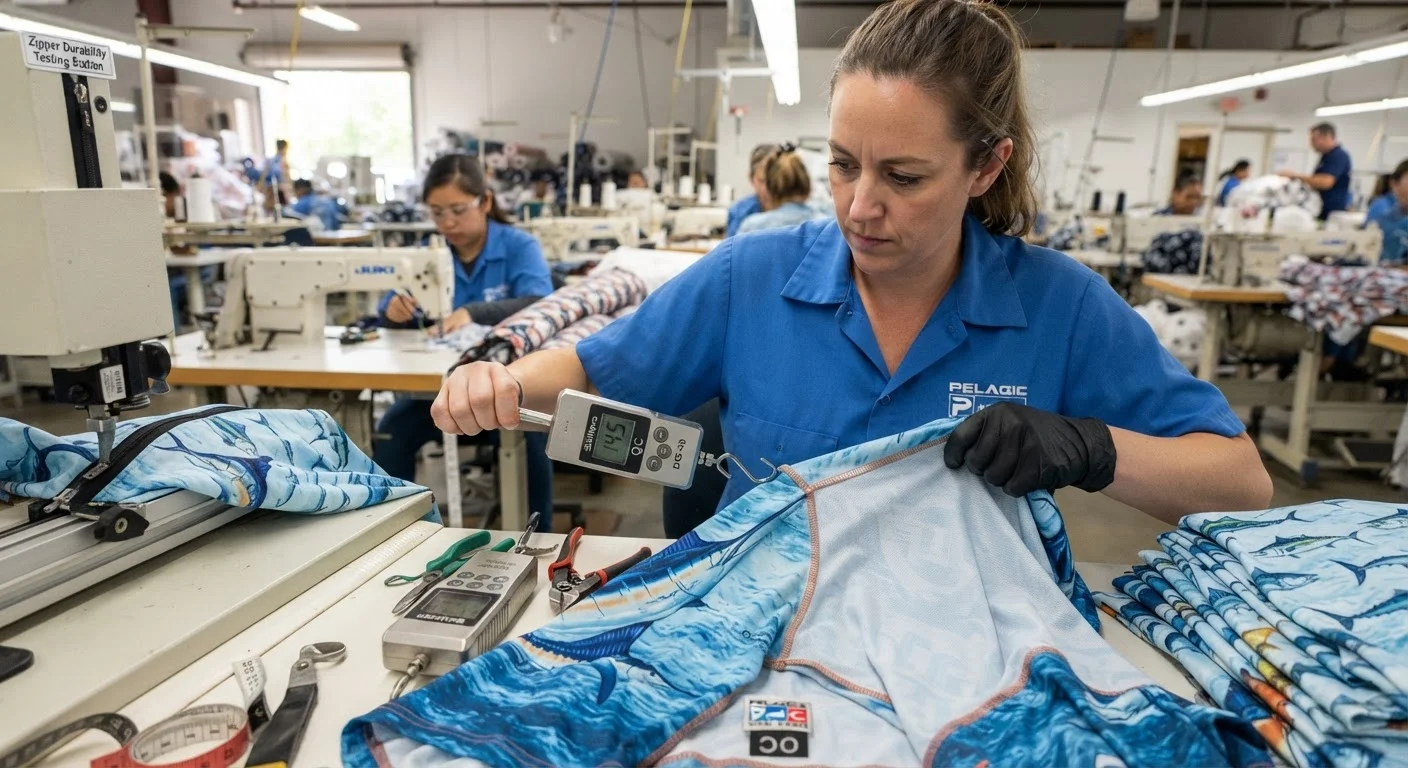
Skipping the trial order is the single most expensive mistake a brand makes when scaling into bulk fishing clothing production. A factory that nails a 200-piece pilot rarely blows up a 10,000-unit order. A factory that cuts corners on the pilot will cut the same corners at scale—just with more zeros attached.
For most fishing apparel programs, 100–300 units across your core styles and sizes is enough to validate fit, stitching, and packaging. If your target order is 10,000+ units, allocate 20–30% of expected volume to a test batch or a secondary supplier before you consolidate everything into one factory.
Keep the SKU count tight: 1–3 core styles (a sun hoodie, a technical button-down, a fishing bib), 1–2 colors each, full graded size run, and one primary decoration method. Testing five styles and six colors at once tells you nothing—it just multiplies your variables until you can't isolate the problem.
The Three-Layer Inline QC Net
Don't wait for final inspection to find out something's wrong.
Start-up checkpoint : inspect the first 30–50 pieces off the line against your PP sample.
Mid-line checkpoint : re-check at 20–30% completion, classifying any defects as machine-setup issues or systemic problems.
Final inspection : AQL 2.5 for major defects, 4.0 for minor, plus a full packing check.
Go/No-Go Numbers Before You Reorder
On-time delivery on trial batch: ≥95%
Major defect rate: ≤2.5%
Rework ratio: ≤5–7% , anything higher triggers a written CAPA before the next PO
Shade variance: ≤1 grade under D65 light, no visible cross-panel difference at 1 meter
Sample trial order : 200 pcs (50 each in S/M/L/XL), 2 colors, 140–160 GSM UPF 50+ poly knit, corrosion-resistant zipper, anti-rust eyelets. Send 5–10 anglers out for 4–6 real outings before you sign the bulk PO.
Case Comparison: Two Factories, Similar Quotes, Opposite Bulk Outcomes
I've watched this happen with brands sourcing custom fishing shirts: Factory A and Factory B both quoted $8.40 per unit, promised 8-week lead time, and sent solid samples. Six months later, Factory A shipped on time with a 1.8% defect rate. Factory B delivered three weeks late, with 12% of units failing QC. Same price, completely different results. The difference wasn't in the quote; it was in what each factory didn't say.
Score them on five criteria:
Criteria | Factory A | Factory B |
|---|---|---|
QC systems (/10) | 9 | 3 |
Production capacity (/10) | 8 | 5 |
Communication (/10) | 9 | 5 |
Sample-to-bulk consistency (/10) | 8 | 6 |
Pricing (/10) | 7 | 7 |
Total | 41 | 26 |
Factory A itemized QC costs at $850 for the order—incoming fabric inspection, inline checkpoints, final AQL 2.5. Factory B's quote had "misc. handling fee" buried in the line items. That vague line covered skipped inspections.
Factory A also proved they'd decorated on actual bulk fabric, not a substitute swatch. Factory B's sublimation sample looked identical—until bulk cutting revealed a lower GSM poly blend that cracked after 15 washes.
Before you compare quotes, ask both factories two questions: "What's your AQL level and how many inspection checkpoints run during production?" and "Is your sample made on the exact fabric roll you'll use for bulk?" A wholesale fishing apparel supplier that hesitates on either answer is quoting hope.
Scripted Verification Questions to Test Factory Capacity Claims
Numbers on a spec sheet mean nothing if the factory can't back them up with records. The gap between "we can produce 1,500 fishing shirts a day" and what actually happens on the floor is where most bulk fishing clothing production orders unravel. Use these exact scripts on your next call.
Verify the daily output claim:
- "What was your actual average daily output for this exact fishing shirt style over the last 3 months? Send day-by-day production logs, not a monthly total."
- "What's your First Pass Yield on this product? Industry benchmark is 95%+ acceptable, 98%+ world-class—where do you land, with reports?"
Verify delivery reliability:
- "Over your last 20 shipments above $50,000, what was your on-time delivery rate?"
- "Have you missed a customer deadline in the last 12 months due to capacity? How many times, and why?"
Verify bottleneck honesty:
- "Name the single bottleneck process in producing my order. What's its max good-units/day throughput, and current utilization percentage?"
Verify with proof, not promises:
- "Send timestamped photos or video of a normal production day—WIP levels at shift start and end, actual worker count on the floor."
- "Give me contact details for 2-3 reference clients who've ordered similar volume for 6+ months."
For orders above 5,000 units, add one non-negotiable line: request a third-party capacity audit before final PO. A wholesale fishing apparel wholesaler confident in their numbers won't hesitate. One that stalls just answered your real question.
Pricing and MOQ Tiers Across Three Order Volumes
Most fishing apparel MOQ requirements follow a predictable three-tier structure once you strip away the sales pitch. Knowing the pattern before you negotiate saves you from overpaying on your first PO.
Tier 1 - Entry/Sample Band
- MOQ: 50-300 pcs depending on decoration complexity
- Price: base rate, no discount
- Use case: sampling, new-vendor trial, style validation before scaling
Tier 2 - Growth Band
- Quantity: roughly 2-5× your Tier 1 MOQ (300-1,500 pcs for most custom fishing shirts manufacturer setups)
- Discount vs Tier 1: 8-20%
- Use case: seasonal reorders, regional launch quantities
Tier 3 - Bulk Band
- Quantity: 5-10× MOQ, typically 1,500-5,000+ pcs
- Discount vs Tier 1: 20-40%
- Discount vs Tier 2: 10-20% additional
Watch the pattern: the biggest price drop happens between Tier 1 and Tier 2, not Tier 2 to Tier 3. A wholesale fishing apparel supplier quoting flat pricing across all three bands hasn't costed the order. They're guessing, same as with capacity.
To set your Tier 1 MOQ, use: MOQ = Fixed Cost ÷ (Selling Price - Variable Cost). This tells you the minimum quantity needed to cover setup and tooling before a single unit turns profitable. That number matters when negotiating with a China fishing apparel manufacturer on UPF-rated fabric minimums.
Conclusion
When you're placing a big private-label fishing apparel order, don't pick a factory based on the prettiest sample. Pick one that can prove its capacity, technical specs, and consistency before you wire a deposit on thousands of units. The factories worth your time hand over UPF test reports without hesitation, walk you through their actual production line on a video call, and nail a trial order that matches your sample piece-for-piece.
Put every wholesale fishing apparel supplier you're vetting through the checklist up there—capacity math, technical verification, trial protocol—before you commit to bulk. That's a few extra days of due diligence versus months of dealing with returned inventory and blown deadlines.
Save this as your reference sheet. Next time a factory quotes you a suspiciously fast turnaround, pull out those scripted questions and ask them directly. Their answers will tell you everything.