A fishing brand founder finds two fishing apparel suppliers offering what looks like the same hoodie. One quotes $8 per unit with a 50‑piece MOQ. The other wants $22 per unit but requires 500 pieces minimum. Same product category, wildly different numbers, and no explanation why.
That gap is the difference between white label and private label fishing apparel, and it's the single most expensive decision you'll make before your brand even launches. Choose wrong, and you're stuck with cash locked in inventory you can't sell or a generic product that can't compete on shelf.
This guide breaks down where the money goes, what MOQ thresholds mean for your cash flow, and how much design freedom you're buying at each price point, so you can pick the model that fits your brand stage, not just your budget.
Cost comparison: Unit Cost + Initial development investment
Let's look at the actual FOB pricing you'll see when you request quotes from suppliers.
White label fishing apparel typically runs:
- Basic styles : $2–5 FOB per unit, at MOQs of 200–500 pieces per color
- Advanced styles : $5.9–12.9 FOB per unit, similar MOQ range
Private label fishing gear costs more upfront:
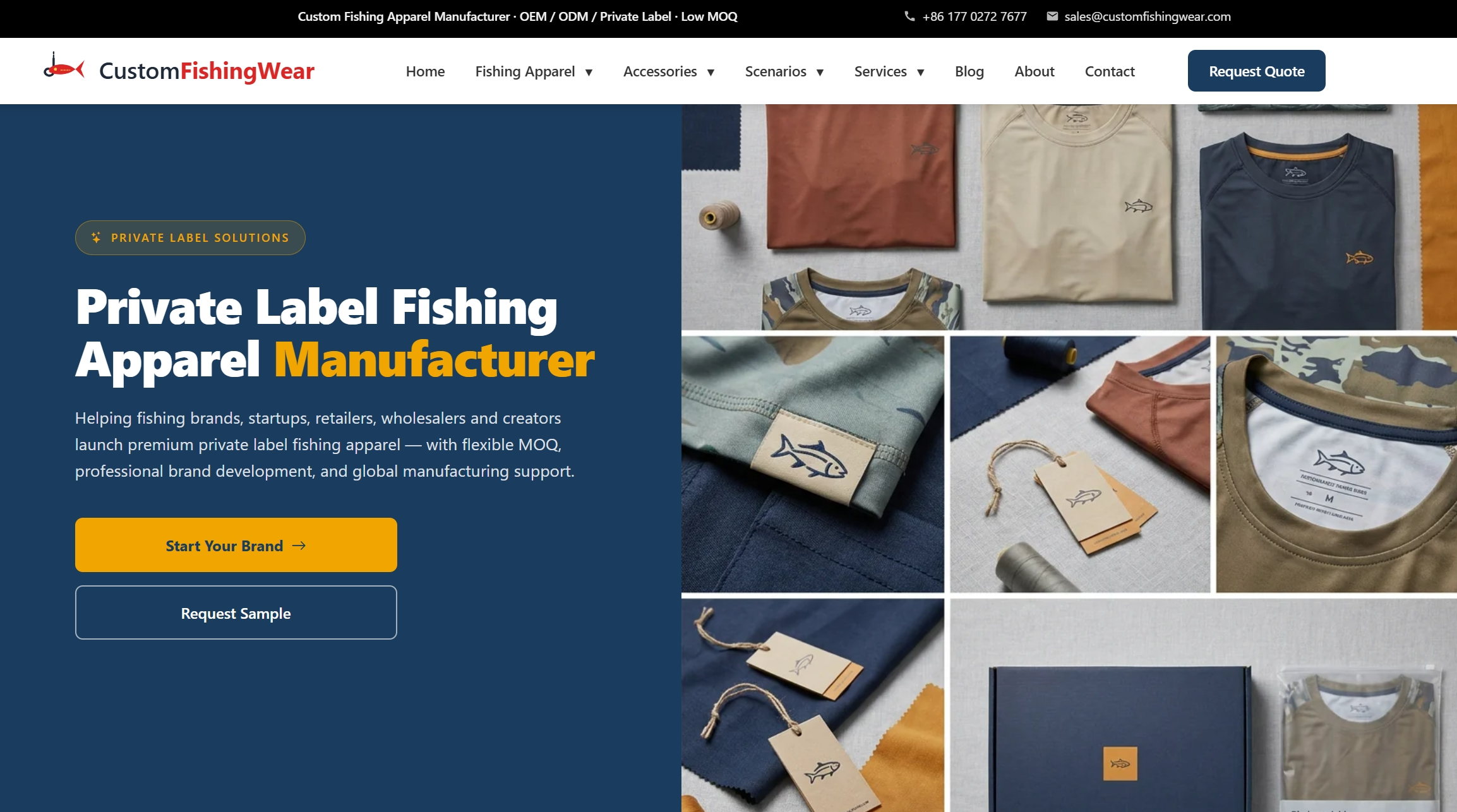
- $6–12 FOB per unit , at MOQs of 500–1,000 pieces per color
That's before you factor in development.
Development costs are where the real money goes
White label skips tech packs and pattern development entirely. You're buying an existing product. Your only upfront costs are brand assets: photography, listing copy, maybe a hang tag redesign. A 300-unit white label order typically costs $1,250–2,650 total, landing your effective per-unit cost between $4.17 and $8.83.
Private label fishing clothing requires a tech pack and sample garment for every style. Budget $1,200–4,500 per style just for development, before you've produced a single sellable unit.
Here's what that looks like when you stack development on top of production:
Model | First Order | FOB Range | Dev Cost | Production Spend | Total Startup Capital |
|---|---|---|---|---|---|
White label basic | 300 pcs | $4–6 | $0 | $1,200–1,800 | $1,200–1,800 |
White label advanced | 300 pcs | $6–9 | $0 | $1,800–2,700 | $1,800–2,700 |
Private label (small batch) | 500 pcs | $8–10 | $1,200–3,000 | $4,000–5,000 | $5,200–8,000 |
Private label (complex) | 1,000 pcs | $9–12 | $3,000–4,500 | $9,000–12,000 | $12,000–16,500 |
The retail math matters too
White label fishing wear typically sells at 40–60% FOB-to-retail ratio. A $4 FOB piece retails around $6.70–10. Private label runs 25–40%, so a $10 FOB piece supports a $25–40 retail price. Better margins, but you're fronting more cash to get there.
Private label startup capital runs roughly 5x higher than white label for your first order. That gap buys you brand ownership and margin. Whether it's worth it depends on your runway.
MOQ Threshold Comparison: How the Minimum Order Quantity Affects Financial Pressure
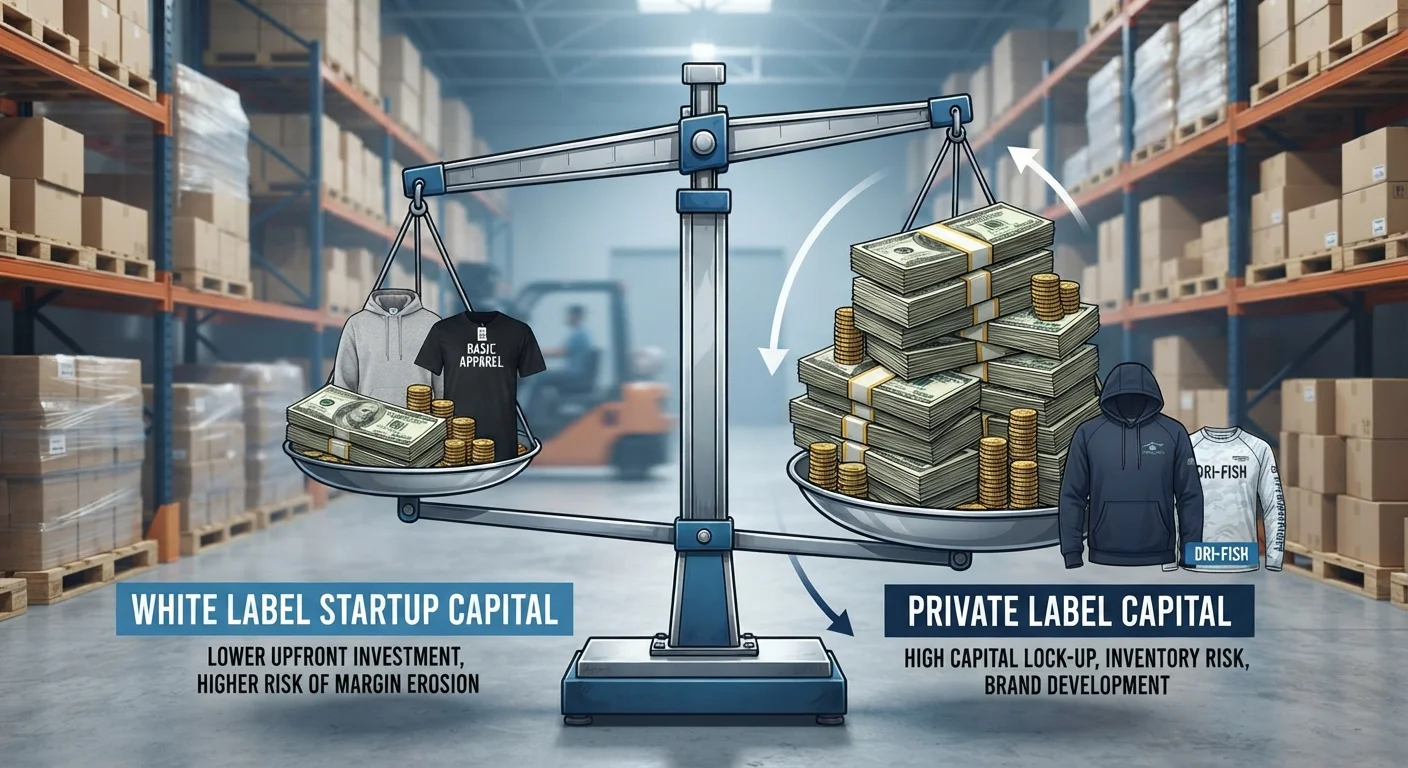
Capital locked = MOQ × unit cost. That formula decides if your fishing apparel launch is a manageable bet or a cash-flow emergency.
White label fishing gear sets MOQ at 200–500 pieces per color. Private label OEM goes to 500–1,000 pieces per color because mills require 1,000–3,000 meters of fabric per color, and factories need enough units to use that minimum without wasting material.
Run the numbers on a real fishing shirt launch across three colors. White label: 200 pieces per color across three colors at $14 per unit means $8,400 locked in inventory. Private label OEM: 800 pieces per color across three colors at $15 per unit means $36,000 locked in inventory.
That's a $27,600 difference in exposure for the same three-color drop. If your sell-through is slower than forecast, that gap is what sits in a warehouse instead of your bank account.
Watch for tiered MOQ traps
Suppliers often offer stepped pricing that looks like savings but increases risk:
Tier | MOQ/Color | Unit Cost | Total Cash |
|---|---|---|---|
1 | 200 pcs | $16 | $3,200 |
2 | 500 pcs | $13 | $6,500 |
3 | 1,000 pcs | $11.50 | $11,500 |
Jumping from Tier 1 to Tier 2 saves $3/unit but doubles your cash commitment. Jumping to Tier 3 saves another $1.50/unit but ties up $5,000 more per color. Unless you're confident in sell-through, that "discount" is a bigger cash commitment.
If a supplier suddenly raises MOQ by more than 30% (say, 500 to 800 units), it's a sign they're cash-stressed. You end up funding their working capital problem.
Customization Freedom Comparison: From Logo Printing to Full Customization Function Design
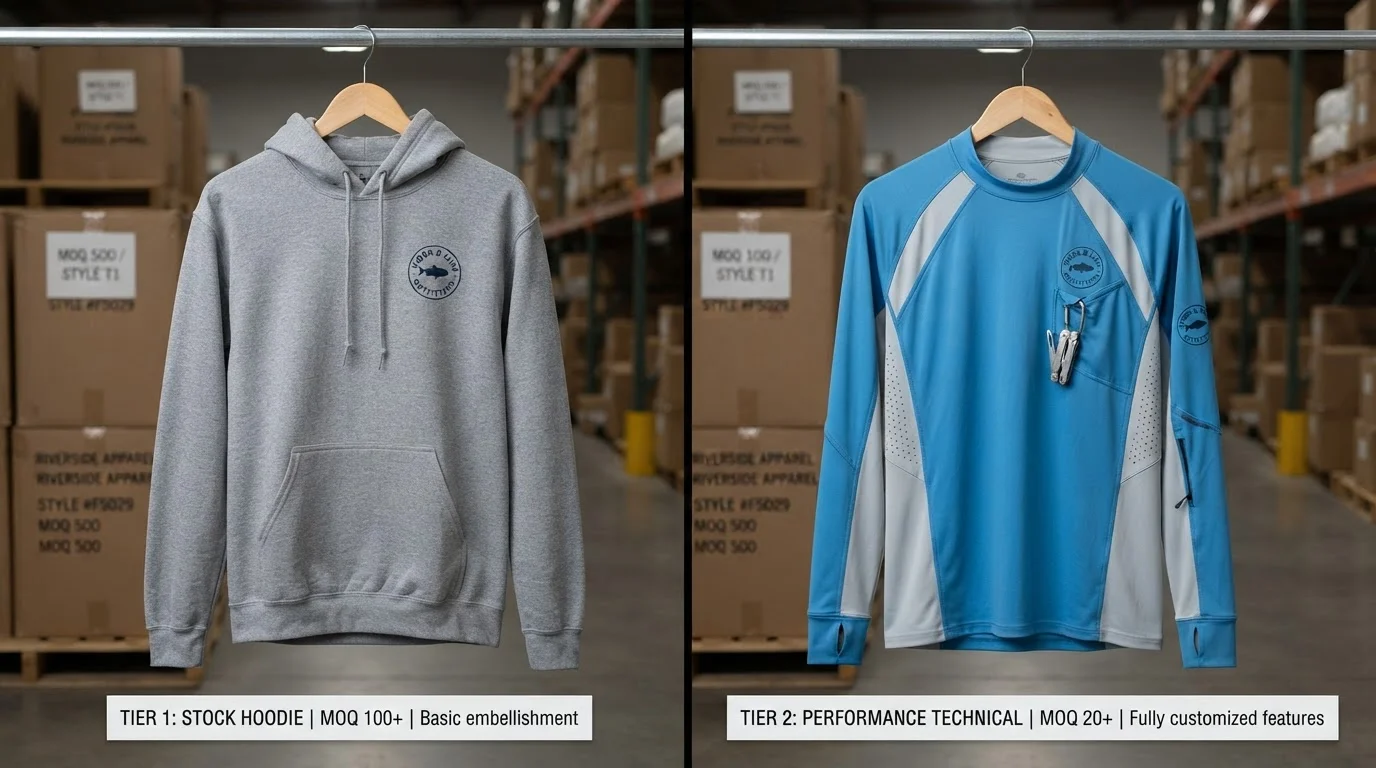
Not all "customization" means the same thing. A supplier who lets you slap a logo on a stock hoodie is playing a different game than one who'll redesign the sleeve pattern for your casting motion. Pick the wrong tier and your "custom fishing shirts wholesale" order blends in with every other boat on the water.
White label: logo and labels only
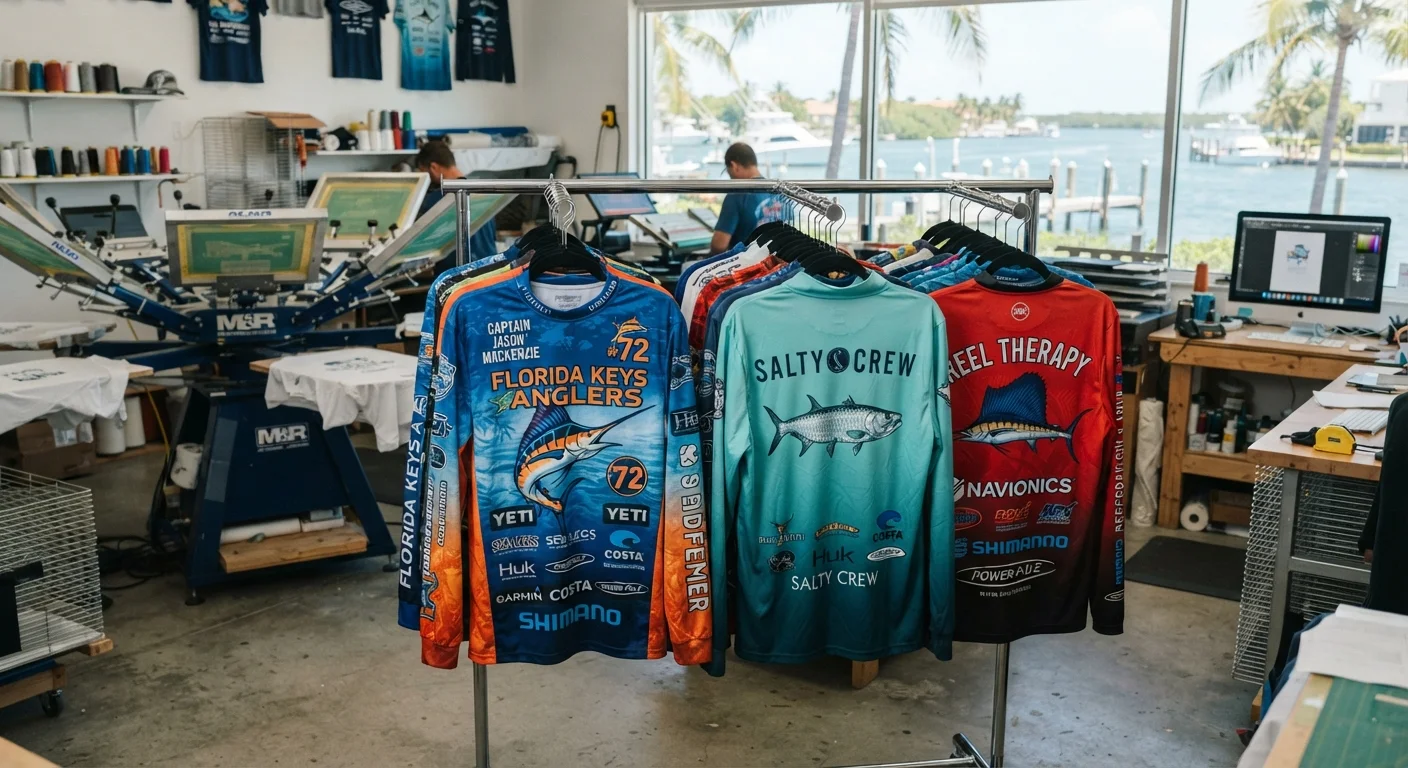
White label customization stops at decoration. You choose between screen printing (best for 1-6 solid colors, 6pt minimum text, vector artwork required), DTG for full-color detail on cotton, sublimation for all-over polyester jersey graphics, or embroidery for caps and premium pieces. Embroidery costs more per unit but never fades.
You'll need three logo files ready: a full-color version, a 1-3 color flat version, and a single-color silhouette for engraving or mono embroidery.
Beyond the logo, you get a neck label swap (woven or printed, S-3XL standard grading), hangtag replacement (300-350 gsm cardboard), and basic packaging with a branded polybag at 50-70 μm thickness.
What you can't touch: pattern, pocket layout, neck type, sleeve type, fabric composition. The garment's bones stay as the supplier built them. MOQ for logo-only work runs 100-200 pieces per style, with 5-8 week lead times.
Semi-custom: the middle ground most brands skip
This is where sublimation earns its keep. Full-color sponsor logos, fish patterns, or camo across the entire jersey, plus minor pattern tweaks. Extend the back hem 3-5cm. Add one gear loop. Adjust body width ±2-3cm. You can often pick collar type and sleeve length from a preset menu without triggering full pattern development. MOQ runs 100-300 pieces per design.
Private label: full functional design
This tier rebuilds the garment around function. Suppliers add articulated sleeve panels for casting motion (that costs 5-10% more fabric), switch to 90-95% poly / 5-10% spandex blends for stretch, or spec UPF 30-50+ fabric at 140-180 gsm for hot climates. Functional add-ons include Velcro patches (2×5cm), D-rings (2-3cm inner diameter), and zip chest pockets sized 12-15cm × 15-18cm.
Custom trims like woven labels, molded zipper pullers, and rubber patches need separate tooling, often with 1,000-5,000 unit minimums.
Aspect | White Label | Semi-Custom | Private Label |
|---|---|---|---|
Freedom | Logo, labels, packaging | Logo + graphics + minor tweaks | Full pattern control |
MOQ | ~100-200 pcs | 100-300 pcs | 500-1,000 pcs |
Lead time | 5-8 weeks | 5-8 weeks+ | Longer, includes tooling |
Not sure which tier matches your brand? customfishingwear.com maps your design brief against these three options and quotes real MOQ and pricing.
Decision Guide: How to Choose Between White Label or Private Label Based on Brand Stage
Your bank balance answers this question before your brand vision does. Most founders skip that math and pick based on ego, then wonder why cash runs dry at month four.
Under $5,000 in launch capital? Go white label. The product already exists. You're not paying for tech packs, sample rounds, or pattern development. Your job is rebranding: logo, colors, packaging, maybe a custom storefront. Launch a small SKU set, track conversion and refund rate, and let real sales data tell you if the product deserves deeper investment. This is how you test demand without building manufacturing infrastructure you don't need yet.
Stable sales history and pushing toward premium positioning? Move to private label. Once repeat purchases justify a longer build cycle, private label buys you exclusivity. You control formulation, fabric spec, packaging, and the full customer experience. That control supports higher AOV and makes your product harder for competitors to knock off overnight.
Quick decision tree
Budget under $5,000, need proof of demand fast → white label
Need to launch in days or weeks, not months → white label
Already have stable sales, want product exclusivity → private label
Brand promise depends on technical differentiation → private label
Unsure about product-market fit → white label first, upgrade later
Rule of thumb: test phase means renting the product through white label fishing apparel. Build phase means owning it through private label. If you don't know demand yet, don't pay for exclusivity you can't use.
Still unsure which stage fits your business? CustomFishingWear.com reviews your budget and sales history, then recommends the model that matches where you are, not where you hope to be.
Key Data Comparison Table: White Label vs Private Label - Comprehensive Quick Reference
Nine numbers separate a smart sourcing call from a costly guess. This table pulls together everything a fishing brand founder needs before signing a PO.
Dimension | White Label | Private Label |
|---|---|---|
Unit Cost (FOB) | $2–12.9 | $6–12 |
Dev Cost per Style | $0–500 | $1,200–4,500 |
MOQ per Color | 200–500 pcs | 500–1,000 pcs |
Customization Scope | Logo, labels, packaging | Fabric, pattern, hardware, trims |
Brand Differentiation | Low–moderate | High |
Initial Capital (first order) | $1,200–2,700 | $5,200–16,500 |
Gross Margin Potential | 30–50% | 50–70%+ |
Time-to-Market | 5–8 weeks | 3–9 months |
Exclusivity | None—same product ships to multiple brands | Contractual, supplier restricted from selling identical spec |
Across every apparel category, white label wins on speed and capital efficiency, and private label wins on margin and defensibility. Neither is objectively "better." One fits testing, the other fits scaling.
Save this table. You'll reference it every time a new supplier quote lands in your inbox.
Frequently Asked Questions (FAQ)
Founders ask the same handful of questions before they commit budget. Here's the direct answer to each.
Can I add a logo to a small white label order?
Yes. Most suppliers allow fishing clothing logo customization starting at 24–100 pieces, depending on the method. Screen printing and heat transfer sit at the lower end of that range. Embroidery and silicone patches often need higher minimums.
Can white label apparel use specific UPF fabric?
Only if that spec already exists in the supplier's blank inventory. You're choosing from what's on the shelf, not commissioning a new fabric weight or yarn count. Need a guaranteed UPF 30-50+ rating with a specific GSM? That's a private label conversation.
Can I get custom pockets or ventilation panels at low MOQ?
Rarely, and when suppliers allow it, expect heavy restrictions. Pattern changes like this typically require private label OEM, with MOQs starting around 300–500 pieces per style.
Is private label always more expensive than white label?
Upfront, yes. Development, sampling, and trims add cost before you ship a single unit. But on repeat orders, private label per-unit cost often drops below what you'd pay running multiple small white label batches. Volume changes the math.
customfishingwear.com will run the numbers against your actual order size and tell you straight which model saves you money.
Pricing tells you half the story. The other half comes from a factory audit most founders skip.
Whether you're vetting a white label clothing manufacturer or a private label fishing gear supplier, start with production capacity, MOQ flexibility, and technical proof.
White label checklist
Existing catalog : Confirm base models ready for decoration. No catalog means you're paying for development you didn't budget for.
Piloting flexibility : Push for MOQs under 500 units for a trial run before committing to full volume.
Sample turnaround : Request a sample of a similar SKU before locking in quantity. The typical flow is briefing, RFQ, sample, then trial order.
Monthly output : 5,000+ units/month signals real scalability for seasonal drops.
Factory verification : Ask for photos, a live video call, and a business license listing "manufacturing," not just trading.
Private label / OEM checklist
Fabric engineering : Demand UPF 50+ test reports under AATCC 183 or AS/NZS 4399, not marketing claims.
Functional finishes : Moisture-wicking, odor control, breathability. These separate real fishing apparel from repurposed activewear.
Cost transparency : Get pattern, sample, grading, and tooling quoted separately. Bundled pricing hides engineering costs.
Certifications : ISO 9001, OEKO-TEX, BSCI or Sedex audits for suppliers exporting internationally.
Delivery SLA : Under 30 days for mid-size orders is a solid benchmark.
Red flags that should end the conversation
No license, no factory address, no video verification.
Zero UPF or lab test documentation for fishing wear.
One flat price with no development breakdown.
Rigid MOQ, no willingness to pilot.
A strong bulk fishing apparel supplier hands you a catalog, flexible MOQ, fast samples, and real certification, no chasing required. customfishingwear.com covers all four. Request a free quote or book a 1-on-1 sourcing consult before you sign anything.
Conclusion
White label gets you to market fast and cheap, while private label builds the brand equity that turns one-time buyers into loyal customers. The right option for where your business stands now.
If you're testing demand or working with a tight budget, white label lets you validate your niche without drowning in inventory. Once you have traction and capital, shifting to a private label fishing gear supplier gives you the customization, exclusivity, and pricing power that actually builds a brand people remember.
Talk to a white label clothing manufacturer who understands fishing apparel specifically, not a generic supplier guessing at your niche.
Reach out to customfishingwear.com for a free quote and MOQ breakdown tailored to your budget.