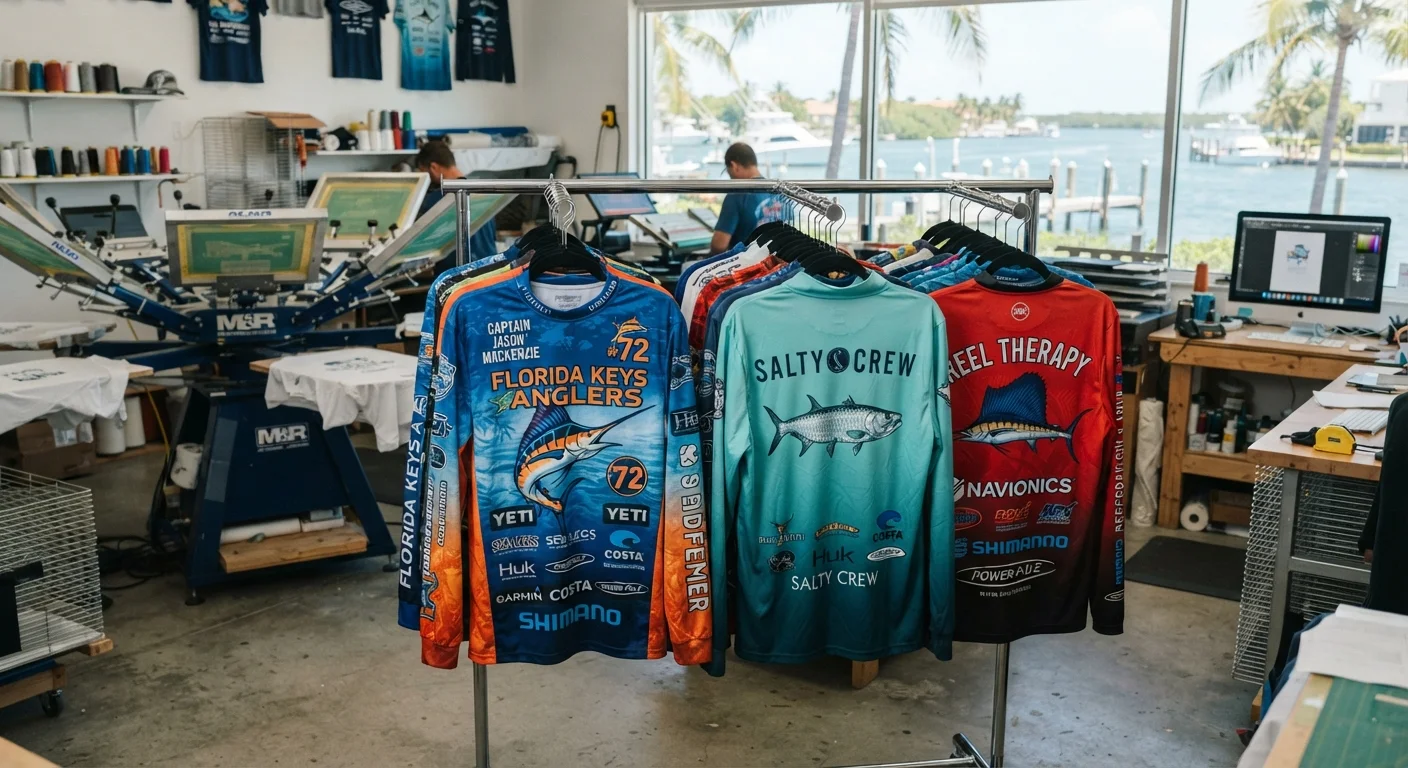
You send a custom fishing apparel factory your dream design for a quick-dry, UPF-rated fishing shirt with mesh vents in all the right places. Three weeks later, a sample arrives that’s almost right, but with the mesh in the wrong place, no reinforcement where the hook guides sit, and the UPF rating missing from the spec sheet. Now you’re burning another week on revisions, another sample fee, and another round of “that’s not what I meant” emails.
A mood board is the root of these issues. A proper tech pack specifies every detail upfront.
Fishing gear has its own rules for tech packs. It requires fabric weights for sun protection, reinforced stitching zones, and moisture-wicking test standards factories actually recognize. Here we break down a real fishing vest tech pack module by module, flag the mistakes that cause the most rework, and hand you a checklist to catch gaps before your factory does.
Section 1: The Real Anatomy of a Fishing-Apparel Tech Pack — Module-by-Module Walkthrough
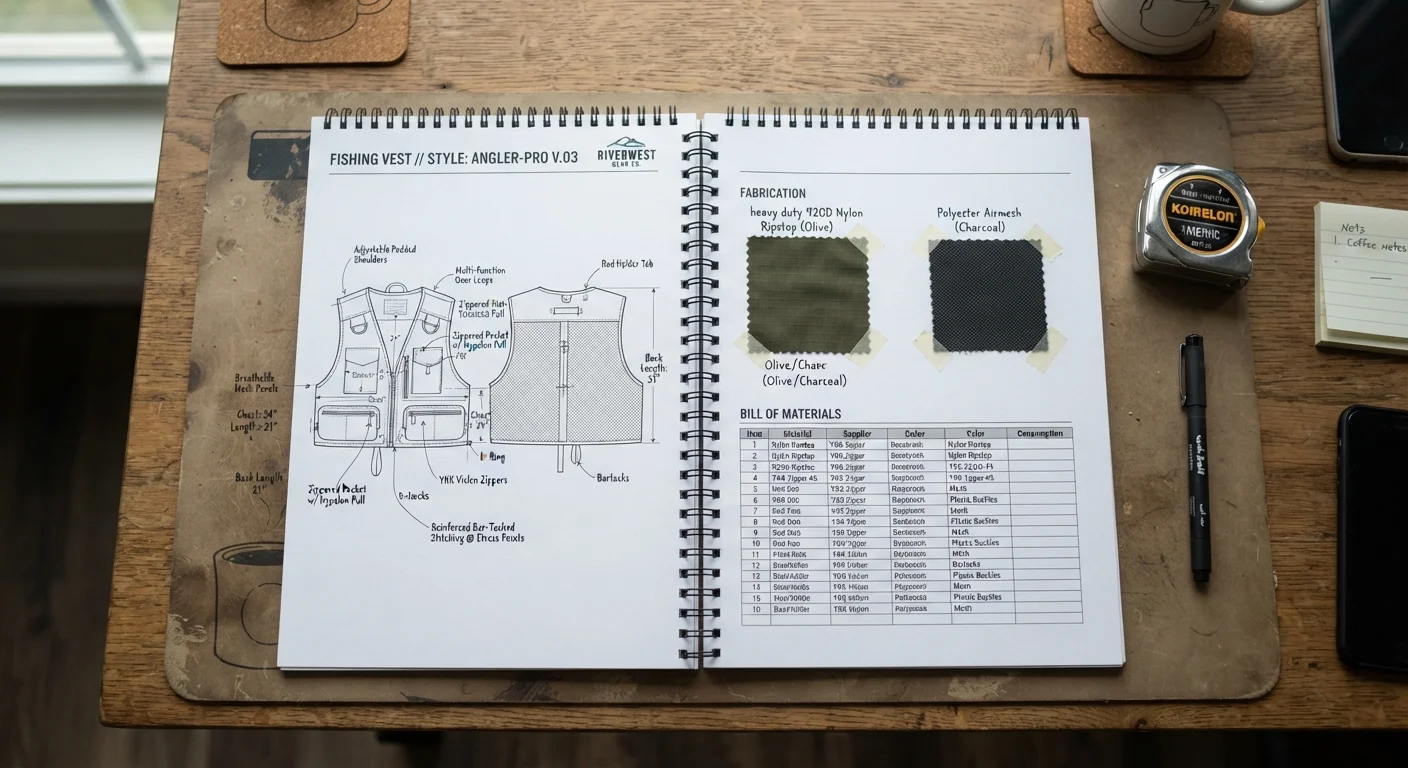
Most tech packs fail because they are built like fashion sketchbooks. A fishing jersey factory needs numbers, callouts, and zero room for interpretation. A real, production-ready tech pack for fishing apparel runs 8 to 9 core modules, usually 10 to 20 pages total. Skip one, and you've handed the factory permission to guess.
Here's what actually belongs in the file, module by module.
Cover Page / Style Header
This is the ID card of your garment. Style number, style name, season, category, factory assignment, lead designer, technical designer, production manager, target costing, target FOB. If a factory can't identify which style they're quoting in five seconds, you've already lost time.
Flat Sketches
Front, back, and side views when the design calls for it — technical line drawings. Every seam, panel, cuff, hem, and vent gets a callout. For a fishing shirt, mark mesh placement precisely. "Mesh vents at underarm and upper back, 4 inches wide" beats "breathable back panel" every time.
BOM — Bill of Materials
This is your shopping list, and it's non-negotiable. Every fabric, every trim, every button, zipper, thread, and label goes here. For fishing apparel specifically, this module needs a fabric performance block that includes fabric name, composition, weight (GSM), color code, and Custom Fishing Apparel supplier code. Without this, your custom fishing apparel factory can't source correctly, and they definitely can't quote correctly.
Fishing gear also demands a hardware and utility trim block that includes snaps, zippers, hook-and-loop, D-rings, cord locks, drawcords, reinforced tabbing. Most fashion tech packs skip these entirely. A basic tee doesn't need this. A fishing vest with six pockets and a rod-holder loop does.
Measurement / POM Sheet
Points of measure, target numbers, tolerances. This is where your apparel production sample either matches your intent or doesn't. Vague measurements produce vague samples, and vague samples cost you a second sample fee.
Grading and Measurement Chart
Full size run measurements, or clear grading rules from your base size outward. This module sits next to the POM sheet. It ensures consistency across S through XXL, while the POM sheet handles accuracy in one size.
Construction Notes
Stitch type, stitch density (SPI), seam allowances, bartacks, assembly sequence. This is where you remove factory guesswork entirely. For fishing apparel, reinforced stitching at stress points is structural.
Labels, Artwork, and Packaging
Trim and label placement — care labels, brand labels, hangtags, exact dimensions, exact positions. If you're running a sublimation printing tech pack for an all-over print shirt, this is also where print placement, repeat size, and color matching get documented. Folding instructions, polybag specs, carton specs all live here too.
Revision and Approval Tracking
Sample comments, approval status, version control. Every round of sample feedback gets logged here. Skip this, and your factory might build from an outdated file, which means paying for a sample that's already obsolete.
Get all eight modules right, and your factory has zero excuse to guess. Get even one wrong, and you're back to email chains, delayed timelines, and samples that almost work, which in production is the same as not working at all.
5 Fishing-Apparel Tech Pack Mistakes and How to Fix Them
Factories misread tech packs when vague words leave room for interpretation. Their interpretation is almost always the cheaper, faster option. In fishing-apparel production, five specific misunderstandings show up repeatedly, and every one traces back to a word or number that was left loose.
1. Vague Performance Claims Get Reinterpreted
Words like "quick-dry," "UV protective," and "water-resistant" mean nothing to a factory without a number and test method. Left vague, they source fabric matching their local standard, not yours. You get a shirt that takes hours to dry instead of minutes, or UPF that drops after one wash.
Turn every claim into a spec:
For moisture-wicking fabric, replace "quick-dry" with a fabric weight of 120–160 gsm woven poly or nylon, plus a lab spec like "drying time ≤30–40 minutes from 100% saturation (AATCC TM201)."
For stretch, "moderate stretch" becomes "15–25% weft stretch, 10–15% warp stretch under 4.5N load, minimum 90% recovery after 1 minute."
For UPF, state "UPF 50+, tested to AS/NZS 4399 or AATCC 183; no print or finish may drop UPF below 40."
For saltwater hardware, zippers must be "coil, non-corroding, saltwater-resistant," verified with a 48-hour salt spray test.
2. Fabric and Color Get Swapped for Cheaper Alternatives
"Lightweight polyester, sky blue" invites a factory to substitute something heavier, noisier, or the wrong shade altogether. Lock the fabric block down with fiber content, a weight range of 140 gsm ±5 gsm, weave structure, and air permeability at ≥100 L/m²/s. For color, drop the names and use Pantone codes. Require lab dips to match within ΔE ≤1.0. If you have a camo or logo print, specify the repeat size, scale tolerance of ±2%, and exact placement with tolerance.
3. Fit Gets Measured on the Wrong Landmarks
Standard shirt fit doesn't account for the range of motion in a cast. If your POM sheet doesn't state exactly where to measure, the factory measures wherever their pattern software defaults. The result is tight shoulders or a hem that rides up mid-cast. Fix this with a one-page how-to-measure guide that specifies reference points, exact method, and tolerance for every measurement. For example, sleeve length ±0.6 cm, shoulder width ±1 cm. Add explicit ease allowances. "Across-shoulder base size M: 48 cm, +4 cm ease versus body measurement" leaves nothing to guess.
4. Functional Details Get Built From Guesswork
"Rod holder," "vented back," and "reinforced placket" don't tell a factory how to build it. Add construction callouts directly on the sketch. Specify stitch type, SPI, bartack length, and load requirements. For example, a rod loop needs 2.0 cm woven tape, a box-x stitch, and load ≥3 kg without failure. The same applies to pockets, mesh vents, and hoods. Give finished dimensions, placement tolerance, and closure specs.
5. Outdated Files and Verbal Changes Cause Rebuilds
If your tech pack still says "as shown" or "approx," and you send changes over WhatsApp instead of a versioned file, your factory is building from memory. Kill every vague word. Give every update a date and red highlights. Confirm by phone that the sample room has the latest file, not the one from two weeks ago.
Section 3: Top 3 Details Beginners Most Often Miss
Ninety percent of first-sample failures in fishing apparel trace back to three details. None of them are complicated once you know where they hide.
1. Hook-Guide Reinforcement Points Never Make It Onto the Sketch
You wrote "reinforce where hooks snag" in a text note somewhere on page 6. The pattern maker never reads page 6 closely. They read the flat sketch.
If the reinforcement point isn't marked directly on the technical drawing with a callout line and a measurement, it doesn't exist as far as the factory is concerned. Circle the zone, add an arrow, and write "reinforced tape, 2.5 cm width, box-x stitch, placed 3 cm below collar seam." Put it on the sketch, not buried in a paragraph. Sketches get read first. Notes get skimmed.
2. UPF Value Gets Buried in the Spec Sheet, Never Reaches the Label
UPF is a labeling requirement. If your care label or hangtag doesn't state the UPF rating, you can't legally claim it on packaging in most markets, and buyers can't verify it on the shelf.
Your tech pack needs a separate line item under the labels module that reads "Hangtag must display UPF 50+ rating per AS/NZS 4399." If this only lives in the BOM's fabric performance block, the label maker never sees it. The UPF fabric supplier of fishing apparel and the label printer are two different vendors. One document has to talk to both.
3. The Test Standard Gets Named, But the Testing Party Never Gets Assigned
Beginners write "moisture-wicking, tested to AATCC TM201" and stop there. Good instinct, incomplete instruction. Who runs the test? At what production stage? Fabric stage or finished garment stage?
Without an assigned testing party and timing, factories either skip the test entirely or run it on raw fabric before dye and finishing, which can change wicking performance completely. Specify "Third-party lab test required at bulk fabric stage, before cut and sew, report due before production cutting begins." That single line prevents a shipped batch that fails wicking performance after the fact, when it's too late to fix anything.
Section 4: The Fishing‑Apparel Tech Pack Self-Audit Checklist
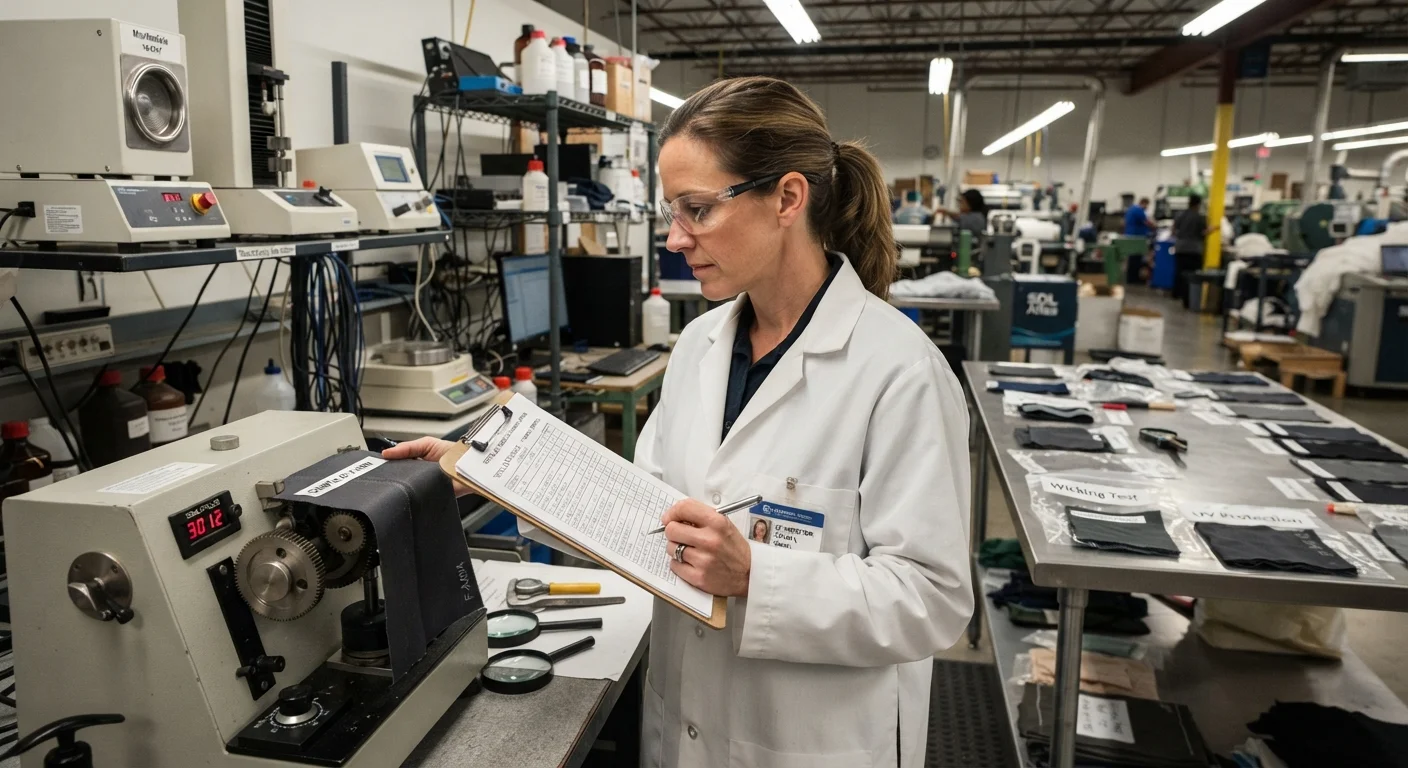
Print this out before your file goes anywhere near a factory inbox. Every line below should already have an answer in your document. If it doesn't, that's your gap, and gaps are where reorders come from.
Cover & File Basics
Include style name, style number, season, designer contact, date, and version number. Add a revision log with dates and approval names. Export the file as a PDF at 300 DPI, under 25 MB.
BOM Completeness
List shell fabric composition, GSM (sun shirts run 130–170 GSM; rain shells 90–140 GSM), weave, finish, Pantone code, and custom fishing apparel manufacturer article number. Note mesh panel GSM, composition, color code, and airflow function. Every trim (zippers, snaps, cord locks, hook-and-loop) needs size, material, and corrosion resistance stated explicitly for saltwater use. For pockets, include bag fabric GSM, closure type, and drainage eyelet material and diameter. Document the UPF rating target in both the BOM and notes, not just in one place.
Measurements & Grading
Include fishing-specific POMs: casting-reach sleeve length (+1–2 cm versus a standard casual shirt), biceps circumference, and drop-tail hem. Provide a base size table with tolerances (woven ±0.5–1.0 cm, knits ±0.7–1.2 cm). State grade rules per POM rather than assuming them. Make sure every POM on the spec sheet also appears on the sketch.
Construction & Finishing
Specify SPI per seam type (10–12 for knits, 8–10 for heavier wovens). Document bar-tack quantity and position at pocket openings and vent hems. For rain shells, list taped seams with seam allowance width (about 1–1.2 cm).
Artwork, Labels, Packaging
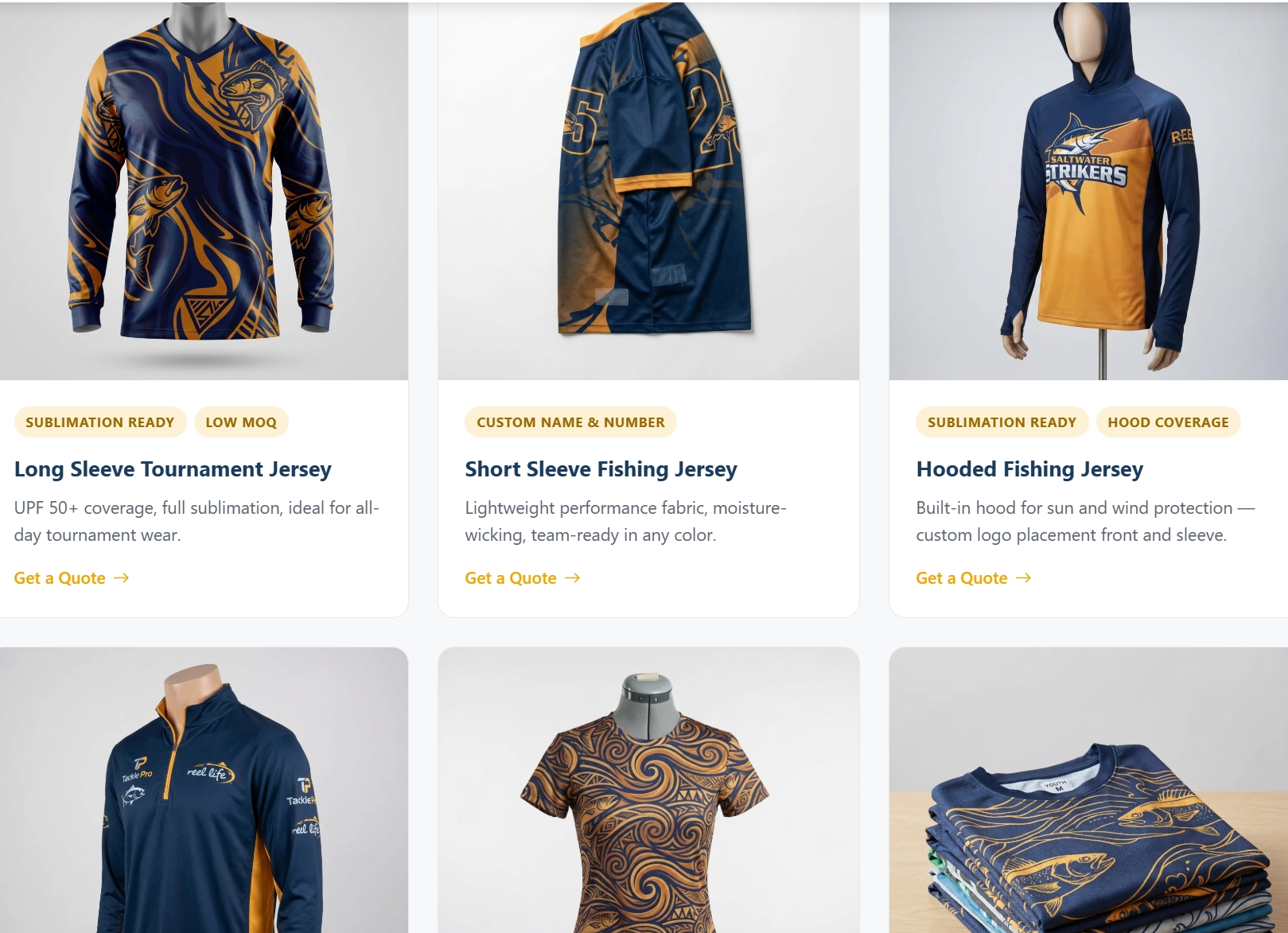
Create a colorway page with Pantone codes tied to every trim, not just the shell. For sublimation printing, document print repeat size, orientation, and technique. Confirm polybag size and thickness, carton quantity, and weight limit (benchmark under 20 kg).
Testing & Traceability
Reference saltwater colorfastness and UPF test methods with an assigned testing party. Match trim card IDs line for line to the BOM entries.
Run your file against this list once. That single pass is worth more than a week of email back-and-forth after the sample lands wrong.
Conclusion
Your garment specification sheet gets orders rejected when it leaves too much room for guessing. Guessing turns a $3,000 sample run into a $15,000 mistake.
You now know the fix. Nail your UPF ratings, hook-snag reinforcement points, and moisture-wicking test standards before the file leaves your inbox. That eliminates 90% of the back-and-forth that stalls the fishing shirt manufacturing process. A fishing apparel factory quotes you confidently in 48 hours, not vague numbers because they're covering their own risk.
Pull out the self-audit checklist from Section 4 right now. Run your current tech pack against it line by line. If something's missing, fix it tonight — not after your first sample comes back wrong.