You’ve got a killer fishing apparel design, a brand name that actually slaps, and maybe even a half-built Shopify store. But every manufacturer you contact wants 500+ units before they’ll even quote you. Sound familiar? That 500-piece MOQ wall kills more fishing brand startups than bad marketing ever will.
Here’s the good news. After digging through dozens of overseas and domestic factories, I found a real shortlist of custom fishing apparel manufacturers that will work with orders under 50 pieces. No inflated “sample fees.” No bait-and-switch minimums once you place a real order.
Below I break down how to vet a low MOQ fishing apparel factory — including five red flags that signal trouble before you wire a deposit — plus ten vetted suppliers with real pricing, sampling timelines, and fabric specs. You can send your first inquiry today instead of googling in circles for another week.
How to Screen Low-MOQ Fishing Apparel Factories: 5 Red Flags to Watch in 2026
I've seen brand-new fishing apparel founders lose $3,000+ deposits to factories that looked legit on Alibaba. It happens more than anyone admits. Before you send a single dollar to any custom fishing jersey design shop, run every factory through these five checks.
Red Flag #1: Vague or Shifting MOQ Numbers
Real low-moq fishing manufacturers quote MOQ per style, per color, per size. "Any quantity works" isn't a MOQ. For sublimation fishing shirt manufacturers, expect 50–100 pcs per style with 10–20 pcs minimum per color. If their MOQ jumps from 50 to 300 to 1,000 across three emails with zero explanation tied to fabric or print method, you're talking to a disorganized middleman.
Red Flag #2: No Itemized Written Quote
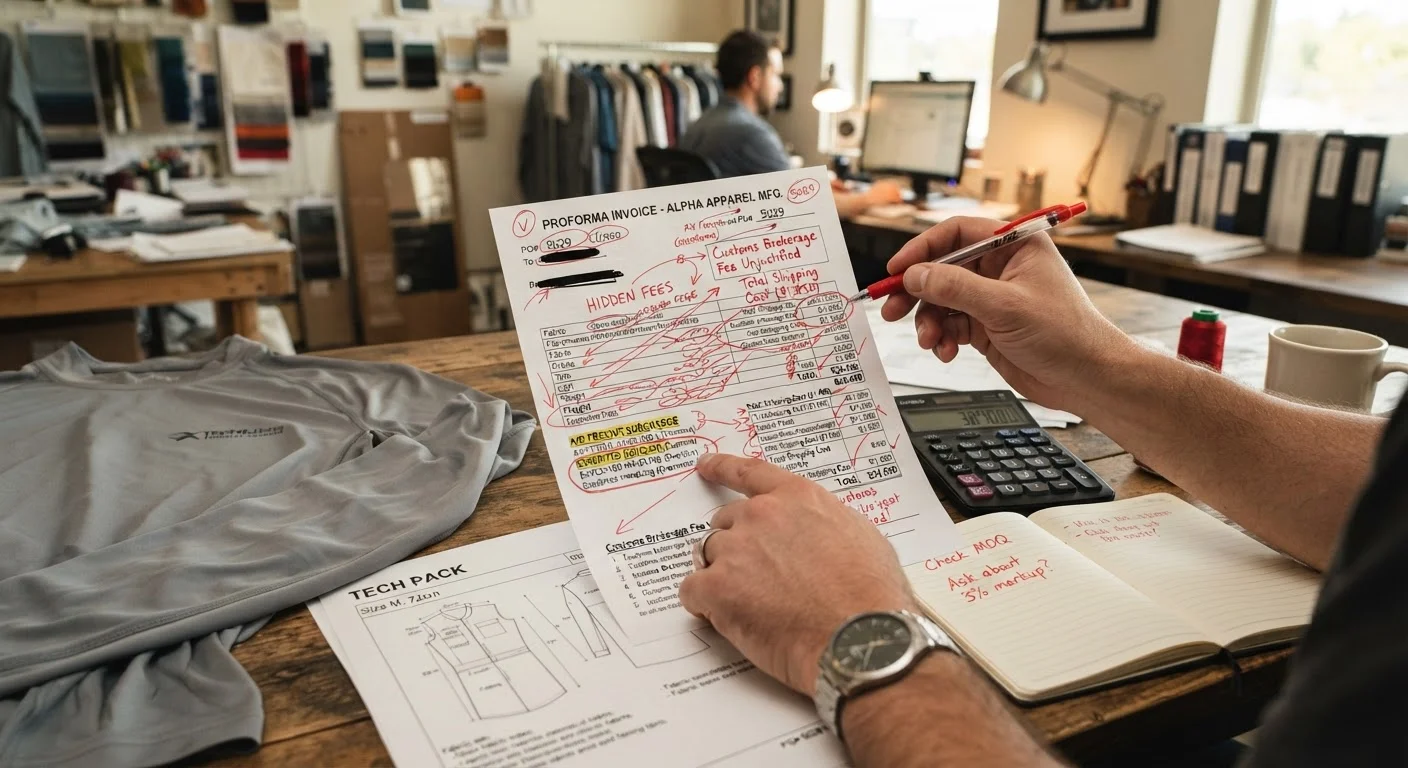
"$20 all-in" for a technical fishing shirt is a red flag. You need a cost breakdown covering fabric (gsm and composition), UPF/anti-microbial finish, printing method, zippers, trims, and packaging. If quotes come in 40%+ below market (say $7 when everyone else quotes $14–18 for a UPF long-sleeve at 100 pcs), demand proof of fabric spec before you get excited.
Red Flag #3: No Factory Verification
Ask for a Google Maps/Baidu location match, 3–5 photos of actual sewing lines with fishing garments (not generic tees), and certifications like OEKO-TEX, BSCI, or WRAP. Claiming "recycled fishing apparel" without GRS or GOTS docs is greenwashing. Also request 2–3 client references from the outdoor or fishing niche specifically.
Red Flag #4: Skipping Samples or Demanding Full Payment
Never pay 100% upfront. The industry standard is a 30–50% deposit, with the balance before shipment. Anything above 70% upfront is a structural risk. A factory pushing straight to bulk production without a pre-production sample (especially for placement prints and technical fabric) is cutting corners that will cost you later. Budget $200–300 for third-party inspection before final payment clears.
Red Flag #5: No Written Contract
"You're our priority" means nothing without a signed PO listing lead times (typically 45–60 days post-sample approval), defect handling, and cancellation terms. If they won't put MOQ, fabric spec, and QC criteria in writing, walk.
Runfish Apparel
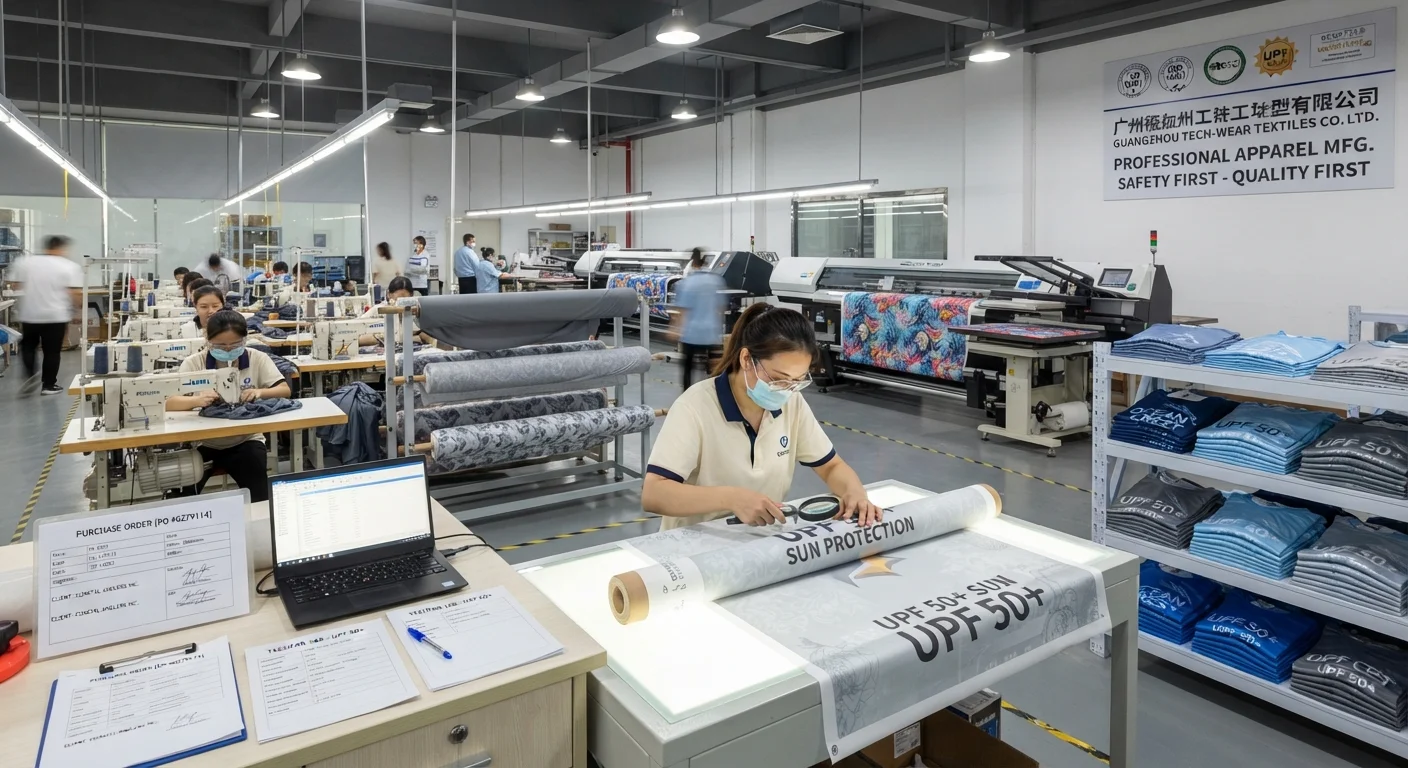
Guangzhou-based Runfish has been building UPF fishing apparel programs since 2009. Their fabric technology page reads like a lab report — because it basically is one.
Core specs:
- MOQ: As low as 30–50 pieces per style for startup brands testing a new sublimation fishing shirt design
- Fabric/Tech: UPF 52–58 (blocks ≥98.1% UV), tested to AATCC 183 and AS/NZS 4399 standards, verified by SGS and BV labs
- Fabric library: 500+ options spanning quick-dry, cooling, and waterproof performance categories
- Certifications: ISO and OEKO-TEX certified
- Scale: 500,000+ garments produced annually, shipping to 50+ countries
- Best fit: Brands who want lab-verified UPF fishing shirt credentials over rock-bottom pricing
- Contact: [email protected] | +86 177 0272 7677 (WhatsApp), replies within 24 hours
You also get design engineering support on OEM/ODM projects, which is useful if you're still finalizing custom fishing team uniform specs.
customfishingwear.com
Seventeen years making nothing but fishing apparel. That's the whole pitch behind CustomFishingWear.com, and the product depth backs it up.
Core specs:
MOQ: 50 pieces per style per color. That's the standard benchmark across their saltwater OEM program, so it works once you're past your first sample run.
Fabric/Tech: UPF 50+ on shirts, hats, and sun-protection lines. Welded waterproof seams on bibs and waders. Quick-dry weaves on pants and shorts.
Product range: One purchase order covers your whole line — sublimation tournament jerseys, fishing hoodies with French-terry weights for cool mornings, waterproof offshore jackets, mesh-lined shorts with salt-resistant hardware, plus gloves and neck gaiters.
Design details: Vented back panels, articulated knees, tool loops that sit flat while you cast.
Best fit: Brands building a full saltwater or tournament collection, not just testing one custom hoodie design.
Ideal for: OEM/ODM programs and private label fishing gear where you want shirts, jackets, and bibs from a single factory instead of juggling three vendors.
LeelineSports
A 30,000 m² factory in Wuhan doesn't scream "small batch." Yet LeelineSports runs a ~50-piece MOQ per style for startup brands anyway. Founded in 2015, it's a legitimate small batch apparel production option in China with the QC muscle bigger orders usually demand — 30 dedicated staff running a 15-step quality process, ISO 9001 and Oeko-Tex certified.
What they do differently:
-3D virtual prototyping simulates sprint, squat, and cast-throw motion before fabric gets cut, which cuts down sample rounds for your custom fishing jersey design.
-You get Coolmax and Lycra fabrics built for moisture-wicking, factory-grade performance.
-Sublimation, screen printing, and embroidery are all under one roof for custom fishing team uniforms with crests or names.
-98% on-time delivery with real-time tracking, serving 70+ countries.
Contact: WhatsApp +86 13986152456
Best fit: brands that want sportswear-level engineering applied to fishing gear, not just a basic tee run.
Appareify
Founded in 2017 out of Guangzhou, Appareify is a serious operation. It produces 400,000+ garments per month, turns samples around in days, and ships bulk orders in 7–20 days for standard styles.
Core specs:
- MOQ: The listed benchmark is 100 pieces, though multiple startup reviews describe them as flexible for smaller test runs
- Fabric/Tech: AI-driven pattern optimization claims to cut sampling cycles by ~60%, plus an eco-score calculator that tracks carbon footprint from yarn to shipment
- Product range: T-shirts, hoodies, leggings, activewear sets, jeans — solid for private label fishing gear beyond just shirts
- Contact: [email protected] | +86 173 2446 1064
Scam Detector flags Appareify at 33.3/100 (medium risk), citing masked domain ownership and thin third-party certification records. I’d push hard for a business license, factory photos, and a small trial order before wiring anything beyond a sample deposit.
Creator’s Fashion
Numbers don't lie. CreatorIQ's 2025 Creator Economy Report shows where fashion brand marketing is heading. Apparel brands grew creator counts by 11% and post volume by 14% year-over-year, pushing EMV up 8% . Engagement dipped 4% , though. More creators mean more noise and thinner returns per post.
Luxury fashion tells the opposite story. Creator counts stayed flat, engagement dropped 13% , and EMV fell 2% . Partnerships are tighter, creators are fewer, and fatigue is steeper.
For your fishing brand startup, skip the influencer flood. CreatorDB data shows mid-tier fashion creators, around 141K followers, hit 3.8% engagement. That is roughly 2.5x the 1.5% category median. One creator posting 1–2x weekly with real engagement outperforms ten mediocre ones.
If you're launching a private label fishing gear line on a tight first-order budget, that math matters. Spend your creator budget on engagement rate. You'll stretch every dollar further than the apparel category average suggests.
Healong
Guangzhou Healong Sportswear has been in the custom fishing jersey business since 2009, and when they say "No MOQ limited," they mean it. After 16 years, that claim holds up.
Core specs:
MOQ: No hard minimum. Sample or reorder runs of 1–10 pieces are standard. Price breaks kick in at 50, 100, and 300 pieces per style.
Lead time: Advertised 2-week turnaround for customized sportswear. Bulk orders past 500 pieces take 3–4 weeks.
Fabric: Moisture-wicking polyester mesh, 140–180 GSM. Full sublimation printing for logos, numbers, and sponsor placements.
Sizing: Kids through adult 3XL–5XL.
Pricing: Roughly $6–12 per piece for sublimated team jerseys, $3–7 per piece for tees or running singlets at 100–300 pieces.
Team stability: 61% of staff have 5+ years tenure. That's rare consistency for small batch apparel production in China.
Best fit: School teams, clubs, and charity runs that need custom fishing team uniforms fast.
Contact: [email protected] | +86 132-8868-2490
Weft Apparel
Some low-MOQ Fishing apparel factories are in the US. Weft Apparel runs its operation out of Amherst, New York, giving US-based fishing brand startups a domestic alternative when overseas lead times or language gaps feel too risky.
Core specs:
MOQ: No published minimum, but their low-MOQ positioning and typical US cut-and-sew benchmarks suggest 50–300 pieces per style, with 1–10 pieces for samples.
Services: Full pipeline covering pattern making, prototyping, sample development, and bulk production, useful if you need to build a custom fishing hoodie supplier relationship from scratch.
Specialty: Sports apparel manufacturing, which overlaps well with moisture-wicking fishing apparel needs.
Location edge: Faster sample shipping, easier communication, and local oversight compared to Asia-based factories that require 300–1,000+ unit minimums.
Best fit: Early-stage DTC brands that want design-to-bulk support without hiring separate pattern makers.
Contact: [email protected] | +1 716 218 3929
Ask directly about per-category MOQ, price tiers at 50/100/300 units, and fabric certifications before committing.
The Evans Group (TEG)
Twenty years in LA's Fashion District, and TEG still won't touch mass overseas runs. That's the whole appeal here.
Core specs:
MOQ: No published number, but small volume production is part of their positioning. TEG built its reputation on launching startups.
Services: Full-package workflow — design consulting, fabric/trim sourcing, couture-level pattern making in their San Francisco studio, then cut-and-sew production back in LA.
Track record: TEG's own history page claims 4,000+ brands launched since 2005. LinkedIn cites nearly the same figure. They run 11–50 employees and under $5M in revenue.
Domestic edge: Everything is made in LA. If "Made in USA" fits your fishing brand startup positioning, that's an edge over overseas sourcing.
Reviews: 4 stars across 27 Google reviews.
Best fit: Designers who want couture-level pattern work and ethical domestic production.
Contact: [email protected] | +1 800-916-0910
Affix Apparel
Two thousand clients in a decade tells you something about staying power. Affix Apparel, headquartered at 7190 W Sunset Blvd in Los Angeles, has run private label and custom cut-and-sew programs since 2011. Production comes out of a Karachi, Pakistan facility the company describes as sweatshop-free.
Core specs:
MOQ: No published hard number, but Trustpilot copy markets a "lowest minimum" positioning for private label apparel. Industry benchmark for this tier lands around 50–100 units per style.
Product range: T-shirts, hoodies, sportswear, tops, jackets — solid coverage if you need a custom fishing hoodie supplier.
Capabilities: Cut-and-sew, screen printing, embroidery, and all-over sublimation printing under one roof, plus material sourcing and pattern grading.
Revenue/size: Estimates range from $2M–$25M depending on the source, with 21–200 employees reported across directories.
Watch this: A UK sister entity, Affix Apparel Ltd, carries an "active proposal to strike off" flag in Companies House records. Stick to the US entity for sourcing.
Contact: [email protected] | +1 323-713-0672
Fishing Apparel Factory (Startup-Focused Guide)
Numbers settle arguments faster than opinions do. Here's the production path breakdown that matters when you're deciding how to launch.
Print-on-demand runs $28–45 per shirt at 1 piece MOQ with a 3–5 day turnaround — zero inventory risk, perfect for testing designs. Stock fabric plus custom print drops to $14–19 per unit at 30–50 pieces, shipping in 7–10 days. Custom sublimation jerseys land at $11–15 per piece for 50–100 units, with a 10–14 day lead time. That's your tournament-grade tier. Domestic small-batch OEM runs $10–18 at 200–300 pieces, 18–25 days, and gives you the consistency growing brands need.
A realistic startup path: spend $500 on a Printful test run to validate 3–5 designs. Move to 50-piece sublimation jerseys through a fishing-focused ODM to lock fit and fabric. Scale to a 200–300 piece private-label run once demand's proven.
Specs worth demanding upfront:
- Waterproof rating ≥10,000mm hydrostatic head
- Breathability ≥8,000 g/m²/24h
- UPF 50+ minimum
- 10–20% recycled content in shell or lining if sustainability's part of your brand story
Sample costs run $50–80 per jacket or bib, $20–40 for performance shirts. Budget 1–2 revision rounds — 3D prototyping can cut that by about 50%.
Ask for ISO 9001, bluesign, or ASTM compliance. That's not bureaucratic box-checking. It's what gets you to the 95% reliability threshold wholesale accounts expect before they place repeat orders.
Founder consensus across multiple fishing apparel launches: expect 3–5 successful drops before you're confidently ordering 500+ units per style. Keystone your margins. A $12 factory cost should become $24 wholesale, $36–48 retail. Anything tighter and one bad batch wipes your runway.
Conclusion
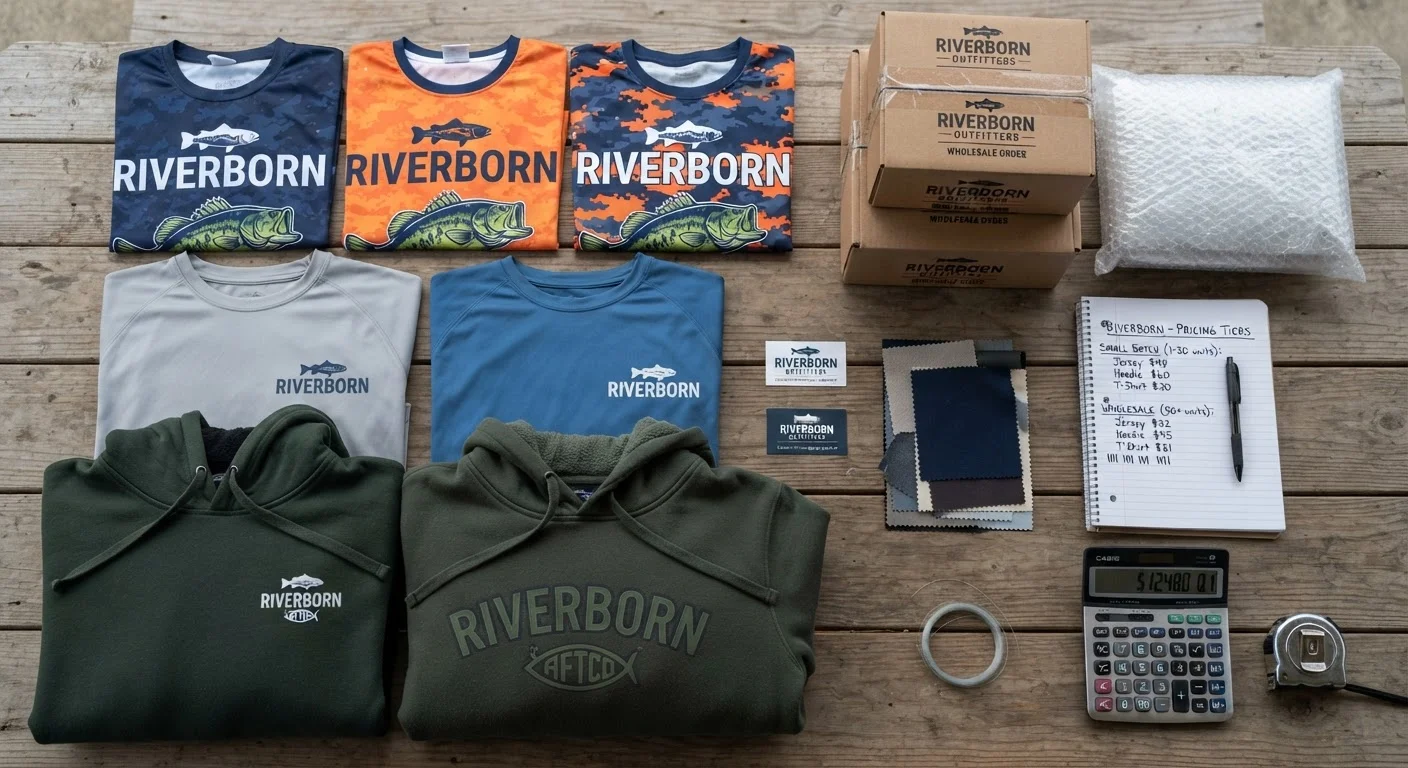
Launching a fishing apparel brand doesn't take a $10,000 minimum order or a warehouse stuffed with unsold hoodies. The 10 manufacturers we covered—from Runfish's sublimation work to Healong's moisture-wicking fabric tech—show that MOQs under 50 units are the new normal in 2026. This isn't a favor factories are doing you.
Your next move: pull up that 9-point checklist, pick 2-3 factories that fit your budget and fabric needs, and send identical inquiries to each one. Compare their sample turnaround, deposit terms, and how fast they reply (response speed alone tells you everything about working with them long-term).
The fishing apparel market won't wait for perfect conditions. Pick a low MOQ custom fishing apparel manufacturer , order samples this week, and get your first design into anglers' hands before your competitors finish "researching."