The average gap between a factory’s initial quote and the final invoice is 20-30%. It comes from hidden fees you were never told about upfront.
I’ve spent years auditing apparel factory contracts, and I see the same pattern every time. A brand gets a clean-looking quote, signs the deal, then gets blindsided by sample development fees, MOQ fishing clothing manufacturer penalties, tooling charges, or a customs bill that shows up weeks after the shipment leaves port.
The insider checklist I wish every buyer had before their first PO includes seven hidden costs, real price ranges, and the exact scripts to use when you call your factory and ask, “Why wasn’t this on the quote?”
Hidden Cost 1 – Sample Development & Prototyping Fees
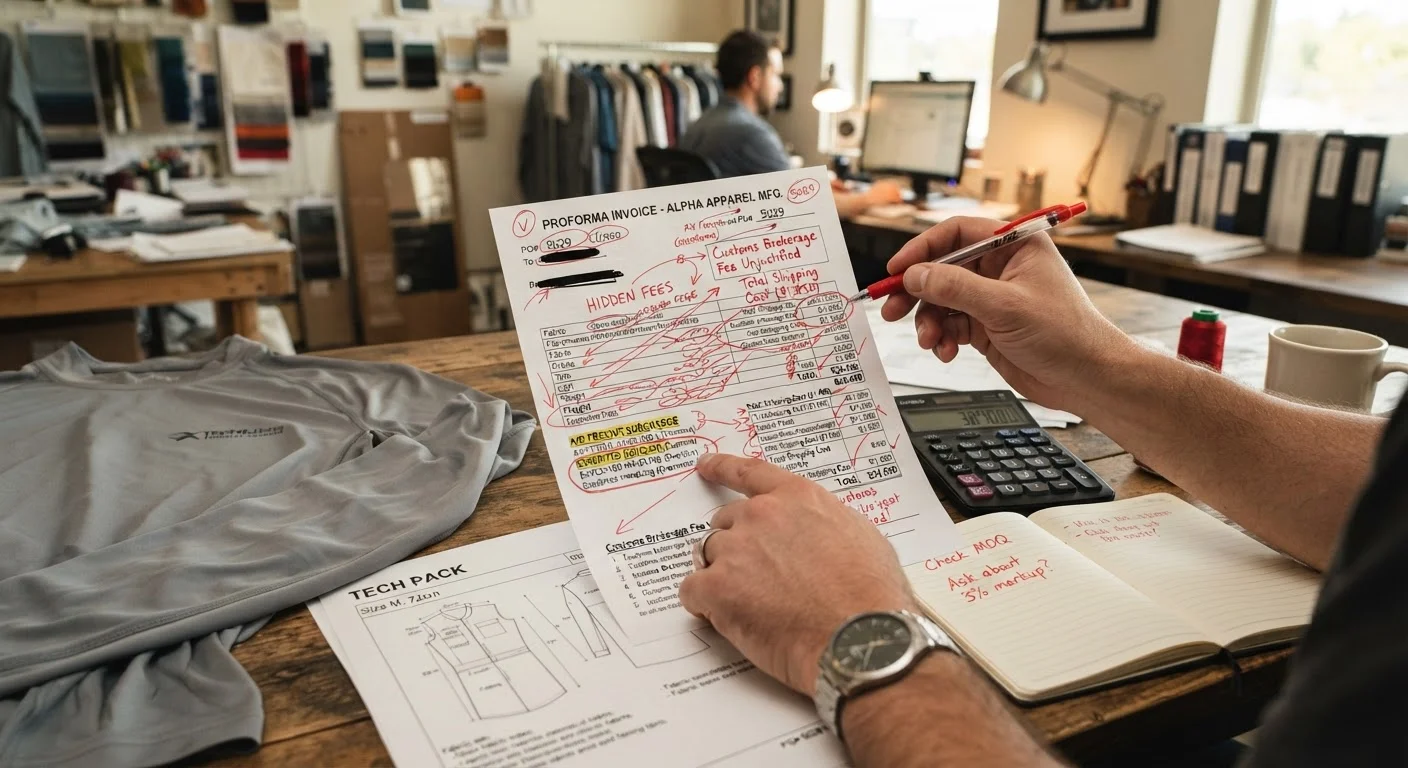
Factories treat sample fees as a profit center.
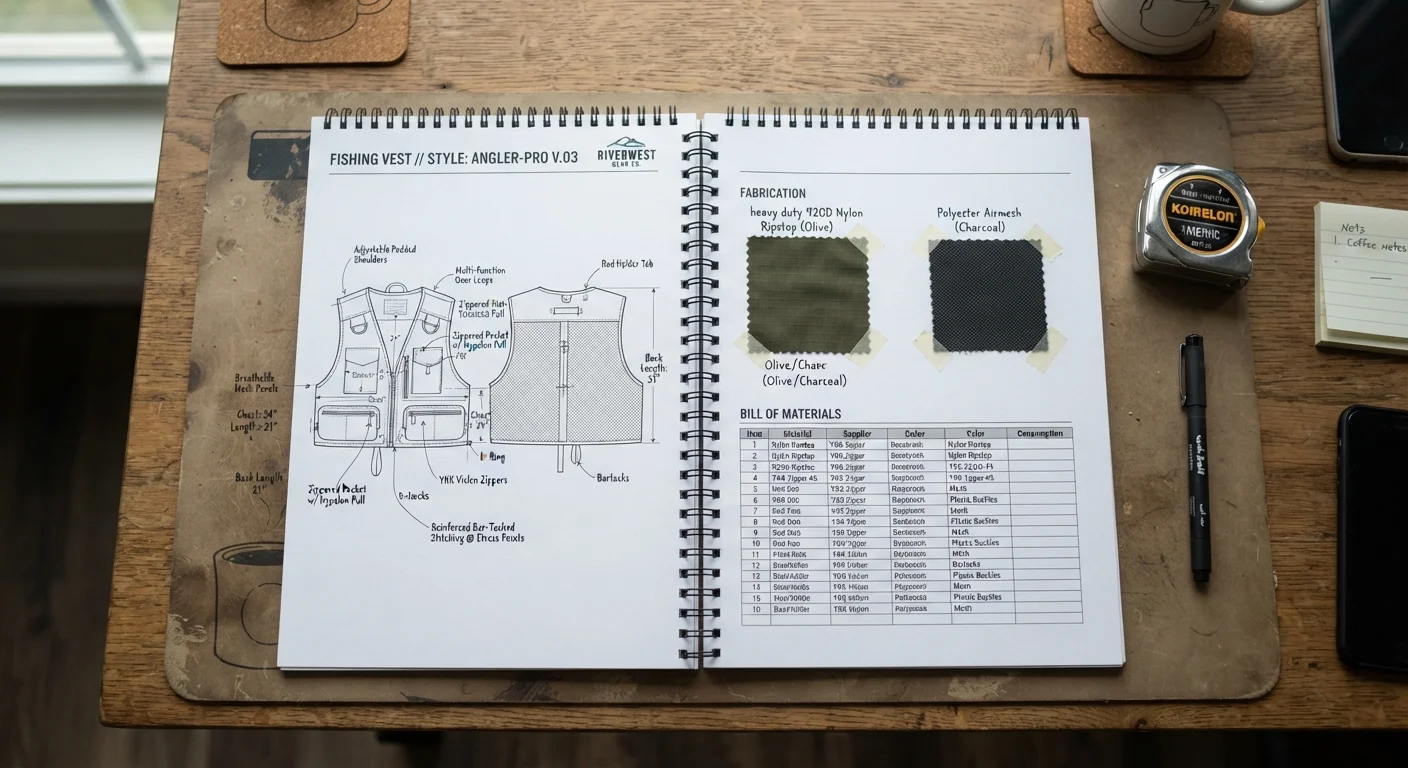
Ask a fishing apparel factory for a quote and you get a clean per-unit price. But managers quietly bill a sample development fee on top of it. For a basic fishing shirt sample, expect $50–$300 per round in Asia. Complex tech gear, like UPF-rated jackets with sealed seams, can run $600–$1,500 per sample .
That’s just the physical sample. Add a tech pack ($400–$2,000) and pattern making ($200–$1,000), and you’re already looking at $1,000+ before a single unit ships.
One sample round is never enough. Most fishing apparel styles need 2–4 rounds before approval. At $200–$1,500 per round, that’s $800–$3,200 hidden cost per style . For a 30-style collection, you’re quietly absorbing $45,000–$150,000 in sampling alone, before production even starts.
Factories also skip mentioning courier fees for sample shipments (~$50 each way, often excluded from the quoted fee) and rarely disclose that sample costs are only refunded if you hit MOQ fishing clothing manufacturer thresholds, typically 500+ or 1,000+ units per style.
Script to send your factory today:
“Can you confirm the total number of sample rounds included in this quote, and what the fee is per additional round? Also, will sample fees be credited against my bulk order, and at what MOQ does that credit apply?”
Get this in writing before you approve a single prototype.
customfishingwear.com
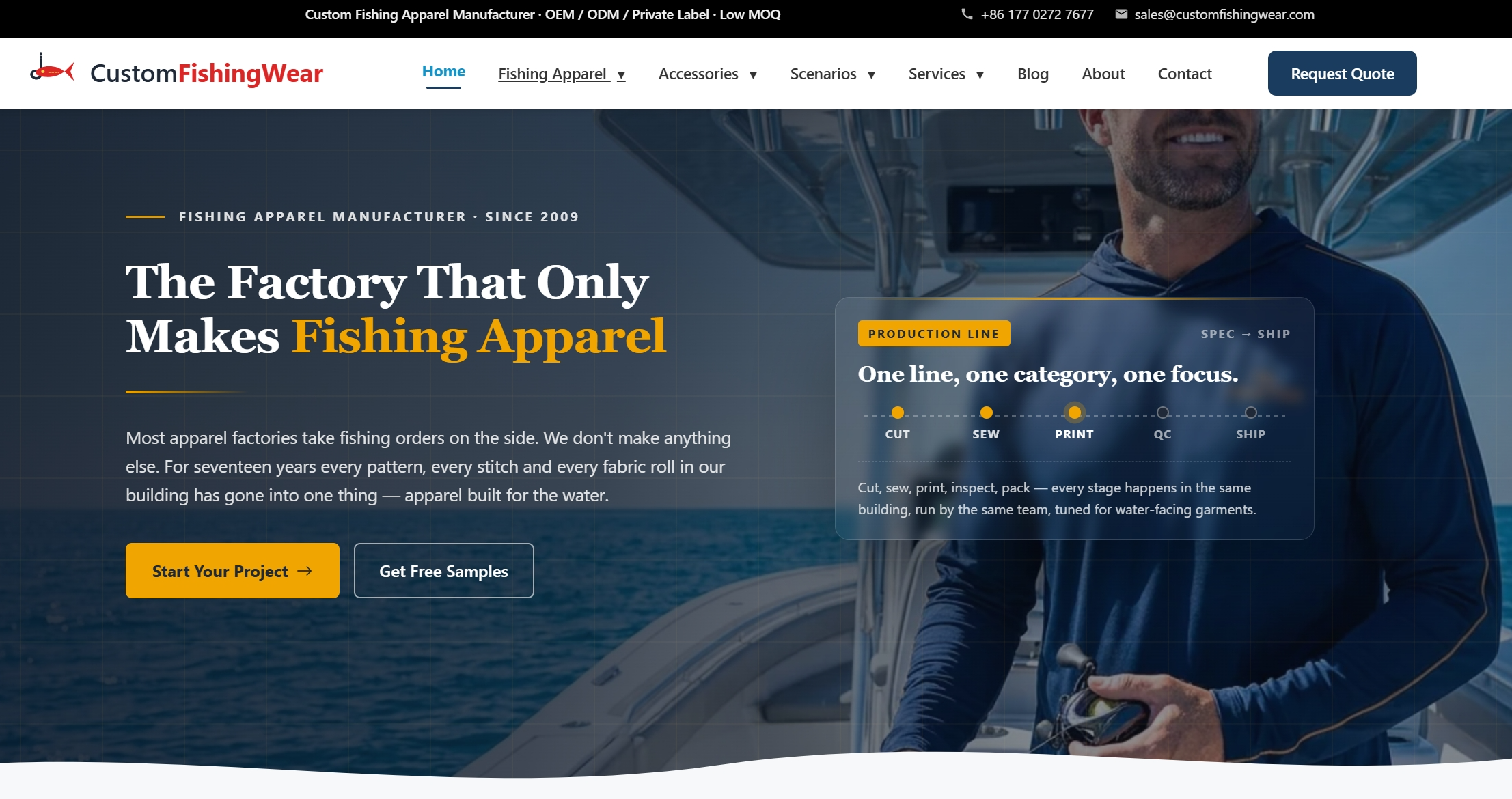
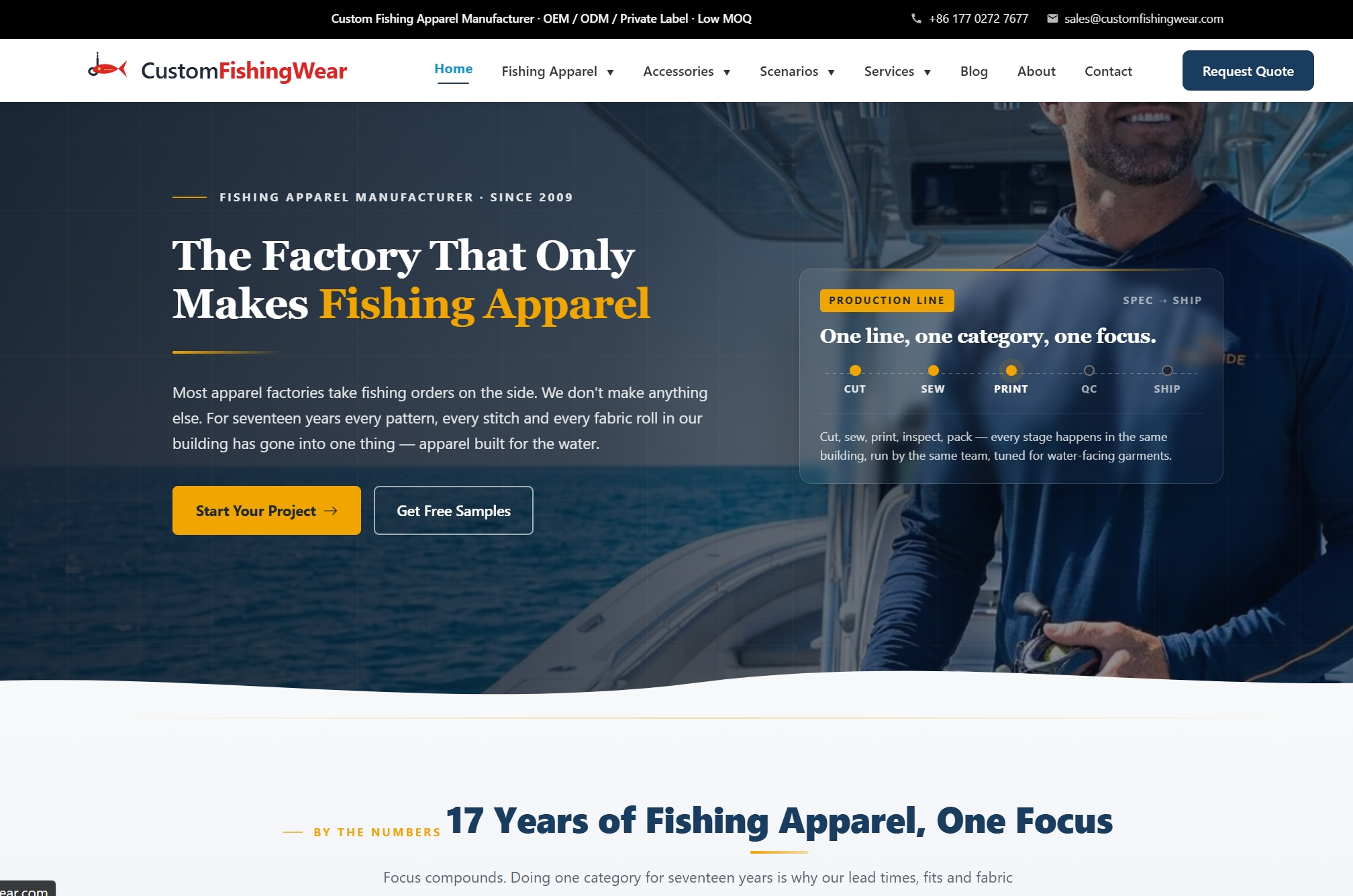
Real numbers beat theory. customfishingwear.com , a China-based OEM/ODM Custom Fishing Apparel factory running since 2009, gives you a benchmark to test the hidden-cost claims above.
This factory only makes fishing apparel: sublimated jerseys, performance shirts, hoodies, shorts, and accessories like gaiters and gloves. That specialization matters. Niche factories tend to have tighter cost structures than generalist sportswear plants, so their pricing is a useful reference point.
Low MOQ fishing clothing manufacturer benchmarks here run 20–50 pcs per design for sublimated jerseys, lower than the 500–1,000 unit thresholds some factories quote. Bulk brand orders sit at 100–300 pcs per color/design . If your current quote demands 500+ units to unlock sample-fee credits, you're paying a premium for a threshold this factory doesn't require.
FOB pricing benchmarks also show what real costs look like. A sublimated long-sleeve jersey (150–160 gsm, UPF 30–50+) runs $7–12/pc at 100–500 pcs. A performance hoodie (230–260 gsm) sits at $13–20/pc . Neck gaiters run $0.80–1.50/pc at 500+ pcs. Use these as your sanity check against any quote that seems inflated.
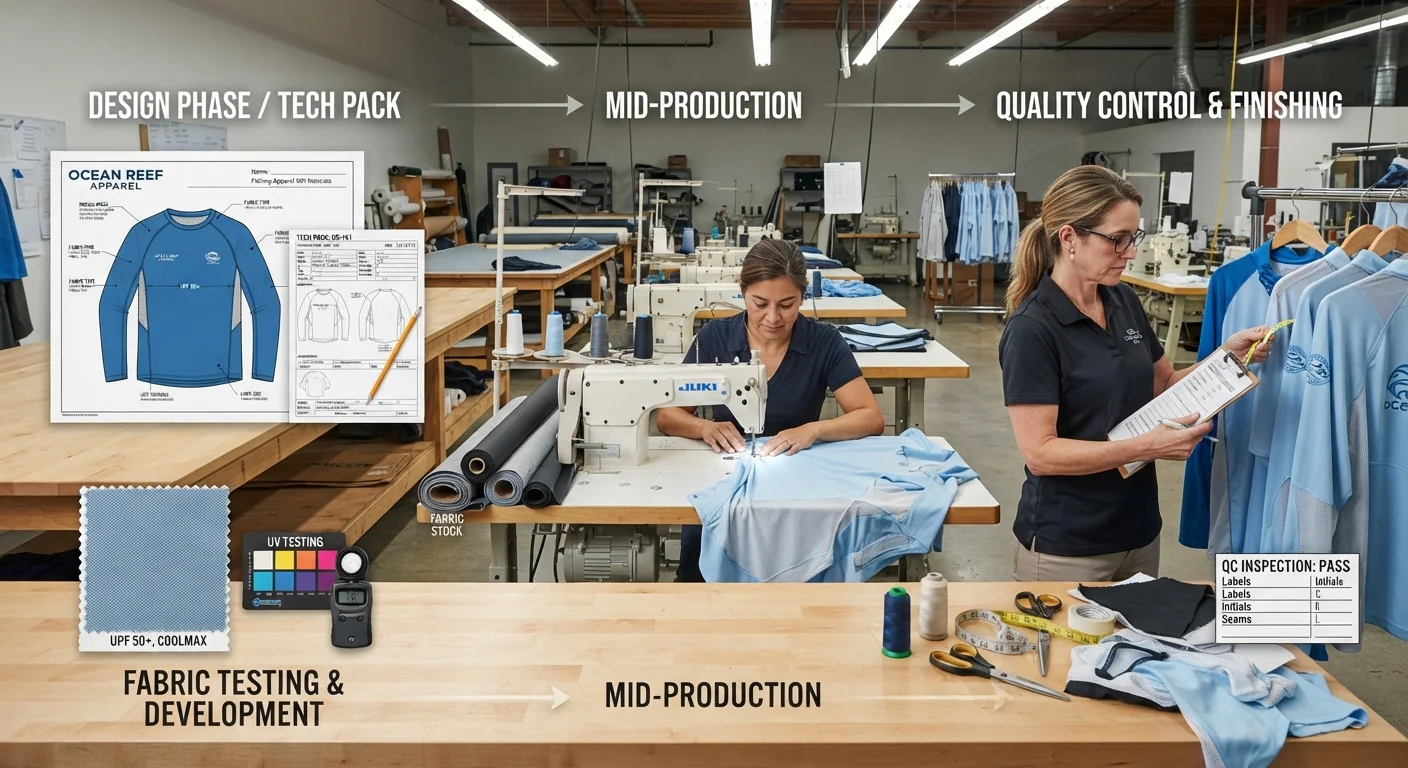
On quality control inspection garment factory practices, expect inline inspection plus final AQL checks (AQL 2.5/4.0), color fastness testing, and shrinkage checks. These are standard for factories exporting to EU/US brands.
Lead times: sampling takes 7–14 days , bulk production 20–35 days post-deposit for 200–1,000 pc orders. Shipping runs FOB China port, with small team orders going air express and larger runs by sea freight. Factor this into your shipping and tariff fishing apparel import calculations before committing to a delivery date.
Hidden Cost 3 – Fabric MOQs, Wastage & Color/Lab Dip Fees
You can end up stuck with 500 meters of fabric in a color you'll never sell if you don't watch for MCQ.
Your fishing garment factory quotes a clean MOQ – say 1,000 pieces per style. But the fabric mill has its own separate Minimum Color Quantity (MCQ), typically 200–500 meters per color, with dye lots of 300–400 kg per color. If your 1,000-piece style only needs 100 pieces in navy, you still buy the full 300m dye lot. That's surplus fabric you're paying for and never using.
Low-MOQ orders make it worse. Expect 20–30% higher per-unit pricing, plus a 15–25% premium if you're forced into stockist fabric to dodge MCQ minimums.
Wastage is the second silent killer. Quotes state "3–5% standard wastage." Real audits show 10–15% actual loss from cutting scraps, shade bands, and defects. At $3/m fabric and 1.5m marker consumption, that gap moves your cost from $4.50 to $5.18 per garment. That's a $0.68 hit nobody flagged.
Lab dips add up fast too. Each color needs 2–3 approval rounds at $15–40/round. Six colors × 3 rounds = $200–500 just approving shades. Third-party testing for UPF fabric testing cost and colorfastness runs $200–600 per style, and certifications like OEKO-TEX tack on 15–25% more on base fabric.
Script to send your factory:
"Please confirm your MCQ per color separately from garment MOQ, state your wastage % in writing, and itemize lab dip fees per round. I need this before approving any color."
Hidden Cost 4 – Compliance Testing, Certification & Quality Control Fees
Nobody puts "compliance testing" on the first quote sheet. It shows up later, buried in a follow-up email, and by then you've already paid a deposit.
Compliance testing and certification for fishing apparel adds 5–15% of order value once you count initial testing plus annual renewals. Third-party pre-shipment and in-process quality control inspection at the garment factory runs $600–$800 per man-day in most Asian manufacturing hubs, including local travel. That's separate from the fabric-level UPF and colorfastness testing covered earlier. This round covers finished-goods AQL sampling (AQL 2.5/4.0), seam strength checks, zipper pull tests, and functional testing for UV-blocking claims on the actual garment, not just the fabric swatch.
If you want OEKO-TEX or bluesign certification to back up your marketing claims, expect 15–25% added onto base fabric cost , plus annual renewal fees most factories never mention until year two. Skip certification, and a retailer audit can reject your entire shipment mid-container.
Add it all up. Compliance testing, inspection, and certification push your shipping and tariff fishing apparel import budget and total landed cost 18–35% over the original ex-factory quote . That's the gap most brands discover only after the invoice lands.
Any legit private label fishing apparel supplier should hand you an inspection report and testing certificate without you asking twice.
Script to send your factory:
"Please itemize your pre-shipment inspection fee per man-day, confirm which AQL level you test against, and send your current OEKO-TEX or bluesign certificate with expiration date. I need this documented before final payment."
Hidden Cost 5 – Logistics, Duties, Port & Broker Fees (2026 Tariff Update)
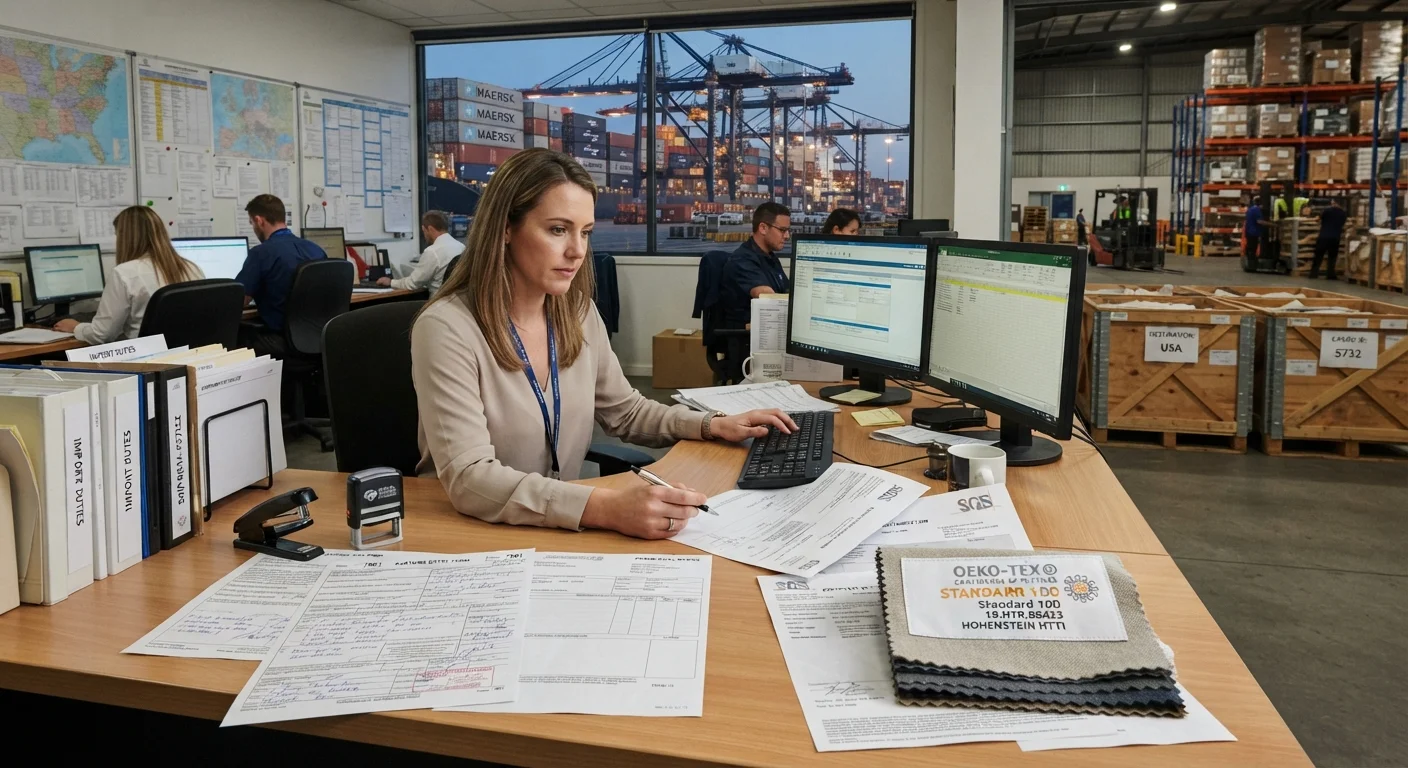
Your freight quote covers ocean or air transport. It says nothing about the eight to ten line items customs adds after that.
Broker fees alone run $150–400 per entry for standard imports, jumping to $250–400+ when you've got multiple HS codes or PGA involvement (FDA, USDA checks on certain fabric treatments). Add ISF filing ($35–55), ABI transmission ($20–40), and a single-entry bond ($45–95). None of these show up on your original freight quote.
Then come the statutory fees nobody explains upfront. Merchandise Processing Fee (MPF) runs 0.3464% of customs value, capped at $651.50. Harbor Maintenance Fee (HMF) adds another 0.125% on ocean shipments only. On a $100,000 shipment, that's roughly $471 combined before any duty.
Port charges compound this. Demurrage hits $30–120 per container per day once free days expire. Terminal surcharges (THC, wharfage) add $200–500+ per container. Miss a document deadline, and correction fees run $100–300 each.
For 2026, Section 232 tariffs now apply 50% on steel/aluminum components (think grommets, zippers, buckles on fishing gear) and 25% on derivative products. Section 122's emergency 10% surcharge applies through July 2026 on covered categories.
Run the math on a $100,000 shipment. Base duty, MPF, HMF, and standard port fees add roughly $1,196. Add a Section 232-affected component, and you're staring at $51,000+ in hidden costs, mostly from tariff surcharges, not freight.
Script to send your factory or forwarder:
"Please provide a full landed cost breakdown including MPF, HMF, broker fees, bond costs, and confirm whether any components fall under Section 232 or 122 tariff categories for 2026."
Hidden Cost 6 – Custom Packaging, Labeling & Branding Fees
Packaging feels like an afterthought until the invoice proves otherwise. Most private label fishing apparel supplier quotes only cover the garment. Everything wrapping around it — boxes, hang tags, poly bags, barcodes — gets billed separately, and it quietly adds 2–5% of your total order value.
Start with tooling. Custom die-cut boxes need $100–$500 in die creation fees. Printing plates for your logo run $150–$600, sometimes $200–$800 if you're using flexo or offset presses. Want a proof before mass production? That's another $30–$180 per sample.
Finishes cost extra too. Soft-touch matte lamination adds $0.25/unit plus a $120 plate fee. Cold foil with embossing runs $0.48/unit and a $260 foil plate. Spot UV on a branded window adds $0.32/unit and a $95 polymer plate. These numbers stack fast across a full collection.
Labeling has its own price ladder. Round stickers cost $0.12–$0.25/unit at 250 pieces, dropping to $0.04–$0.08 at 2,500. Need Amazon FBA barcodes applied? That's $0.55/unit. Selling in Canada? Bilingual packaging adds 15–30% on top.
Rush timelines hurt most. Miss your production window and expect a 25–50% surcharge. Overorder packaging and storage runs $0.50–$2.00 per sq ft monthly. Underorder, and MOQ shortfall fees hit $100–$300.
Script to send your packaging supplier:
"Please confirm whether dies, plates, proofs, and samples are included or billed separately. I also need your rush fee percentage and any MOQ surcharge in writing before I approve artwork."
Hidden Cost 7 – Lead Time Delays, Rush Fees & Cash Flow Impact
Every extra week on your production schedule quietly drains your bank account. Nobody hands you an invoice for this cost. It shows up as cash you can't touch, sitting in inventory that hasn't sold yet.
Here's the math your factory never walks you through. Cash Tied Up = (Lead Time in Days ÷ 365) × Annual COGS. If your annual COGS is $5M and your lead time runs 90 days, you've got $1,232,877 locked up in product that isn't generating revenue. For a smaller brand doing $1M in COGS with a 60-day lead time, that's still $164,384 frozen in inventory.
Then add carrying costs. Warehouse space, insurance, obsolescence risk — that tied-up cash carries a 20-30% annual cost. On $1,232,877 locked up, you're paying $246,575 to $369,863 per year just to hold product you already paid for.
Rush fees make this worse. Compress a standard 5-7 day lead time into 2-3 days, and expect a median rush premium of 35% , sometimes spiking to 100% above base cost. Manufacturing tiers get steeper: cut lead time by 25% and pay 30% more ; cut it by 75% and you're staring at a 120% premium .
Late deliveries cost you customers too. 50% of clients switch suppliers after getting burned by delays. That's lost revenue on top of lost cash flow.
Script to send your factory:
"Please confirm your standard lead time in writing, your rush fee structure by percentage reduction, and any penalty clause if delivery runs more than 10 days late."
Conclusion
That “competitive” quote you got is missing 20-30% of your real costs. Sample fees, mold charges, fabric wastage, compliance testing, tariffs, packaging, and rush fees don’t disappear just because they weren’t itemized. They show up later, usually right when your cash flow can least absorb them.
The brands that scale in 2026 aren’t the ones who found the cheapest MOQ fishing clothing manufacturer. They’re the ones who asked the right questions before signing—using the exact negotiation scripts in this guide to force transparency on every line item.
Pull out your current quote, run it against all 7 cost categories above, and email your factory (or your shortlisted private label fishing apparel supplier) the questions we gave you. Do this before your next PO, not after. That’s the difference between a predictable launch budget and scrambling to cover surprise invoices three months in.