You've got a supplier quote sitting in your inbox, and something feels off. Maybe it's the 300-piece MOQ for what you thought was a simple logo swap. Or that fabric weight listed as "premium blend" with zero GSM number attached. Sound familiar? Most first-time buyers sourcing a moisture wicking fishing shirt or trying to nail down UPF fishing base layer specs get burned right here, at the quoting stage, before a single sample ships.
This is the breakdown a Customize fishing base layer factory floor manager would walk you through before you wire a deposit. Real GSM tables for tropical versus cold-water fisheries. The actual fit-tolerance issues that cause return headaches. MOQ tiers that shift depending on whether you're doing solid colors or full sublimation. And where your money really goes in that per-unit cost. By the end, you'll know exactly what to ask before you send that next inquiry.
Fishing Base Layer Fabric Weight: Which GSM Works Best for Your Fishery?
Grams per square meter. That's what GSM means, and it's the single number that determines whether your custom fishing gear keeps anglers dry or leaves them soaked and shivering. Get this wrong, and you'll eat a 15-20% return rate on your first production run. Get it right, and you've got a repeat customer who tells three friends.
Most fishing base layers fall into three practical weight classes. Nobody needs seven categories with fancy names. You need to know which bucket your target fishery falls into, then order accordingly.
The Working GSM Table
130–150 gsm (Ultralight) — Tropical and warm-water fishing. Flats wading, summer river spinning, aggressive shoreline casting where anglers are moving nonstop. This is your go-to for a moisture wicking fishing shirt that needs to breathe hard and dry fast between casts.
170–200 gsm (Lightweight/Sweet Spot) — The year-round default. If a client asks for one fabric that "does everything," this is it. Works for mild-to-cool conditions, mixed-season fisheries, and multi-species anglers who don't want three different shirts in their bag.
200–260 gsm (Midweight) — Boat fishing, drift fishing, anything with stop-and-start movement in cold conditions. This is where a polyester spandex blend fishing shirt starts earning its keep, with enough warmth retention without turning into a sweat trap.
260–320+ gsm (Heavyweight) — Reserved for static, extreme-cold scenarios. Ice fishing. Sitting in a blind for six hours. Anchored boats in sub-20°F water. If your buyer's target market is mostly stationary anglers in brutal cold, this is the only weight that makes sense.
Why Guessing Costs You Money
I've seen buyers order 300gsm because "heavier sounds better," then get flooded with complaints from summer flats customers who overheated in ten minutes. I've also seen the opposite: a 150gsm order shipped to a cold-water fishing brand, and their customers froze on day one.
Simple math solves this. Start with air temperature. Above 60°F, stay in the 120-170gsm range. Below 20°F, you're in 260-320+ territory. Adjust for activity level. High-movement fishing (wading, constant casting) shifts you 10-20gsm lighter than the temperature baseline suggests. Static fishing shifts you 20-50gsm heavier. Factor exposure time. Long sessions in wind or spray push you toward the upper end of whatever band you land in.
A late-fall river angler at 45°F who's walking all day lands around 180-190gsm. A midwinter ice fisherman sitting still at 15°F needs 300-400gsm, full stop.
When you're sourcing from a fishing performance wear supplier, don't accept "premium blend" as a fabric description. Ask for the exact GSM number and the intended use case. Any OEM fishing clothing factory worth working with will hand you a spec sheet without hesitation. If they hedge on the number, that's your first red flag before you've even talked MOQ.
Fit and Pattern Customization: Athletic, Regular, or Compression?
A size L t-shirt from three different factories can fit three completely different ways. Same label, same numbers on the tag, wildly different silhouette. Fit is about pattern ease, and you have to make that decision before the factory cuts a sample.
Three core fit types exist in performance apparel. Pick the wrong one for your target angler, and return rates eat your margin.
Regular Fit: The Safe Default
Regular fit uses positive ease. The pattern runs bigger than the body. Chest gets +6-10cm over body circumference. Waist and hip get +4-8cm . Straight side seams, generous armholes, no waist taper.
This is the lowest-risk option. Production complexity is low, cost premium sits at 0% against baseline, and return risk stays low because the fit forgives body-type variation. Start with regular fit if you're building custom logo fishing shirts for a promotional line or a bait shop giveaway.
Athletic Fit: Tapered, But Not Tight
Athletic fit still uses positive ease, less of it. Chest ease drops to +3-7cm . The waist tapers aggressively against the chest measurement, creating the V-shape silhouette anglers associate with performance gear. Sleeve width stays uniform, so buyers with larger biceps sometimes complain about tightness.
Expect a 15-20% cost premium over regular fit, plus medium-to-high return risk since body-type mismatches cause more sizing complaints. Good for fitness-adjacent fishing brands targeting a younger, gym-to-water crowd.
Compression Fit: Second-Skin Performance
Compression uses negative ease. The pattern runs smaller than the body, and stretch fabric closes the gap. Pattern measurement equals body measurement times (1 minus compression percentage). A 100cm hip with 15% compression cuts to an 85cm pattern.
This works only with quick dry fishing fabric that stretches beyond the compression rate. A 15% compression garment needs fabric with 25-35% minimum stretch . Otherwise it feels restrictive without functional benefit. Quality checks matter. Fabric pinch at mid-thigh should not exceed 2-3mm of loose material, and seams need to sit symmetrically.
Cost runs 25-40% higher than regular fit, with the highest return risk of the three. For cold-water anglers wanting warmth without bulk, or anyone wanting compression fit fishing gear for long boat sessions, that premium buys real function.
Fit Type | Cost Premium | Return Risk |
|---|---|---|
Regular | 0% | Low |
Athletic | +15-20% | Medium-High |
Compression | +25-40% | High |
MOQ Demystified: Real Minimums for Custom Fishing Apparel
Ask five factories for their MOQ and you'll get five different answers. That's not a scam. The minimum order quantity is a sliding scale tied to how much you're asking the factory to customize. Understanding that scale determines whether you negotiate from strength or get quoted whatever number a sales rep pulls out of thin air.
The MOQ Ladder, Rung by Rung
Here's the breakdown across real fishing apparel suppliers:
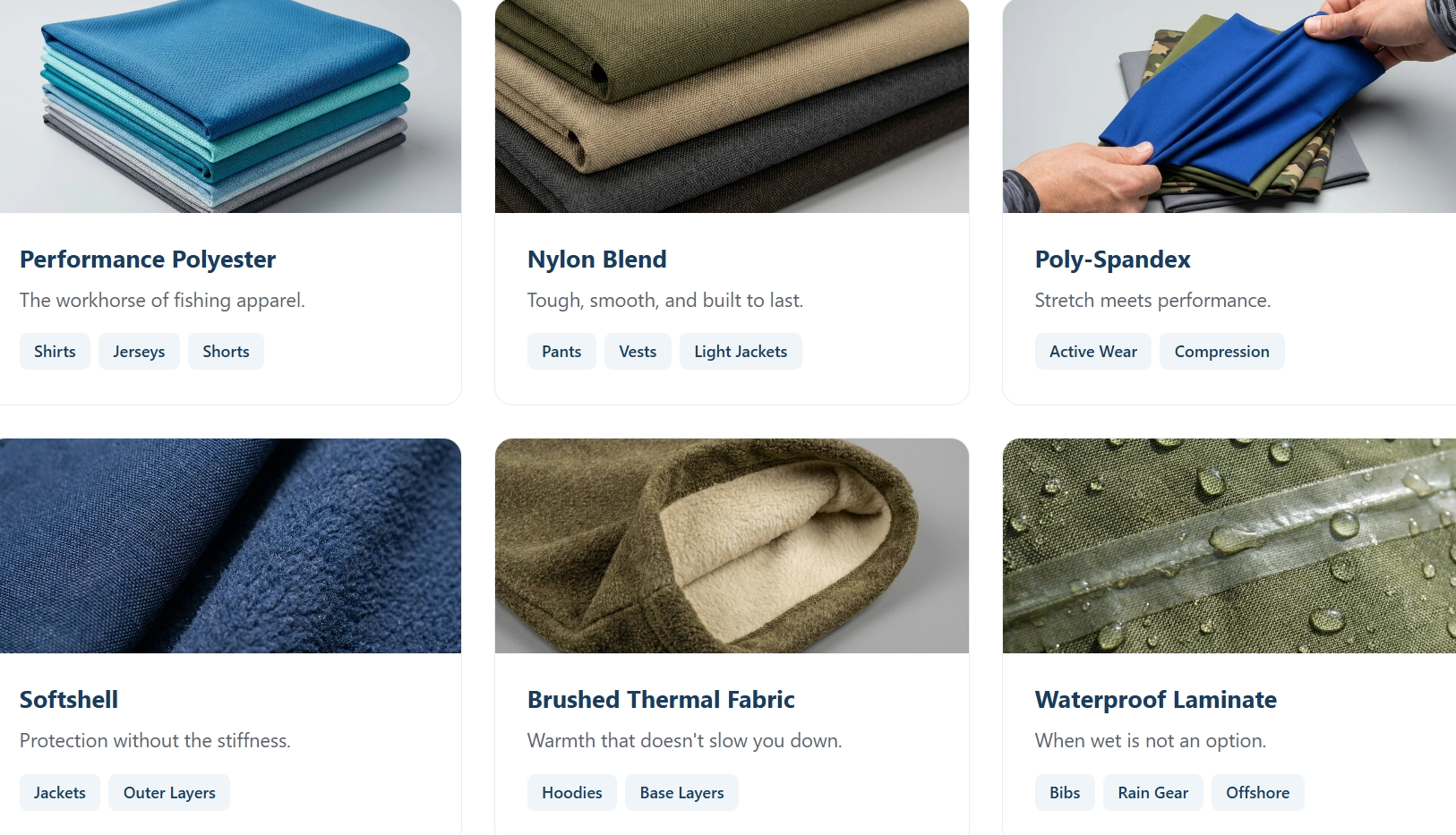
Ultra-low (10-50 pcs per design) — Rise Sportswear runs a 10-piece MOQ on existing patterns, no MOQ at all on reorders. Runfish and Weft both start at 50 pieces per style per color. This tier works if you accept standard fabric and an existing cut, just swapping your logo on.
Standard low (50-150 pcs) — Most fishing apparel private label programs land here. Domy Beach's ready-made and semi-custom lines both sit at 100 pieces per style. This is your realistic floor for a custom logo fishing shirt with minor color changes.
Medium (150-300 pcs) — Full custom patterns of fishing base layer, new pockets, new panel construction. Domy Beach quotes 100-150 pieces for full custom, jumping to 200-300 for full ODM work involving new materials.
High (300-500+ pcs) — Custom technical fabric, special coatings, proprietary laminations. Fabric roll minimums drive this, not the factory being difficult.
Sublimation Printing Changes the Math
Sublimation printing fishing shirt orders carry their own pressure. The print film and setup cost make sense only above a certain volume. Domy Beach calls 150-200 pieces their "practical minimum" for custom sublimation, even though some factories will accept 50-100 pieces per design. Below that threshold, expect your per-unit price to jump noticeably to cover setup amortization.
One Rule That Trips Up First-Timers
MOQ is set per design, per colorway. A 100-piece minimum means 100 units of one design in one color, not 100 units split across three colors you liked. Size mixing is fine within that number, S through XXL. Colors and designs are not.
Production Cost Breakdown: From Fabric to Finished Shirt
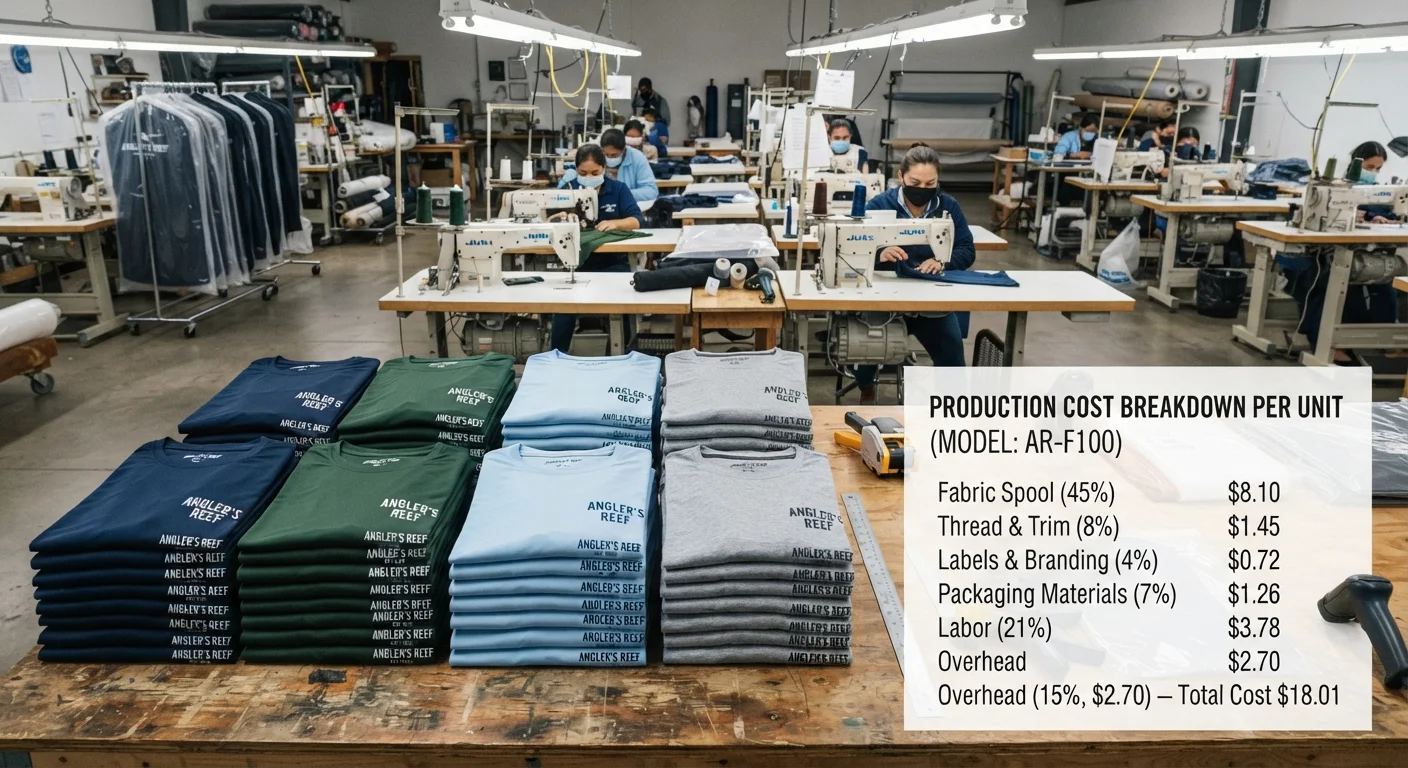
A breakdown of where every dollar goes. Fabric eats the biggest slice, but it's not the only line item padding your invoice.
Fabric: Your Biggest Line Item
For a technical polyester spandex blend fishing shirt, fabric consumption runs 0.20–0.30 kg per piece , depending on cut and size range. Performance fabric with moisture-wicking and UPF treatment prices out higher than basic cotton jersey, typically $6–$10/kg versus $4–6/kg for plain knit.
Do the math: 0.25kg × $8/kg lands you at $2.00 per fishing shirt in raw fabric alone. That's before trims, printing, or a single stitch.
Fabric makes up 40–50% of total manufacturing cost on technical apparel. If your quote shows fabric under 30% of the total, ask why. Something's either underpriced upstream or overpriced somewhere else in the chain.
Where the Rest of the Money Goes
CMT (Cut, Make, Trim): $1.20–$2.50 per shirt. Compression fit and athletic patterns push this toward the top of the range — more seams, tighter tolerances, slower machine speed.
Trims: $0.30–$0.60 per piece. Woven size/care labels, thread, elastic binding for cuffs and hem.
Sublimation printing: $1.50–$4.00 per shirt for full all-over prints. Full coverage designs with 6+ colors sit at the top of that band. A basic chest logo runs closer to $0.80–$1.50.
Packaging: $0.20–$0.50 per unit. Polybag plus hangtag is standard. Some private label programs request individual boxes, which adds another $0.15–$0.30.
Overhead: $0.50–$1.00 per shirt, covering factory utilities, admin, and QC labor allocation.
A Working Cost Table
Component | Cost Range (per unit) |
|---|---|
Fabric | $2.00–$3.50 |
CMT | $1.20–$2.50 |
Trims | $0.30–$0.60 |
Sublimation print | $0.80–$4.00 |
Packaging | $0.20–$0.50 |
Overhead | $0.50–$1.00 |
Total FOB (factory quote) | $5.00–$12.10 |
That range is wide because it has to be. A solid-color moisture wicking fishing shirt with a single embroidered logo lands near the bottom. A full-sublimation, custom-pattern piece from an OEM fishing clothing factory lands near the top.
Don't Forget Landed Cost
FOB isn't your real number. Add freight, and add import duty — commonly 15–20% depending on origin and destination. A $6 FOB fishing shirt can land at $8.50–$9.50 once it clears customs. A fishing performance wear supplier quoting you FOB without mentioning duty exposure isn't giving you the full picture. Ask for landed cost estimates upfront, not after the container's already on the water.
Conclusion
A 150gsm moisture wicking fishing shirt built for tropical flats will fail on a cold-water charter. A compression fit that reads great on paper can run a full size off if you skip the tolerance sheet. The difference between a base layer that performs and one that gets returned comes down to three things: nailing the GSM for your water conditions, locking in a fit spec the factory can replicate at scale, and knowing your cost breakdown before the first sample ships.
You now have a real framework for vetting an OEM fishing clothing factory instead of guessing. Before you send that first inquiry, pull together your GSM range, target MOQ, and fit specs. Then ask for a tiered quote in writing. That single move separates brands that launch on schedule from ones stuck in a three-month sampling loop.