Launching a fishing vest under your own brand sounds simple — until you're stuck comparing MOQs, fabric grades, and vague supplier quotes that don't add up. Get the fishing vest features wrong, and you'll end up with a product that looks fine on paper but fails on the water: pockets that tear, "Waterproof" coatings that leak, or a per-unit cost that kills your margins before you've sold a single unit.
This guide breaks down what separates a well-engineered custom fishing vest from a generic one. It covers the fabric types that hold up to saltwater and sun exposure, the pocket configurations anglers really use, and the cost factors that tell you whether your quote is fair or inflated. Whether you're vetting your first OEM fishing vest manufacturer or scaling a bulk order, you'll know what questions to ask and what red flags to avoid before you commit to production.
Custom Fishing Vest Customized development core process: From requirement definition to mass production
Five stages stand between a sketch on your desk and a container of finished vests. Skip one, and you'll pay for it later: usually as a re-run, a missed launch date, or a shipment that doesn't match what you approved.
1. Define the Scenario and Requirements
A serious OEM fishing vest manufacturer starts by asking what mix of use cases your order covers: fly fishing, saltwater, kayak, ice fishing. That split (a common pattern is roughly 40% fly / 30% saltwater / 20% kayak / 10% ice) drives every fabric and pocket decision downstream. First-year volumes usually land between 1,000–5,000 units, and target FOB pricing runs USD 18–45/piece, climbing past USD 60 for insulated ice-fishing or heavy saltwater builds. This stage should produce a draft Spec Sheet: sizing (S–3XL), functional checklist, target volume, target price.
2. Lock the Spec
Fabric weight is fixed by scenario: 120–160 g/m² for fly fishing, 180–220 g/m² for saltwater, 200–260 g/m² shells with 80–160 g/m² insulation for ice fishing. Waterproof rating (5,000–10,000mm hydrostatic pressure, AATCC 22 or ISO 4920) and hardware pull strength (>40kg) go into a full Tech Pack and BOM.
3. Sampling and PPS
Plan for 1–3 rounds: first proto for fit, second for pocket layout, third (PPS) to lock the line. Each round runs 7–15 days, up to 20 for complex ice-fishing styles. Ask for lab dips and fabric test reports before sampling begins, because it prevents a wasted round.
4. Quotation and MOQ Confirmation
Garment MOQs typically run 200–500 pieces/color. Fabric MOQs (1,000–3,000 meters/color) matter more — fall short and expect a 3–10% surcharge or a 1–3 week delay. A clean quote breaks out fabric, trims, zippers, labor, and packaging line by line, with tiered pricing at 200/500/1,000 units.
5. Pilot Run and Bulk Production
A 30–100 piece pilot run catches defects before scale-up, targeting under 3–5% defect rate. Bulk runs 45–75 days from PPS sign-off and are checked against AQL 2.5–4.0 inspection standards.
Custom Fishing Vest Key Function Design: Pocket System and Practical Configuration
Pocket count is an engineering decision tied to how anglers move. Get the layout wrong and you'll hear about it in returns, not reviews.
Pocket Count by Fishing Type
Fly fishing vests need 12–22 pockets across chest, torso, and back, with pro-grade builds like the Orvis PRO hitting 18. Multi-species and lure fishing vests typically run 18–20 pockets, with 75–80% zippered for security on the water.
A working breakdown for custom specs:
Fly fishing (stream/river): 15–20 pockets, 40–50% concentrated on the upper chest for fast access
Lure/shore or boat fishing: 12–18 pockets, with larger horizontal lower pockets sized for lure boxes
Casual/recreational fishing vests: 6–11 pockets, focused on side zip pockets plus 1–2 chest pockets
The access-time benchmark for good design: every high-use pocket should allow single-hand retrieval in under 10 seconds. That's tested by opening angle and hand-reach ergonomics based on casting posture.
Reference builds worth studying include the Bassdash vest, which runs 20 pockets (15 zippered) with a dual drop-down worktable pocket and a back mesh pouch for hydration bladders. The Guts vest uses 18 pockets (14 zippered), separating fly boxes from thermometers and other gear by zone.
Hardware: D-Rings, Tool Loops, Fly Patches
A standard configuration uses 3–5 D-rings—one large one on the back for a net, 2–4 smaller ones on the chest for clippers and line cutters. Material matters more than most buyers realize. Stainless steel or aluminum alloy is standard, and it should pass ≥48 hours salt spray for mid-tier product, ≥72 hours for saltwater-grade builds. Zippers and hardware should also survive ≥5,000 open-close cycles without failure—this is where cheap OEM fishing vest suppliers cut corners.
Tool loop systems typically include one hemostat docking station up front, 2–4 rod holder loops, and MOLLE webbing gear-lash points running 12–20 cm. Webbing itself should hit ≥8–10 kN breaking strength—borrowed from backpack hardware standards, but it applies here too.
Fly patches are simple but often overlooked in spec sheets. They use hook-and-loop backing inside the front worktable pockets, holding 1–2 removable EVA foam patches at 6–10mm thickness—thick enough to hold hooks securely without bulking up the pocket.
Ergonomics and Weight Distribution
A vest loaded with pockets is useless if it restricts casting motion. Adjustable shoulder straps and waist belts should cover a 100–151 cm waist range and 49–56 cm torso length adjustment—that's the range that lets one design fit S through 3XL without redesigning the pattern.
Weight matters too. Fully loaded vests should be designed around 3–5 kg of carried gear, distributed bilaterally so one shoulder doesn't take the load. Build this Pocket IQ principle into your spec sheet: 80% of frequently used gear should be reachable without twisting the torso. Less rotation, less fatigue, longer days on the water.
Breathability and UPF Protection
For hot-climate markets, mesh coverage should hit 30–40% of total surface area, concentrated on the back and underarms where heat builds fastest. Lightweight multi-pocket builds push this further—40–50% mesh coverage on the upper back and shoulder straps alone.
UPF rating matters beyond the spec sheet. UPF30 blocks about 97% of UV; UPF50+ blocks 98–99%. For tropical or high-altitude markets, spec the main fabric at UPF50+ minimum, with even the mesh sections holding UPF30+ through tighter weave or coating.
None of these numbers are theoretical—they're the difference between a fishing vest fabric that performs after 50 wash cycles in salt air, and one that doesn't. When you're vetting a custom fishing apparel manufacturer , ask for these figures directly. If they can't produce test data, that's your answer.
Fishing Vest Materials Type selection comparison: Performance analysis of nylon, polyester and composite materials
Fabric choice makes or breaks a fishing vest long before it hits the water. Nylon abrades roughly 10 times better than cotton, and between the two major synthetics, the order holds steady: nylon ≥ polyester ≫ cotton/canvas. That's the baseline every fishing vest fabric decision starts from.
Nylon vs. Polyester vs. Cotton: The Core Trade-offs
Abrasion resistance: Nylon leads, polyester trails close behind, cotton falls well short. If your vest sees rocks, boat rails, or brush, nylon or ripstop nylon earns its spot. Quick-dry performance flips this. Nylon absorbs 4–10% moisture and loses strength when wet. Polyester absorbs under 1% and holds its strength regardless. Odd-shaped-cross-section polyester dries even faster, making it the better call for high-sweat, humid conditions.
UV and heat stability: Nylon softens around 100°C and melts near 210°C. Polyester holds strength up to 150°C and melts around 255°C, so it's better suited to sun exposure and hot-climate wear. Polyester also resists UV degradation more reliably over time. Cost: Nylon runs roughly double the price of comparable polyester. A common strategy builds the vest body in polyester and reinforces high-wear zones, shoulders, tool pockets, chest panels, with nylon.
Nylon Composite Fabric Specs by Denier
For buyers spec'ing waterproof fishing vest material, denier weight tells you what you get:
Denier | Weight | Tear Strength | Waterproof Rating | Moisture Vapor Transfer | Best Use |
|---|---|---|---|---|---|
40D | 60–80 g/m² | ≥15N | 5,000–8,000mm | 5,000–8,000 g/(m²·24h) | Lightweight, breathable builds |
70D | 90–110 g/m² | ≥25N | 8,000–10,000mm | 4,000–6,000 g/(m²·24h) | Durable all-around use |
210D | 150–180 g/m² | ≥40N | 10,000–15,000mm | 2,000–3,000 g/(m²·24h) | Heavy-load, wading-grade vests |
UPF and Climate-Based Fabric Matching
UPF matters as much as waterproofing. Standard export-grade nylon runs UPF 40+ to 50+; polyester carries decent inherent UV resistance on its own. For tropical markets, spec odd-cross-section polyester (80–120 g/m²) as the main body with 70D–210D nylon reinforcement at stress points, target UPF 40+–50+, waterproof rating 3,000–5,000mm. For temperate zones, a nylon-polyester blend at 100–140 g/m², waterproof 5,000–8,000mm, UPF 30+–40+, covers variable weather without overbuilding the fabric.
When you ask a custom fishing apparel manufacturer for specs, these are the numbers that separate a real Tech Pack from a guess.
Custom Fishing Vest Cost Factors:Customized cost composition and quotation breakdown
Every fishing vest production cost breaks down into five buckets, and materials eat the biggest one. Fabric, lining, and mesh together run 40–60% of total cost — higher than most apparel categories because functional vests pack more material per square inch. Hardware and trims (zippers, D-rings, webbing, hook-and-loop) claim another 10–20%, pushing toward the top of that range on multi-pocket builds where hardware density is high. Sewing labor takes 20–30%, sampling and development another 5–10%, packaging 5–8%, and freight plus duties 5–15%.
Here's what that looks like on a real order: a mid-tier fishing vest with 10 pockets and 3 hardware types, quoted at USD 22 FOB, 1,000-unit run. Strip out 15% margin and you land at about USD 19.13 in true fishing vest manufacturing cost. Fabric and trims take around USD 10.52 of that — split roughly 7.09 for main fabric (1.8m at USD 3.8/m) and 1.24 for mesh/lining. Labor lands near USD 4.78, sampling USD 1.34, packaging USD 1.15, logistics USD 1.34.
What Actually Moves Your Unit Price
Three levers matter more than anything else:
Fabric grade — standard polyester runs USD 1.5–2.5/meter. Waterproof coated fabric jumps to USD 3.5–6/meter, adding USD 3–5 per vest, or 15–25% to total price.
Pocket count and hardware complexity — basic 6-pocket builds run labor around USD 2.5/piece. High-configuration vests with 14+ pockets and layered construction push labor to USD 4.5–5.5.
Branding work — embroidery runs USD 0.20–0.50/piece for a simple logo, up to USD 1.20 for multi-color. Screen printing adds USD 0.40–1.50.
MOQ Leverage Nobody Talks About
Bulk fishing vest orders shift pricing fast. Fabric bought by the roll drops 5–15% versus small-batch pricing. A USD 400 sampling fee amortizes to USD 2/piece at 200 units — but just USD 0.20/piece at 2,000 units. Rush orders flip this in reverse, adding 15–30% in labor and management surcharges. Plan your timeline, or pay for skipping the line.
OEM Customization vs. Spot Purchase: A Decision Guide for Custom Fishing Vest Procurement Paths
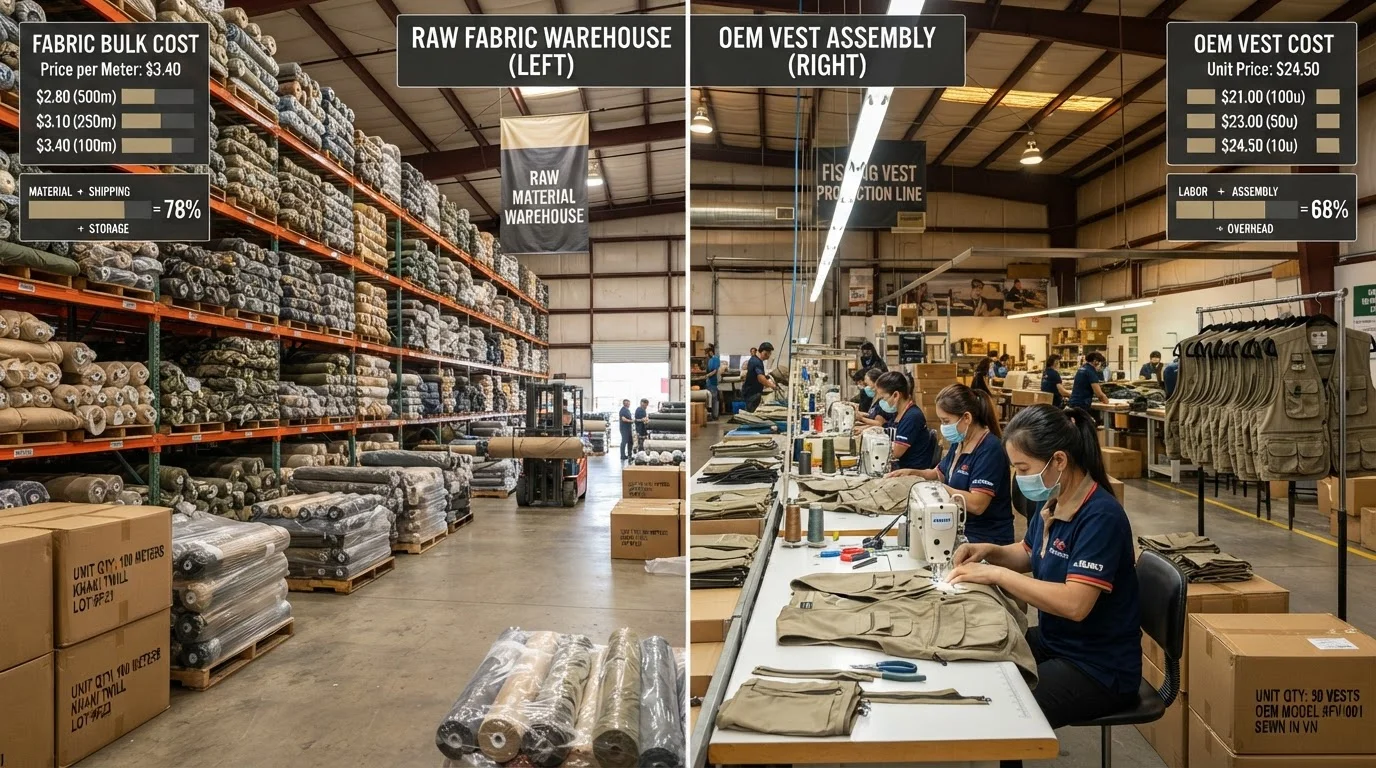
Two sourcing paths lead to very different outcomes. Most buyers pick the wrong one for their stage without realizing it.
Design Freedom: What You Can Actually Change
OEM gives you full control over pocket count and sizing, zipper placement, mesh zones, strap width, and even non-standard features like flotation modules, reflective strips, or MOLLE webbing for radio clips. Fabric and hardware choices—nylon or polyester weight (120–300 g/m²), waterproof rating (5,000–10,000mm), YKK vs SBS zippers—all lock into your spec sheet before production starts.
In-stock/ODM works differently. You customize an existing pattern with color, logo placement, and packaging. Structural changes like moving a pocket or altering the shoulder cut usually require re-tooling and hit a separate MOQ threshold. Fabric choices stay limited to what's already on the factory's shelf.
MOQ and Lead Time: The Real Trade-off
OEM MOQs run 300–1,000 units per color, sometimes 500-plus for multi-pocket functional vests. Lead time stretches 60–90 days: 2–4 weeks for sampling, 2–3 weeks for confirmation, 4–8 weeks for bulk production.
ODM and in-stock flip both those numbers. MOQs drop to 50–200 units per style, with some suppliers taking 20–50 mixed-color orders. Lead time shrinks to 7–30 days, just relabeling or minor rebranding on existing stock.
Which Path Fits Your Brand Stage
Startups (<3,000 units per year, <500 per style): Stick with ODM. Test 3–5 existing styles at 50–100 units each over 3–6 months before committing to a custom fishing vest program.
Growth-stage brands (500–2,000 units per style): Split the difference. OEM your bestsellers once a style proves 1,000-plus annual units, and keep test styles on ODM.
Established brands (5,000-plus units per style): Go full OEM with 3,000–5,000-unit first-year commitments, and build proprietary pocket systems or buoyancy structures into your IP.
OEM Risk Checklist Before You Sign
Ask every custom fishing apparel manufacturer for a development Gantt chart—sampling (10–15 days), confirmation, first bulk run (30–45 days)—with penalties written into the contract for missed milestones. Confirm spec-change fees upfront: resampling typically runs USD 100–300 per style, and fabric swaps can strand your original material as dead stock. Negotiate 2–3 free minor revisions before final approval, and lock IP ownership over patterns and tech packs in writing. Otherwise nothing stops a factory from reselling your design.
How to Read a Fishing Vest Quotation:Key Points for Interpretation of Quotation and Supplier Evaluation
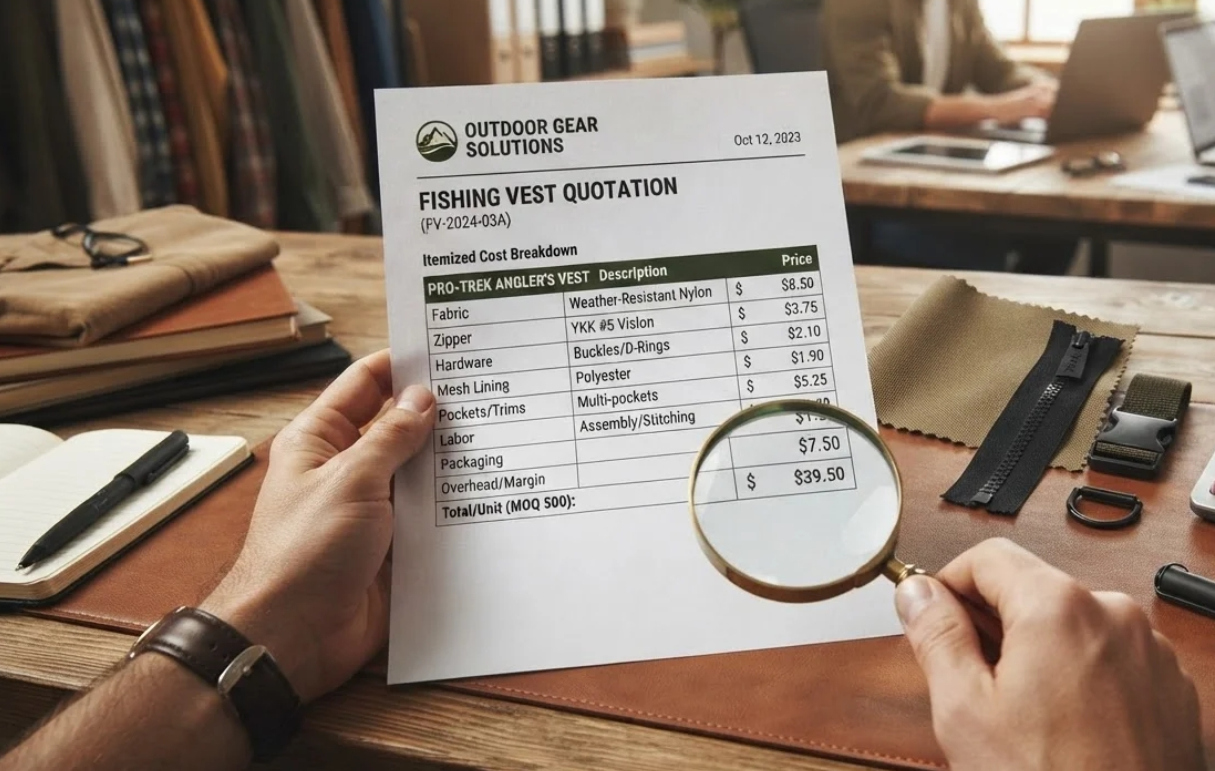
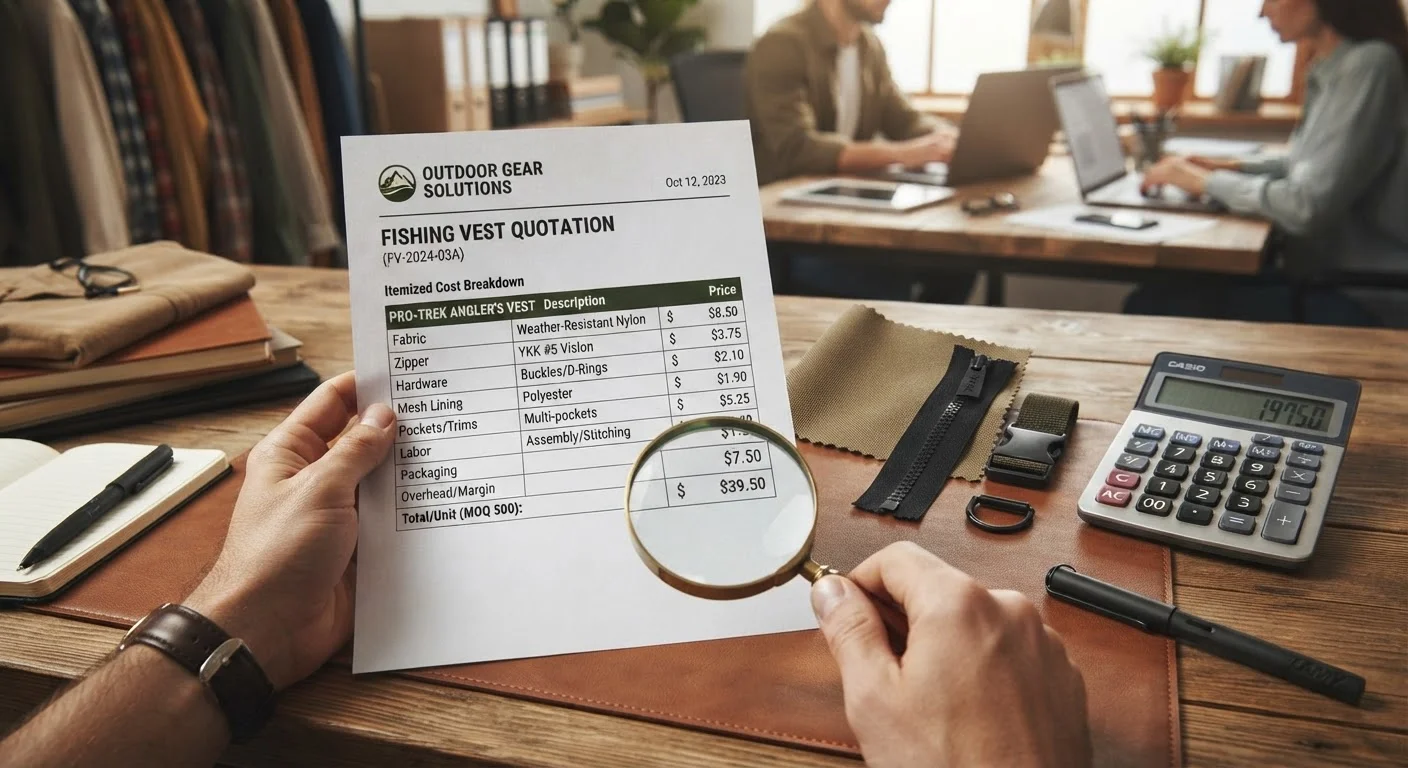
A quote with one number and no breakdown tells you nothing about what you're buying. Real fishing vest production cost comes from five stacked layers. If a supplier skips straight to "¥46/piece," that's your first red flag.
What a Real Quotation Should Show
A professional quote breaks down:
Fabric spec : material, weight (140–220 g/m² is standard for functional vests), width (57–60 inch), and price per meter, plus usage per piece including waste ratio (typically 5–8%)
Trims : zipper brand (YKK vs. unbranded), buckle size, hook-and-loop length, thread, labels, packaging. Trims usually run 15–30% of total cost.
Labor : process count (25–40 steps for multi-pocket vests), standard minutes per piece (0.35–0.5 hours), and hourly rate (¥20–28)
Trade terms : FOB/CIF/DDP with named port, MOQ tiers, lead time, payment terms, and quote validity period
Running the Numbers Yourself
Take a 1,000-unit FOB Shanghai order. Main fabric plus lining might run ¥21/piece. Trims (zipper, buckle, hook-and-loop, thread, labels, packaging) land near ¥13.70. Labor at 0.4 hours × ¥24/hour adds ¥9.60. Add ¥3.50 for overhead and waste, and you get roughly ¥47.80/piece before margin. If a quote comes in at ¥46, ask directly: is the fabric weight lower than stated, are zippers unbranded, or did they drop a test spec like water repellency?
Red Flags That Signal a Low-Price Trap
Fabric listed only as "Polyester" with no weight, width, or weave. No way to verify the price.
Hardware described as "zipper + accessories" with no brand or size
Labor cost under ¥6–7/piece with no process count or time breakdown
A single lump-sum price with no itemization
Missing trade term or port, making cross-supplier comparison impossible
If a custom fishing apparel manufacturer can't itemize these five buckets on request, that's your answer. Move on to the next quote.
Custom Fishing Vest Common Questions in Customization (FAQ)
Every buyer asks the same handful of questions before placing a first order. Here are straight answers, with the numbers that actually matter.
Q1: How much does a custom fishing vest cost per piece?
Volume drives the price. Small runs (10–50 pieces, sampling included) land at USD 25–40/piece , with sampling fees of USD 30–80/piece covering pattern-making and single-unit tailoring. Standard batches (100–300 pieces) drop to USD 12–20/piece for regular polyester/nylon builds, or USD 18–30/piece for waterproof, multi-pocket, brand-grade construction. Past 500 units, basic tricot-mesh vests compress to USD 8–12/piece , while layered waterproof builds stay above USD 12–18/piece . Fabric weight causes most of the swing: lightweight vests use 130–160 gsm, insulated or waterproof duck-hunting-style builds use 200–240 gsm. Spandex blends (92% polyester/8% spandex) add 8–15% for stretch and comfort. Every functional add-on (waterproof coating, UPF 50+, tear resistance, YKK zippers) adds another 5–20%. Branding adds more cost: screen printing runs USD 0.2–0.5 per placement, embroidery USD 0.5–1.2, and full sublimation printing can raise total garment cost 10–25%.
Q2: What's the best fabric for a custom fishing vest?
Polyester or nylon technical fabric is standard, lightweight, quick-dry, and abrasion-resistant. For summer freshwater use, spec 130–160 gsm plain or twill weave. Saltwater or multi-pocket tool vests need 160–200 gsm ripstop. Always request shrinkage data: post-wash shrinkage should stay ≤3% . For sun-heavy environments, insist on UPF 50+ with third-party test reports, not verbal claims. Waterproof coating should hit ≥5,000mm hydrostatic pressure for wet or marsh conditions, and a dense taslon or twill weave handles wind resistance without extra weight.
Q3: What measurements matter for fishing vest sizing?
Suppliers need chest, waist, body length, and shoulder width, plus a 6–10 cm chest allowance for layering. Main tool pockets should run 10–14 cm wide, 12–16 cm tall , enough for a small lure box or pliers. Front zippers typically use #5 or #7 for durability. Most factories offer S–3XL; locking M/L/XL as 70–80% of total volume keeps inventory risk manageable. Expect a 7–10 day sampling turnaround before moving into small pilot batches of 10–30 pieces for fit and function testing.
Q4: How do I lower per-piece cost without cutting quality?
Trim pocket count from 10+ down to 6–8 core pockets , and labor drops 10–20%, saving USD 1–2/piece. Limit zippers to the front and 2–4 key pockets, switching the rest to hook-and-loop or snaps for another USD 0.5–1/piece savings. Simplify branding to single-position screen printing instead of multi-point embroidery (USD 0.5–1.5/piece saved). On the material side, standardize one base fabric across a color range to hit a 1,000-meter fabric MOQ and unlock a 5–15% price drop. Bundling a fishing vest order with a fishing shirt program on shared fabric can shave USD 0.3–0.8/piece off processing. And keep sample revisions to 1–2 rounds . Every extra revision round after that adds hundreds of dollars in development cost and pushes your timeline back.
Q5: What artwork files do I need for logo printing?
Vector files only: PDF, AI, or EPS. Bitmap logos need ≥300 dpi at true garment scale. Convert designs from RGB to CMYK before submission to avoid color drift between screen and fabric. Large-format prints need 3–6mm bleed to prevent white edges after cutting. Standard placement: left chest logo at 6–8 cm wide , back logo at 20–28 cm wide , with exact distances from collar and side seam noted in the tech pack.
Q6: What's the MOQ for a custom fishing vest with a logo?
Sampling MOQ is usually 1–3 units , priced individually with logo application included. Full production MOQ from most sportswear factories runs 100–200 pieces per style , splittable across 2–3 colors with a minimum of 10 pieces per color/size. Once a sample passes, seal it: record fabric weight, color code, pocket dimensions, and zipper spec, then photograph it as the production reference standard for your QC team.
Q7: What should I check in the sample before mass production?
Re-weigh the fabric. A supplier claiming 150 gsm should hold up on a scale. Check waterproof coating for even application with no thin spots or leaks. Pull on major seams to catch puckering, uneven stitching, or loose threads. Cycle every zipper multiple times to confirm smooth operation. Then wear the sample and simulate real use: cast, bend to retrieve a tackle box, and load pliers, lures, and a phone into each pocket to confirm size and access angle work as designed. Log every check on a sample approval sheet; it becomes your bulk production benchmark.
Conclusion
Developing a custom fishing vest means matching the right material, pocket configuration, and production partner to your specific brand goals—whether that's a lightweight breathable fishing vest fabric for tropical markets or a fully waterproof fishing vest material built for offshore abuse.
The brands that get this right treat their design process as a series of informed trade-offs (cost vs. durability, MOQ vs. customization). Working with an experienced custom fishing apparel manufacturer means you skip the trial-and-error and go straight to a product that sells.
If you're ready to move from research to a real quote, send us your specs. We'll walk you through fabric samples, pricing tiers, and OEM fishing vest options built around your actual order volume, not a generic catalog price.