The first time saltwater soaks through a cotton tee, you learn that what works on a lake doesn't survive an ocean. Salt corrodes zippers, chews through cheap seams, and the sun bouncing off open water will fry skin that a shady riverbank never touched. Yet most "what to wear fishing" advice treats saltwater trips like any other outdoor outing—vague nods toward "breathable fabric" and "sun protection" that leave you guessing when you're staring at a gear rack the night before a charter.
This guide skips the generalities. We're breaking down exactly what belongs on your body for saltwater fishing, starting with your head and working down to your boots, covering the specific fabrics, coatings, and design details that separate a UPF fishing shirt built for the ocean from one that'll be peeling and stinking by your second trip.Brands often develop custom Saltwater Fishing Apparel with advanced UV protection fabrics. By the end, you'll have a scenario-specific packing list, not just a vibe.
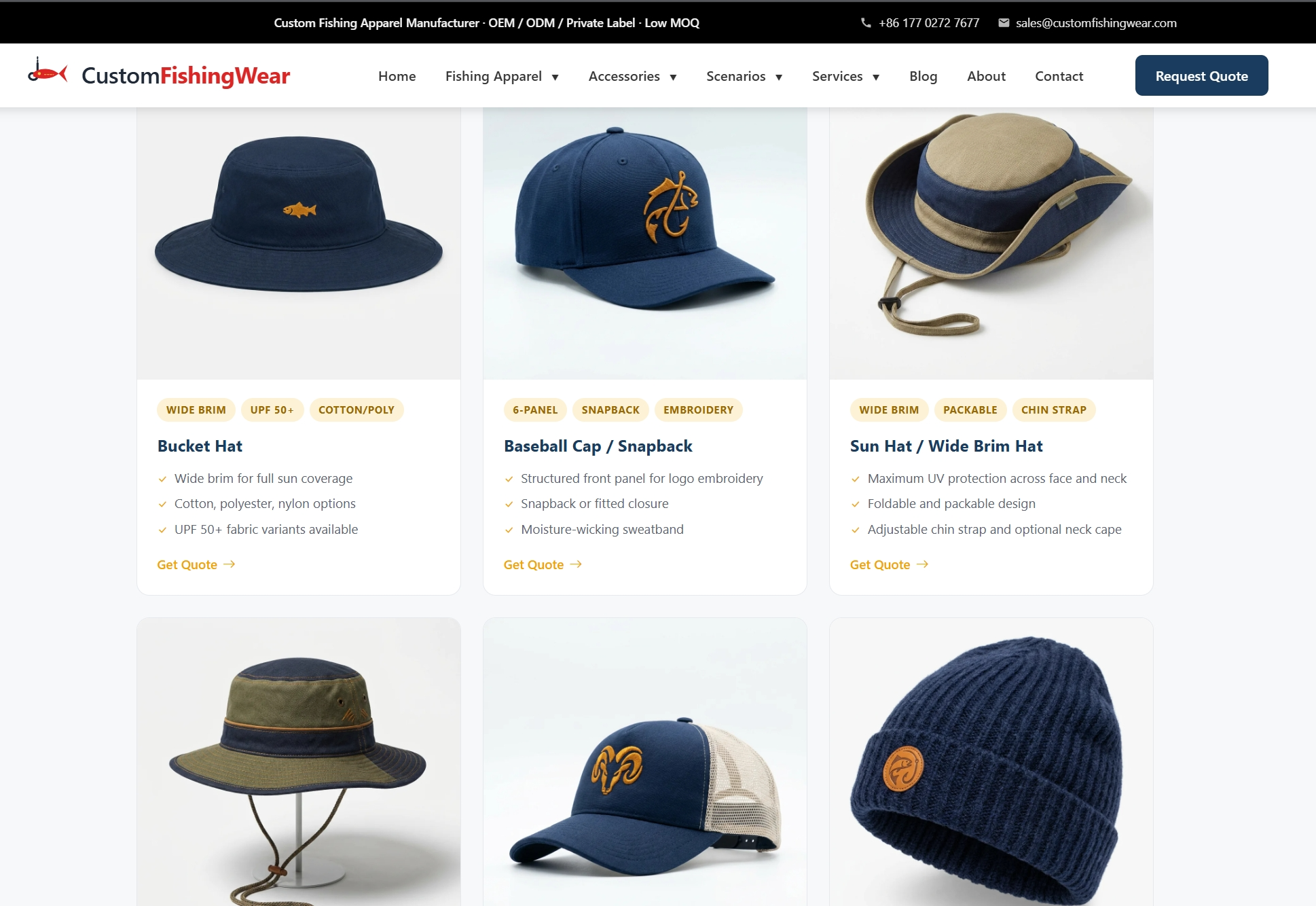
Head Protection: UPF 50+ Hats and Neck Gaiter for Maximum Coverage
Your scalp, ears, and neck take the worst beating on open water. Sunlight doesn’t just come from above—it bounces off the surface and hits you from below, too. That’s why generic ball caps fail offshore.
What to look for in your hat:
UPF 50+ rating , which blocks about 98% of UVA/UVB. Anything under 2% transmission earns that classification.
Brim width of at least 3 inches all around. That’s the Skin Cancer Foundation’s baseline for real coverage, though 3.5 to 4.5 inches is better for full-day trips.
Integrated neck flap or cape running 6 to 10 inches from the hatband. Some fishing hat with neck flap designs stretch to nearly 10 inches for full ear-and-neck shielding.
Non-mesh UPF fabric on the crown. If there's ventilation, it should be laser-perforated while still holding the UPF 50+ rating.
The neck gaiter is your second layer. Pick one in tightly-knit polyester or nylon, 17 to 19 inches long, with 4-way stretch. Pull it up over your nose and ears, tuck it under your hat's edge so there's no gap at your jawline or the back of your neck. Darker colors block more UV than pale ones. Worth remembering when you're comparing options at the register.
UPF 50+ Quick-Dry Fishing Shirt (Long-Sleeve with Thumb Holes)
Your forearms and torso spend more hours exposed than any other part of your body on a boat deck. That's the math a good UPF fishing shirt is built to solve.
Fabric composition matters more than brand loyalty here. Most quick dry fishing shirt options run 84–100% polyester, sometimes blended with 10–16% spandex for stretch. Bassdash uses an 84/16 polyester-spandex mix that resists shrinking and pilling. Baitium goes with 95% recycled polyester. If you'd rather skip synthetics entirely, RiverRuns offers a 100% nylon twill option — less stretch, but still resists moisture absorption and dries fast.
Construction details separate a $20 shirt from one that lasts.A private label UPF fishing shirt program helps outdoor brands create unique collections.
Raglan sleeves (seen on FISHEAL, Bassdash, MIER) give you full range of motion for casting without the fabric binding at your shoulder. Flat-lock seams reduce chafing during long hours reeling or netting fish. Thumb holes aren't a gimmick — they anchor sleeves in place so they don't creep up mid-cast, extending UPF coverage all the way to your fingers.
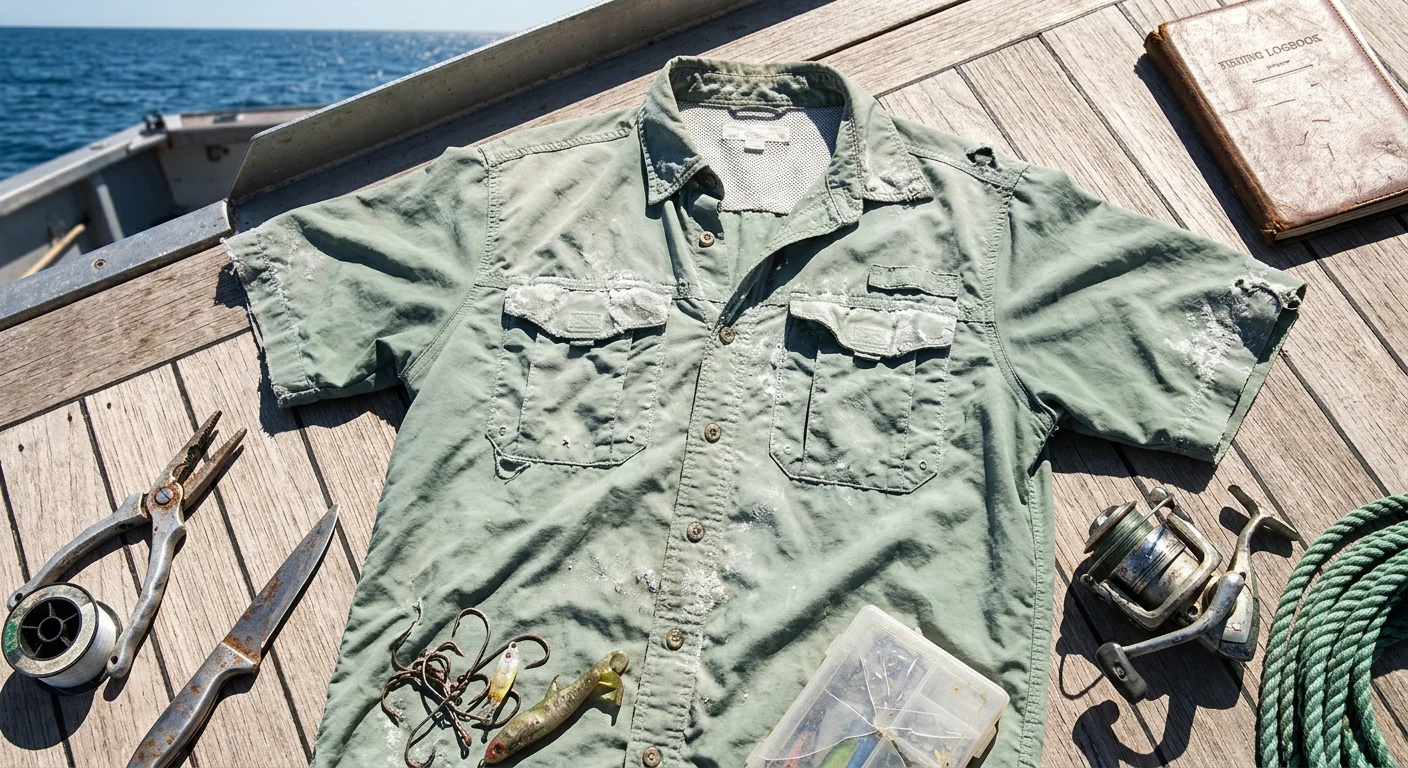
Skip cotton entirely. It holds moisture, dries slow, and offers next to no UV blocking once wet — exactly the wrong combination for a saltwater trip.
Breathable Fishing Pants: Shorts vs. Long Pants
Legs get sunburned too—ask anyone who's spent six hours on a kayak seat with shins baking in reflected glare. Long pants win for most saltwater trips. Shorts have a place, but it's narrower than most anglers think.
Long pants solve three problems at once. UPF 50+ fabric cuts leg UV exposure by up to 98% compared to bare skin. On open water, where sun bounces off the surface from below, that matters more than it does on a riverbank.
Look for 10,000–20,000 g/m²/24h MVTR (moisture vapor transmission rate). That spec keeps you from overheating even in long sleeves and pants. Pair it with a 5,000–15,000mm hydrostatic head rating plus DWR coating, and spray or light rain won't soak through. Good breathable fishing pants run 200D–500D nylon or polyester, weighing 270–500 grams a pair.Experienced Saltwater Fishing Apparel suppliers provide performance fabrics for harsh marine conditions. Reinforced knees and seat handle boat decks and rocky jetties without shredding.
Shorts make sense for trips under two hours, temps above 90°F with high humidity, and reliable sunscreen reapplication every 90 minutes. Moisture-wicking shorts run 5–8°F cooler than pants in that heat—useful for short dock sessions or frequent wading where you're stepping in and out of water anyway.
Deep-sea boat fishing: long pants, UPF 50+, no exceptions. Specialized fishing apparel factories support durable materials and technical garment production.Little shade, hours of exposure, spray coming off the bow. Near-shore rock or jetty fishing: long pants for abrasion protection against barnacles and jagged rock, not just sun. Beach or surf casting: convertible pants with zip-off legs give you flexibility—shorts if you're wading and cooling off, full pants once the sun gets brutal midday.
Skip cotton shorts. They're the beach-day mistake that turns into salt rash by hour three.
Non-Slip Deck Boots and Wading Shoes: Footwear for Wet, Slippery Conditions
A wet fiberglass deck is basically ice with a fish smell. One bad step and you're on your back with a rod in your hand. Staying upright matters more than comfort here.
For boat decks and offshore trips, deck boots are non-negotiable. Look for rubber or neoprene uppers that are fully waterproof, paired with non-marking, siped outsoles. The siping matters more than you'd think. Those thin razor-cut slits expel water on contact and bite into wet teak or fiberglass. The BASSDASH 6" model uses wavy lugs plus an 8mm molded EVA insole with memory foam for all-day standing. SUREWAY's version adds micro-channel openings that spill water out the sides and a non-marking, oil-resistant sole. Both include reinforced toe and heel caps with pull tabs, so you aren't fighting wet boots on and off between spots.
For wading between rocks or riverbank, skip the boots. Ventilated mesh wading shoes with siped, non-marking soles like Patagonia's Vibram Megarip drain fast and grip mossy rock better than bulky rubber ever will.
Fishing Gloves: Corrosion-Resistant, Cut-Proof, and Grip-Enhancing
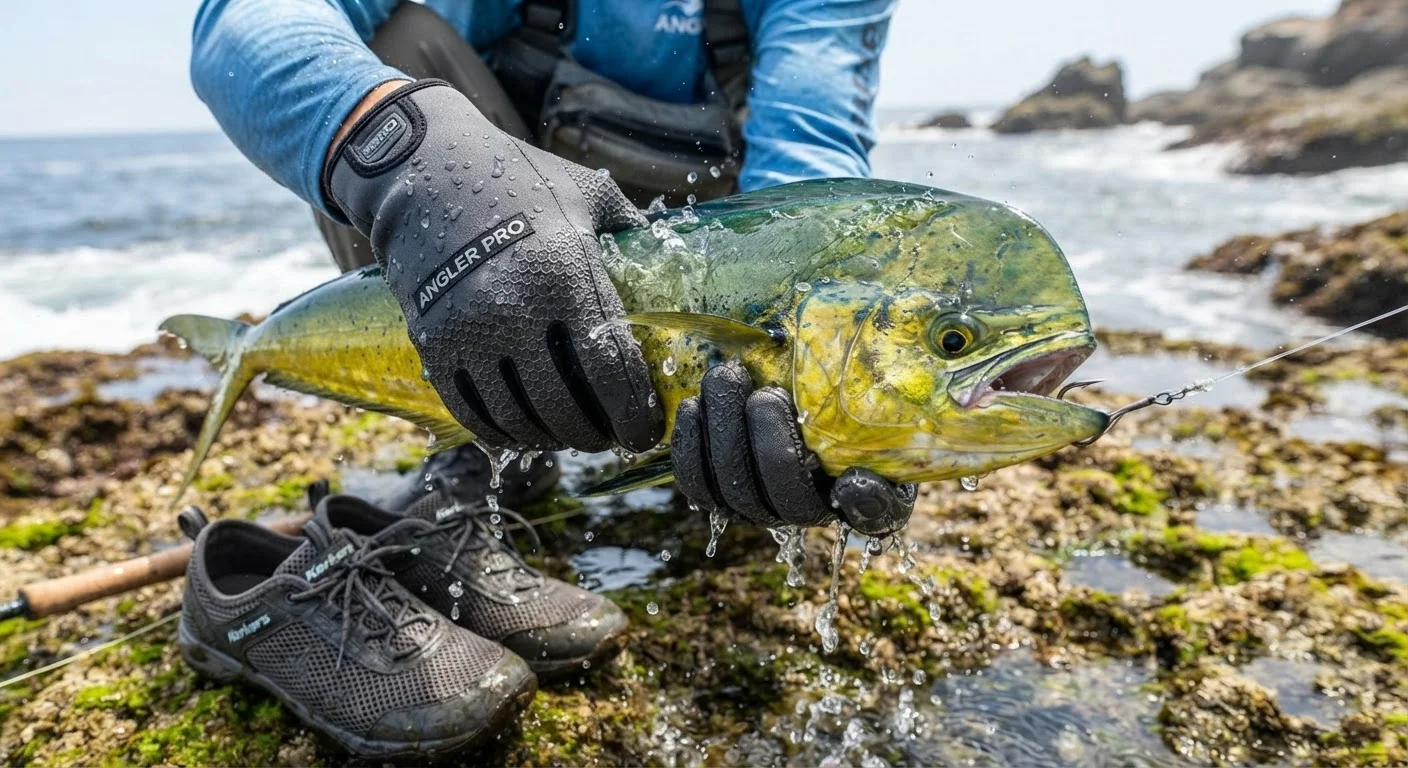
A thrashing mahi with a hook still in its jaw doesn't care about your bare hands. Neither do barnacle-crusted rocks or a fillet knife slipping on slime. Saltwater fishing gloves exist to handle three separate threats — cuts, corrosion, and slick-when-wet grip. Most gloves at the hardware store solve none of them.
Cut and puncture resistance comes down to ANSI ratings. Look for A5 minimum, A6–A7 for serious offshore or commercial work. Siza's S1014 gloves run A3 with high-strength PE thread. Fine for scales and fish bones, not hook-proof. HammerHead's Mahi Mahi Ahi gloves use UHMW ANSI Level 5 fabric rated 15 times stronger than steel, built for spearfishing and lobster snares. Lindy's SuperFabric gloves claim 800% more puncture protection than typical fish-handling gloves against knives, hooks, and teeth. For maximum protection, stainless-steel chainmail hits ANSI A9. Total overkill for a weekend trip, standard on commercial fish-processing lines.
Corrosion resistance is where saltwater separates good gloves from garbage. Nitrile and latex coatings resist acid, alkali, and chemical exposure. Lindy's gloves are rated for both fresh and saltwater, with slime and odor rinsing off easily. Any metal hardware — buckles, hooks — needs rust-resistant alloy or stainless construction. Siza's magnetic hook holds 1.8 kg but still needs a fresh-water rinse after saltwater use to stop corrosion on its metallic threads.
Grip is non-negotiable with wet, slimy hands. Sandy or foam nitrile coatings, textured latex with irregular folds, or Griptanite silicone printing all deliver traction on slick fish and wet rails. Superior Glove's double-dipped foam nitrile palms handle oily, humid conditions specifically. For leadering or gaff work offshore, pair a long gauntlet cuff with reinforced palm and thumb crotch. That's where line pressure and abrasion concentrate over a full day on deck.
customfishingwear.com – B2B Custom Saltwater Fishing Apparel Manufacturer
Retail racks aren't the only place this gear comes from. Since 2009, CustomFishingWear has been a factory-direct fishing apparel manufacturer of nothing but fishing apparel. No crossover into general outdoor wear, no diluted focus.
Their saltwater line covers UPF 50+ performance shirts, sublimation tournament jerseys, waterproof offshore jackets, bibs, waders, performance shorts, and saltwater fishing gloves. All built from polyester, nylon, and spandex blends formulated for salt, sun, and cold exposure.
The process is simple: brief your concept or tech pack, get a physical sample in 7–10 days, approve fit and color, then move to production with in-line QC checks. Brands and charter fleets across North America, Europe, and Australia reorder seasonally once specs are locked in.
Polarized Sunglasses: Why You Need Both 100% UV and Polarization
Squint hard enough at open water for six hours and you'll pay for it that night with a pounding headache. That's glare fatigue, and it's why polarized fishing sunglasses are a two-part system. Most anglers only buy half of it.
100% UV (UV400) protection blocks UVA/UVB up to 400nm. Skip it, and you're risking cataracts, macular degeneration, and eyelid cancer down the road.
Polarization cuts horizontal glare bouncing off the surface, letting you see fish and structure instead of blinding reflection.
Tinted lenses without UV coating are actually worse than no glasses at all. Dark tint makes your pupils dilate, and if there's no UV400 rating behind it, more UV floods in than if you'd worn nothing.
Look for "100% UV" or "UV400" and "polarized" printed together on the label. If a pair only says "polarized" with no UV claim, assume zero UV protection until proven otherwise.
Waterproof Jacket / Spray Top: Light Shell vs. Heavy Bibs
Spray coming off the bow doesn't stop at your chest. It soaks your waist, your seat, your legs, and a jacket alone won't touch any of that. This is where anglers split into two camps, and picking wrong means either sweating through a hike or sitting in a puddle for six hours offshore.
Light shells are built for mobility. They run 400–500 grams, pack down small, and prioritize breathability for high-exertion movement. A hydrostatic head of 1,500–5,000mm handles light showers and drizzle fine for shore fishing, active wading, short exposure. Push past that into sustained rain, and you'll feel the gap.
Heavy bibs give you lower-body coverage from chest to ankles. They weigh 550–750 grams, but you get real protection while sitting, leaning, or taking spray over the rail—what boat fishing and kayaking demand.
Construction matters as much as category. A 3-layer waterproof jacket delivers the best waterproofing, breathability, and durability, but costs more. 2.5-layer stays light and cheap, trading some durability for packability. Look for taped seams, a real waterproof membrane (not just DWR coating), adjustable hood, pit zips for ventilation, and waterproof zippers. Skip any of those and water finds the gap.
Match the gear to the water:
Shore or bank fishing, light rain → jacket only
Kayak fishing → jacket + paddle pants
Small boat fishing → full suit, jacket and bibs together
River wading → bibs, minimum
AFTCO's own comparison backs this up. Their Transformer suits stray showers and light rainfall, while the Hydro's 30K membrane is built for steady, sustained rain—the kind you get offshore, not the kind you get walking to your truck.
Saltwater Fishing Outfit Combinations by Fishing Scenario
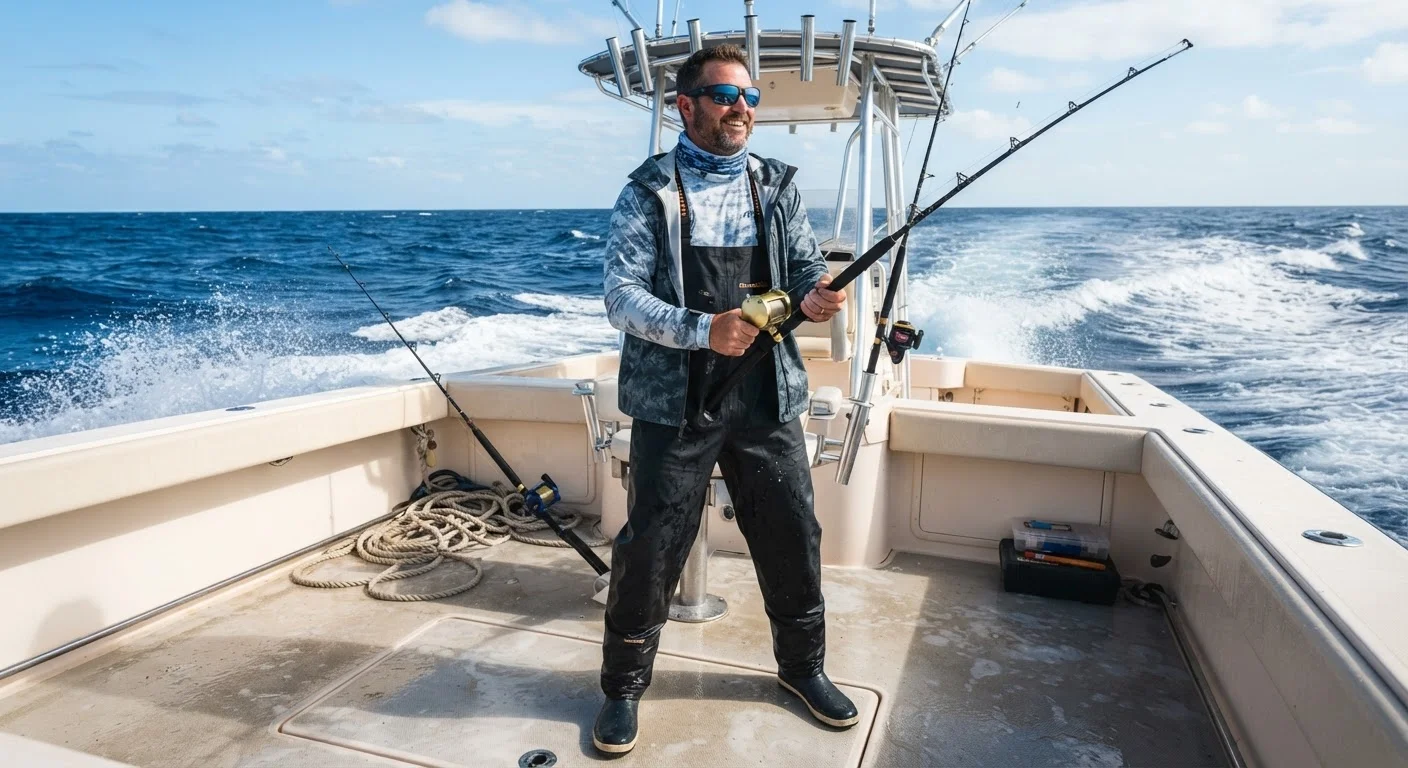
Every piece of gear we’ve covered so far solves one problem. Put them together the right way, and you get an outfit that survives a full day on salt water without thinking about it twice. The pieces stack up differently depending on where you fish.
Near-shore rock and jetty fishing
UPF 50+ hat with neck flap, and gaiter pulled up when you’re climbing over barnacle-crusted rock.
Long-sleeve UPF fishing shirt with raglan sleeves and thumb holes.
Long breathable fishing pants (200D–500D nylon) that resist abrasion against jagged edges and also block sun.
Non-slip deck boots or siped wading shoes. Footing matters more here than anywhere else.
Cut-resistant gloves (ANSI A5 minimum) for handling fish near rock and line.
Deep-sea boat fishing
Wide-brim hat plus neck gaiter for hours of direct exposure with no shade offshore.
Long-sleeve moisture wicking fishing shirt under a light waterproof jacket or spray top for bow spray.
Long pants, UPF 50+, no exceptions. Deck reflection is brutal.
Non-slip deck boots, siped rubber or neoprene, waterproof.
Polarized fishing sunglasses with UV400. Glare off open water causes real fatigue by hour four.
Grip-enhancing gloves for leadering and gaff work.
Beach or surf casting
Convertible pants with zip-off legs that work as shorts while wading and full coverage midday.
Quick dry fishing shirt, UPF rated.
Wading boots or barefoot with surf booties depending on bottom conditions.
Sunglasses and hat with flap, non-negotiable even on overcast days because UV bounces off sand and water both.
A full outfit across these categories runs $150–$300 depending on brand and coverage. Skip any one piece and you’re burned, soaked, or on your back on a wet deck by lunch.
Common Saltwater Fishing Clothing Mistakes and Why They Fail
Ask any charter captain what ruins a trip fastest, and cotton comes up before bad weather does. It's the single biggest offender, but it's far from the only one.
Cotton anything. It holds up to 27 times its weight in water and can take hours to dry, versus 30–60 minutes for synthetics in marine wind. Once soaked, insulation collapses and chafing starts at every seam.
Dark colors on hot flats. Black and navy absorb more heat than khaki or sage, pushing body temp up fast in 85°F+ conditions. Some anglers also swear dark fabric spooks fish in clear, shallow sight-fishing water.
Tight, non-ventilated fits. They trap sweat against skin instead of letting it evaporate, which defeats the purpose of moisture wicking fishing apparel.
Open-toe sandals on deck. Hooks, knives, and gaffs don't care about your toes. Add a wet fiberglass deck, and non-grip soles turn a small mistake into a real fall.
Skipping rain gear on a "clear" forecast. Marine weather flips faster than land weather. Without a packed waterproof fishing jacket, you're back to the cotton problem mid-trip.
Standard fabrics with no salt or UV treatment. Saltwater and strong UV break down untreated seams and threads faster than most anglers expect, fading color and weakening fabric trip after trip.
One outfit for every scenario. Flats, offshore, and wade fishing each demand different waterproofing and airflow. There's no single combo that covers all three well.
Conclusion
Saltwater doesn't forgive bad gear choices—it just accelerates them. A cotton tee turns clammy and chafes by hour two; the wrong boots send you sliding across a wet deck at the worst possible moment. The difference between a miserable trip and a great one usually comes down to three things: a proper UPF fishing shirt and sun protection layers, non-slip deck boots, and the right gloves and polarized lenses. This is about staying upright, unburned, and comfortable enough to fish instead of fighting your own clothes.
Before your next trip, run through this list piece by piece—head to feet—and replace anything that's cotton, slick-soled, or missing UV protection.Brands can evaluate custom wholesale price options for premium Saltwater Fishing Apparel orders. Gear up once, gear up right, and let the ocean test your knots, not your wardrobe.