Picking a manufacturing partner for your fishing apparel line impacts your margins, your speed to market, and whether your product actually performs on the water.
Most brands learn the difference between OEM and ODM fishing clothing only after they get stuck in a production deal that doesn't fit their needs.
The difference comes down to fishing apparel customization scope, pricing structure, MOQs, lead times, and how much control you actually have over quality. Get this wrong, and you'll either overpay for flexibility you don't need or lock yourself into a rigid product that doesn't match your brand.
Let's break down what separates OEM from ODM so you can pick the model that actually makes sense for your business.
OEM Fishing Apparel Customization Scope
OEM fishing apparel manufacturing gives you full control. You build the product from scratch, spec by spec.
Fabric Performance Specs
Your fabric choices determine whether the gear survives a day on the water. OEM fishing apparel factories let you dial in:
UPF protection : UPF 50+ is the standard for shirts, hoodies, and jackets, tested against AATCC 183 or AS/NZS 4399.
Fabric weight (GSM) : Lightweight shirts run 130–150 g/m² in woven or knit polyester/nylon blends for breathability.
Waterproofing : Premium vests and jackets often hit a waterproof rating of ≥20,000 mm paired with breathability of ≥15,000 g/m²/24h.
Functional finishes : Odor-control, antibacterial, and insect-repellent treatments are all selectable add-ons.
Pattern, Fit, and Functional Features
This is where OEM separates itself from ODM. You build it from scratch.
Garment types : Long-sleeve sun shirts, hooded sun shirts, jackets, pants, vests, bibs, tournament jerseys, hats, and neck gaiters.
Fit control : Regular, relaxed, or athletic cuts with graded size tolerances of ±1–1.5 cm.
Functional add-ons : Rod-holder loops, plier pockets, D-ring placements, reinforced stitch density (10–12 SPI), and corrosion-resistant zippers for saltwater use.
Branding and Compliance
Everything on the garment can carry your brand — labels, hangtags, packaging, and print method (screen print, embroidery, sublimation). Sublimation runs need a MOQ of 50–100 pieces per design.
On compliance, buyers lock in:
Lab-tested UPF and waterproof reports
Factory audits (BSCI, Sedex, ISO)
Final Random Inspection at AQL 2.5
MOQ and Lead Time Reality
Full OEM isn't cheap or fast, but it's precise.
MOQs : 300–1,000+ pieces per style for technical outerwear.
Pricing example : A 300-pc run of UPF50+ long-sleeve shirts often targets $8–10/pc FOB.
Lead time : 90–120 days from design to delivery, with sampling taking 7–10 days.
If your brand needs exact specs and total ownership over performance and design, OEM is the model built for that.
ODM Fishing Apparel Customization Scope
ODM trades some control for speed and lower entry costs. You start with a proven base style and customize fabric, fit, color, branding, and function.
Lower MOQs, faster samples, less risk.
What You Can Customize
ODM fishing apparel programs give you flexibility without starting from scratch:
Style selection : Pick from shirts, hoodies, jackets, pants, vests, boat shirts, offshore and fly-fishing variants, available as base templates.
Fit adjustments : Change silhouette, sleeve length, collar style, and size-set grading.
Fabric picks : Choose polyester, nylon, stretch blends, or woven shells that hit UPF 50+, quick-dry, and breathable specs.
Performance finishes : Add odor-control, antibacterial, insect-repellent, and waterproofing treatments on top of the base fabric.
Branding : Place your logo, choose woven labels, hangtags, print decoration, and thread color.
Functional details : Configure pockets, ventilation panels, zipper and button styles, hood adjustments, cuff and collar protection.
Packaging : Get custom retail-ready packing designs.
MOQ and Sampling Reality
For smaller brands, ODM pulls ahead of OEM.
Light customization (logo swaps, label changes): MOQs start at 50 pieces per design.
Full custom development (fabric, fit, branding): 100 pieces per design.
Some factories run 50 pieces per style per color, and with stock-fabric options that drops to 30 pieces.
Simple samples take 5–7 days once specs are confirmed. Pre-production samples run 7–10 business days. Revisions add 5–7 more days depending on complexity. Some factories turn around tech packs and quotes within 48 hours.
Quality Control Still Holds the Line
ODM doesn’t mean loose standards. Reputable factories run in-line QC during cutting, sewing, and assembly, then close with a Final Random Inspection (FRI) using AQL-based checks on stitching, waterproofing, and button strength.
Approval runs through requirement review, fabric/trim confirmation, sample approval, bulk production, inspection, and delivery.
Where ODM Fits Best
Offshore and saltwater apparel brands rely on ODM because factories already have compliance documentation ready for US, EU, and AU markets. Sun hoodies, boat shirts, and camo-fishing crossover pieces with upgraded pocket systems also fit well.
If you want proven performance specs without the 300-piece minimums, ODM fishing apparel customization gives you a faster, cheaper path to market, as long as you’re comfortable working within existing base patterns rather than building from zero.
OEM vs ODM Pricing: Breakdown by Product Category
Numbers tell the real story. Run the math on OEM vs ODM fishing apparel and you'll see the gap is about where the money gets spent and when.
Upfront Investment
OEM demands cash before you make a single sale. Design and engineering alone run $3,000–$25,000+ , since you're building patterns and specs from nothing. Tooling for custom hardware (zippers, D-rings, snap systems) adds $3,000–$50,000+ depending on complexity. Sample development costs $500–$3,000 per round , and most brands need 2–3 rounds before locking a final pattern. Total OEM upfront for a fishing apparel line often lands between $25,000–$150,000+ .
ODM skips most of that. Factories already own the design, so engineering costs drop to $0 . Tooling is limited to logo work and minor mods, running $0–$2,500 . Sample fees sit at $50–$300 per sample — 30–40% lower than OEM's $80–$150 per-piece sample cost for a brand-new pattern. Total ODM upfront stays in the $4,000–$25,000 range.
Per-Unit Cost Reality
Here's where it flips. At scale, OEM apparel often runs 10–15% higher per unit than ODM for the same style and volume — extra pattern development and multiple sample rounds add cost that never fully disappears.
Once you clear high volume thresholds, OEM's amortized tooling starts closing the gap. Generic consumer product data shows this pattern: at 10,000 units, OEM lands around $17.15/unit vs ODM's $10.00/unit ; at 50,000 units, OEM drops to $15.50/unit vs ODM's $9.00/unit . ODM stays cheaper, but the spread narrows as OEM's fixed costs spread across more pieces.
MOQ-to-Cost Tradeoff
Apparel-specific MOQs reinforce this. OEM soft goods require 500–2,000 units per SKU ; ODM needs 50–300 units per SKU . For a fishing apparel brand testing new styles, that difference alone can mean the gap between a $5,000 pilot run and a $40,000 commitment.
OEM vs ODM Minimum Order Quantities (MOQ)
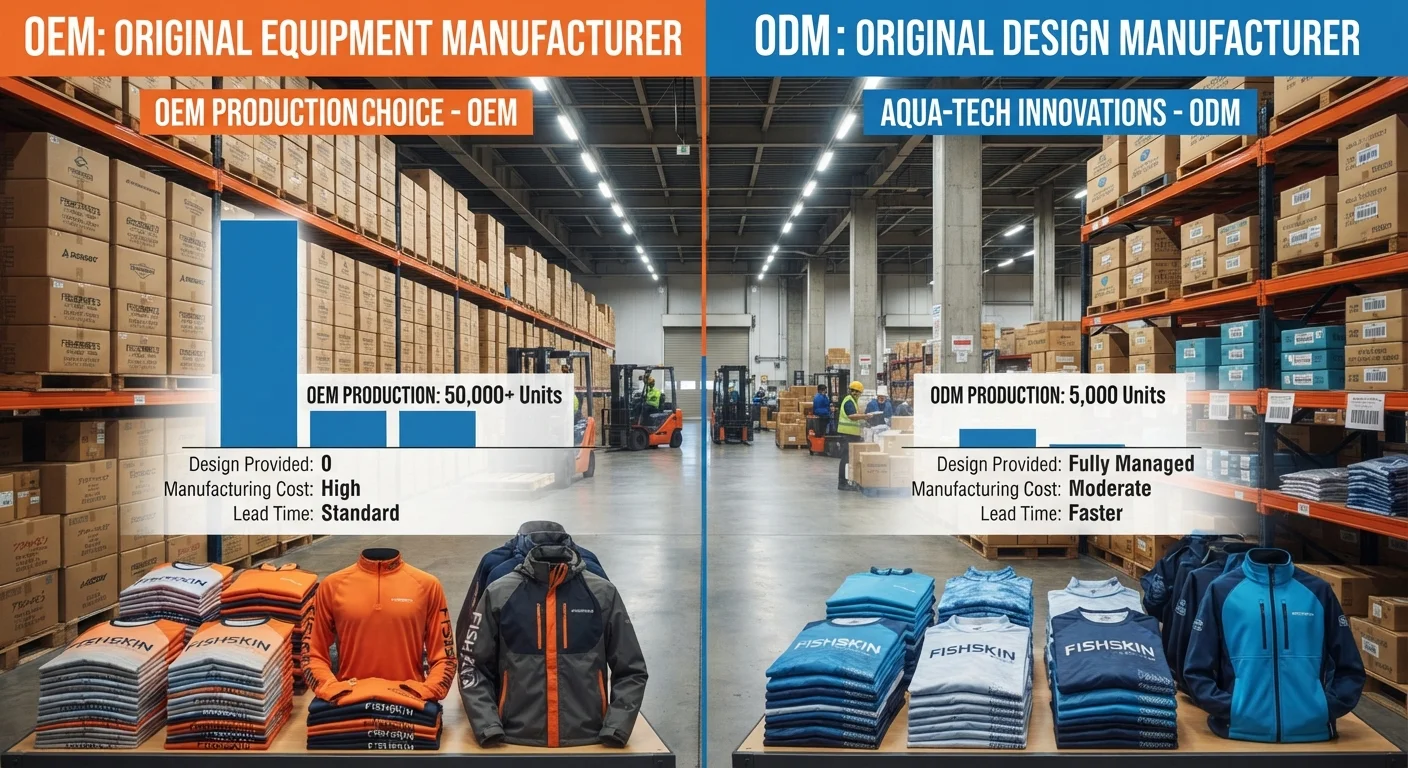
Numbers don't lie: OEM MOQs run 500–5,000+ units , while ODM MOQs sit at 50–1,000 units . That gap holds true whether you're sourcing electronics, plastics, or fishing apparel.
Cross-industry benchmarks confirm the pattern. Chinaguide's 2026 sourcing data puts OEM at 500–5,000 units and ODM at 100–500 units for most product categories. Epic Sourcing's breakdown backs this up — general consumer goods run 500–5,000+ units for OEM versus 50–1,000 units for ODM.
Category matters too. Electronics push MOQs higher on both sides — OEM demands 2,000–10,000 units (InnovChip data shows 5,000–50,000+ for complex electronics), while ODM stays lower at 200–1,000 units . Beauty and personal care follow the standard split: OEM at 1,000–5,000 units , ODM at 100–500 units . Pet products land smaller across the board — OEM 500–2,000 units , ODM 50–200 units .
First Order vs Reorder Strategy
Your first OEM run demands 1,000+ pieces , but reorders drop to 200–500 pieces once the relationship's established. ODM works the opposite way — first orders can start as low as 50–200 pieces , with reorders holding steady at 50–100 pieces for hardware and catalogue-style products.
One catch worth flagging: custom packaging MOQs don't always scale down with your product MOQ. Even when your apparel order sits at 100 pieces, custom-printed boxes and labels often require 500–1,000 units separately. Budget for that mismatch before you commit to a OEM and ODM fishing apparel supplier.
OEM vs ODM Lead Times
Time is the real cost most brands forget to calculate. A missed spring launch window doesn't just cost a sale — it costs you an entire fishing season.
OEM fishing apparel needs 60–120 days from design approval to first shipment. ODM cuts that to 15–45 days because the base pattern and tooling already exist. Apparel-specific data backs this up: OEM production runs 30–60 days , ODM 21–45 days . Factor in sampling, QC, and sea freight, and door-to-door timelines stretch to 75–150 days for OEM versus 53–110 days for ODM .
Where the Time Goes
Sample development is where the real gap opens up. OEM sampling takes 14–30 days , with revisions adding 7–14 days per round . ODM samples land in 7–14 days , with revisions cut to 3–7 days . Quality inspection runs 3–7 days for OEM versus 2–5 days for ODM . Sea shipping stays flat at 20–35 days regardless of model.
Sportswear data flips this: ODM sample development can run longer — 10–21 days versus OEM's 7–10 days — because ODM often involves more design collaboration upfront. But once the pattern's frozen, bulk production timelines converge. Both OEM and ODM factories need 30–45 days to run a confirmed order. The bottleneck isn't factory speed. It's how long you spend finalizing design before production starts.
Reorders Change the Math
Once tooling and materials are locked, OEM reorders drop to 6–10 weeks . ODM reorders move faster still since no new development is required. If your fishing apparel line depends on hitting seasonal windows, ODM's compressed pre-production timeline is often the deciding factor over OEM's full customization.
OEM vs ODM Quality, Durability, and Application Fit
Quality doesn't disappear in either model—it just shifts location. OEM puts the risk on your spec sheet. ODM puts it on the factory's hidden design choices. Know which one you're managing, or you'll get blindsided.
Where the Risk Lives
With OEM fishing apparel, you own the design. Defects usually trace back to incomplete specs—missing tolerances, vague test methods, or compliance gaps you forgot to define. The factory fills in blanks with its own assumptions. Your fix: freeze every measurable requirement (seam tolerances, waterproof ratings, UPF test methods) before you sign the PO.
With ODM, the factory owns the base design. You often only see the spec sheet and cosmetic options. Hidden risks show up as undisclosed fabric grades, cost-down substitutions, or zipper components swapped without notice. Your fix: demand the bill of materials, reliability test reports, and a change-control clause before committing.
Most brands skip this part: OEM vs ODM alone doesn't determine final quality. Supplier QMS certifications (ISO 9001), process capability, and your own testing regime do the heavy lifting. Ask for First-Pass Yield (FPY) data and field return rates on comparable apparel programs, regardless of which model you're using.
Durability Tuning: How Much Control You Get
OEM lets you engineer for a specific mission profile—saltwater exposure, UV degradation over a full season, abrasion resistance for boat decks. You can lock in derating rules and require HALT-style stress testing before mass production.
ODM sets a typical-use reliability baseline. You can add acceptance tests, but reshaping fabric composition or seam construction usually means major cost and delay.
Application Fit
OEM wins for niche performance needs like offshore tournament gear, extreme-condition fabrics, or custom mechanical features like reinforced rod-holder loops. ODM wins when your application is close to standard sun-protection or boat-shirt categories, where speed and cost matter more than perfect optimization.
Conclusion
Choosing between OEM and ODM fishing apparel comes down to where your brand is in its growth.
If your designs are locked in and you need manufacturing that follows your specs, OEM keeps costs predictable and creative control in your hands. ODM is the faster route when you're racing to market or don't have design resources in-house—their pre-developed patterns and shorter lead times can save months.
The pricing gap, MOQ flexibility, and quality differences we covered directly affect your margins and how quickly you can catch seasonal demand.
Audit your product roadmap. Do you have unique designs ready to produce, or do you need a shorter path to shelf-ready inventory? Whichever it is tells you which model to pursue.
Get quotes from manufacturers on both fronts. The right partnership should pay for itself in less than one fishing season.