I've pulled the same "UPF 50+" tag off two shirts that performed nothing alike under a noon sun. One held up, the other let my shoulders burn through in under an hour. It's fabric science. After a decade of testing gear on boats, banks, and everywhere in between, I've learned exactly where brands cut corners. We're going under the label and breaking down the eight fabric variables that separate a legitimate UPF sun protection fabric from a dye job, and a real quick dry fishing shirt material from one that feels thin. Brands creating custom performance fishing apparel need these fabric benchmarks before development.You'll get the technical thresholds (fiber density, GSM ranges, denier counts) plus a 90-second hands-on test for each factor, so you can verify performance yourself before you ever swipe your card.
Fiber composition ratio: The golden rule for Polyester/Nylon/Spandex
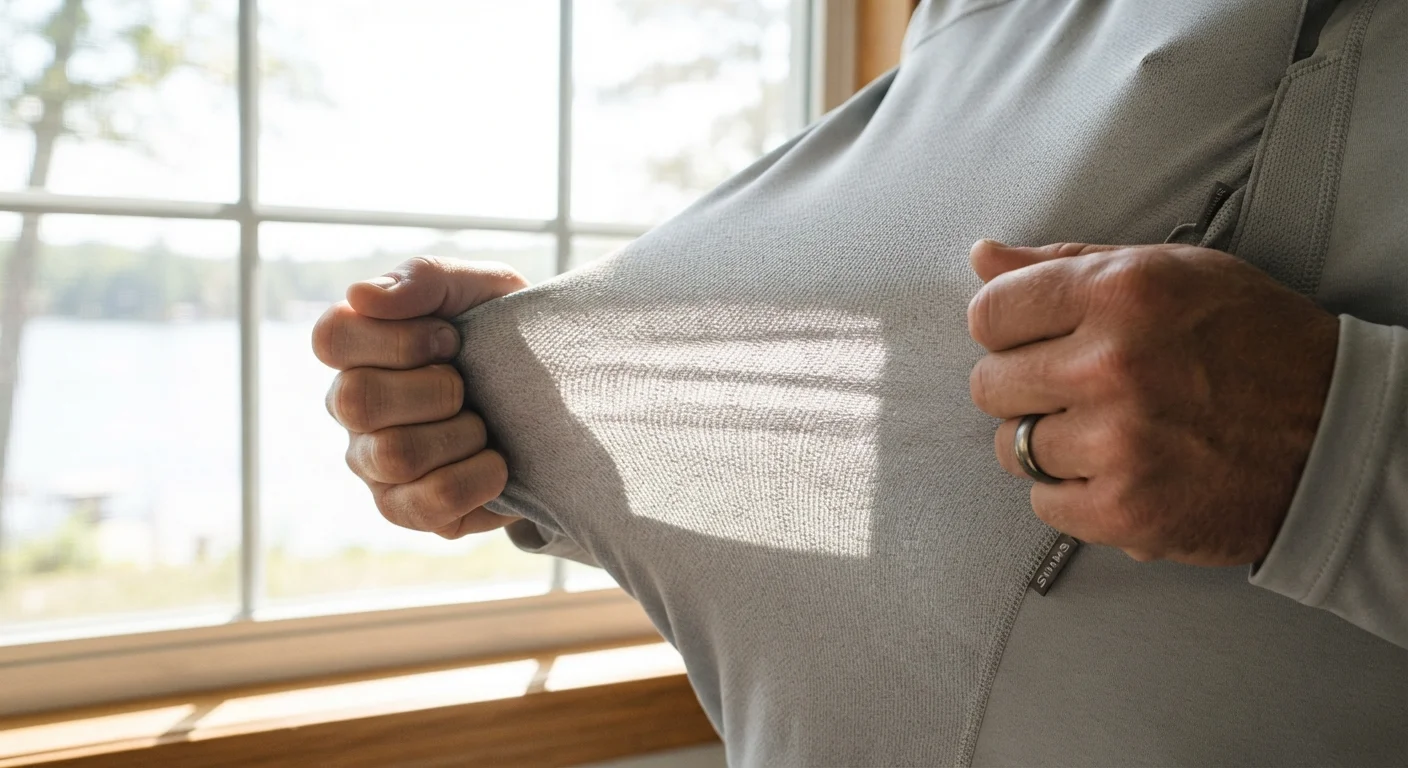
Flip that care tag over. The ratio printed there tells you more than any marketing headline ever will.A professional performance fishing apparel manufacturer evaluates fiber ratios before mass production.
Every legit performance fishing shirt should hit 85–92% Polyester, 5–8% Nylon, 5–7% Spandex . Polyester stays above 85% to lock in UV blocking and print stability. A small dose of nylon smooths out that plasticky hand-feel. Spandex handles the four-way stretch you need mid-cast.
Want more range of motion? Think kayak fishing, backpack straps rubbing your shoulders all day. Shift to 80–85% Polyester, 8–10% Nylon, 7–10% Spandex . You get more stretch, more abrasion resistance, and slightly less UV punch. Still solid.
The hard rule: Nylon should never exceed 30%. Cross that line and quick-dry performance drops off fast. Nylon holds moisture longer than polyester, which kills the “quick dry fishing shirt material” claim brands love to slap on the label.
I see shirts labeled “100% Polyester, no spandex” all the time. No stretch fiber means restricted movement, and cheap polyester without spandex pills fast. I’ve had shirts turn fuzzy after three trips.
90-second test: Check the label ratio first. Pinch the fabric and stretch it diagonally. If it snaps back instantly with zero fight, spandex is doing its job. If it feels stiff or paper-like, you’re holding low-grade polyester with nothing to balance it.
UPF Sun Protection Level: The Difference Between Inherent UPF and Coated Sun Protection
Two shirts can both say "UPF 50+" and mean completely different things. One blocks UV from the fiber itself. The other relies on a surface coating that washes off.
UPF 50+ means only 1/50, roughly 2%, of UV rays get through. That's 98% blockage, with UVA transmission under 2%. China's national standard GB/T 18830-2009 requires UPF over 40 and UVA transmission below 5% before a product can even claim "sun protection." Anything below UPF 25 is basic protection at best, blocking around 93%.
Inherent UPF builds UV absorbers or blocking particles directly into the fiber during spinning. UV gets absorbed or scattered inside the fiber structure. Wash it fifty times, abrade it on rocks, and the rating holds. Coated UPF sprays a finish onto the fabric surface after weaving. It's cheap and works great on day one, but degrades fast with washing, sweat, and sun exposure — exactly the conditions you fish in.
Cotton makes this worse. A dry cotton tee might test UPF 15-20. Get it soaked with sweat or rain, and that number can drop below 10. This is why polyester and nylon dominate real fishing apparel — dense, hydrophobic fibers barely shift UPF wet or dry.A trusted performance fabric fishing apparel supplier can verify UV protection materials and testing standards.
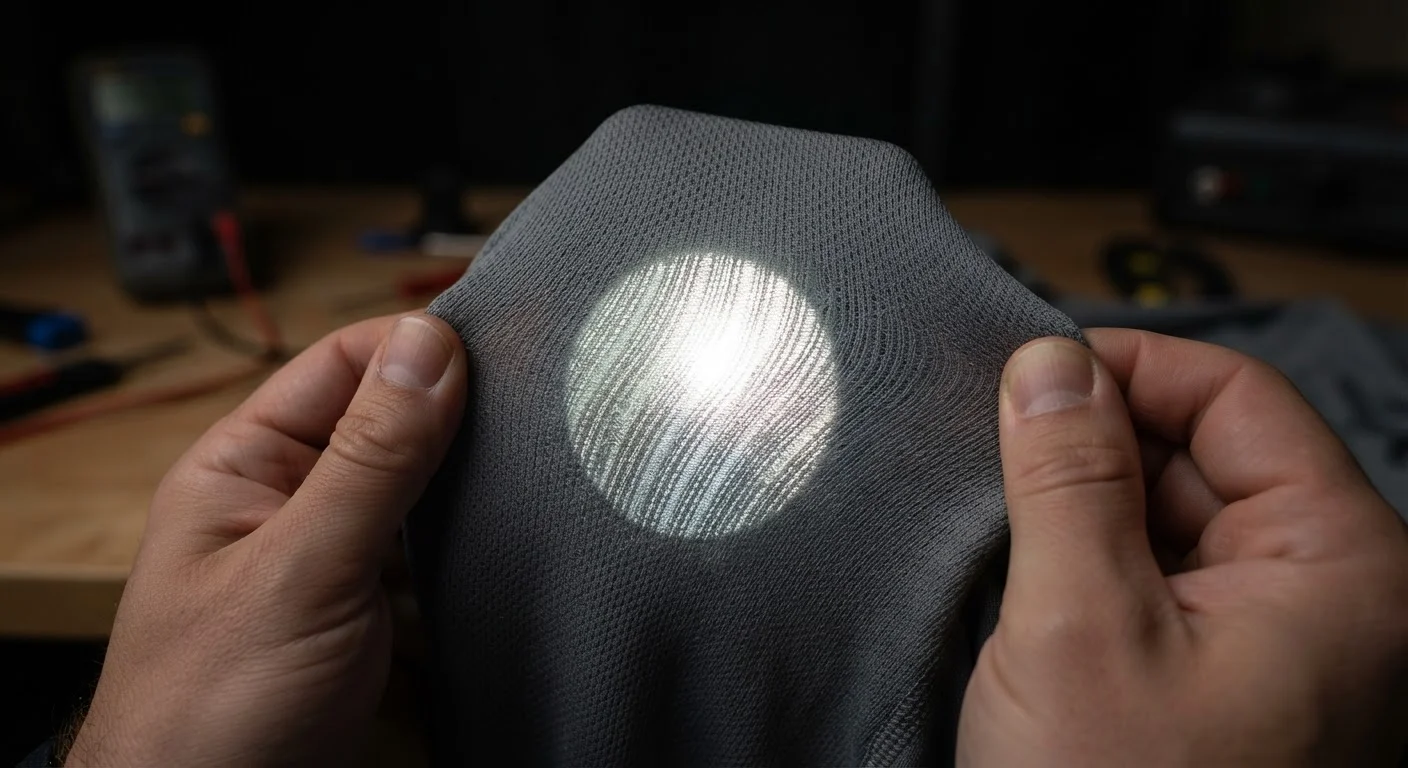
Try this 90-second flashlight test. Stretch the fabric flat, shine a phone light through the back side. If light punches through easily with visible pattern, you're looking at UPF under 30. Real UPF 50+ fabric looks almost matte and opaque under strong light, with just a faint glow at the edges. Check this against the label's stated standard (GB/T 18830, AS/NZS 4399, or AATCC 183) — if there's no standard listed, don't trust the number.
Quick-drying performance: Measured standards for GSM weight and moisture-wicking rate
Polyester dries 3–4 times faster than cotton , measured under GB/T 21655.1, the standard that governs "quick dry fishing shirt material" claims.
The test measures grams-per-hour evaporation. Grade I hits ≥0.40 g/h, Grade II sits at ≥0.30 g/h, Grade III bottoms out at ≥0.20 g/h. A standard cotton tee sits at around 0.10 g/h. That gap is why your cotton undershirt still feels damp an hour after your polyester shirt already dried.
GSM weight decides which grade you land in.OEM performance fishing apparel projects allow brands to adjust GSM, fabric blends, and performance targets. General athletic wear runs 130–200 gsm, but fishing apparel has its own sweet spots:
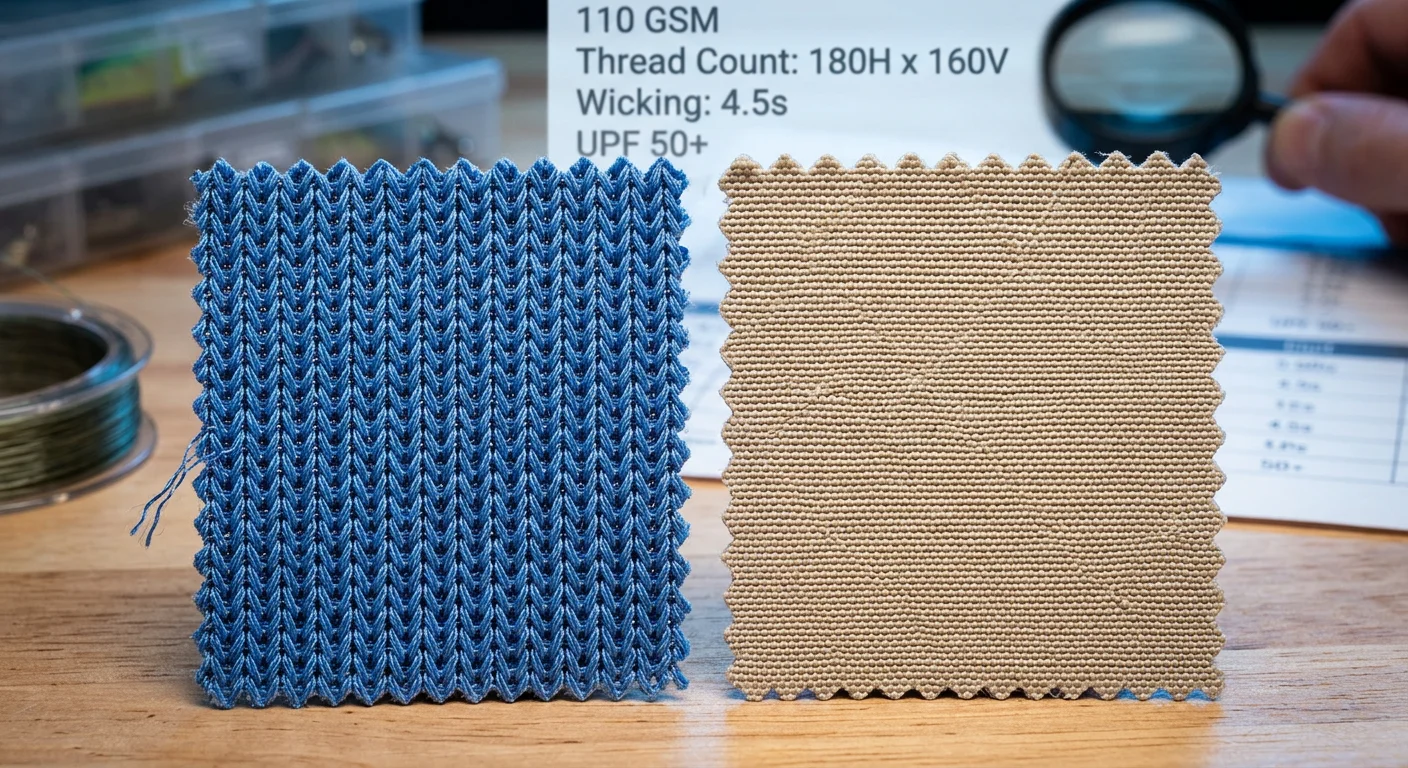
120–140 gsm — tropical/summer shirts, hits Grade I–II drying rates, moisture permeability above 10,000 g/(m²·d). Drop below 110 gsm and UPF plus abrasion resistance collapse fast.
150–170 gsm — the versatile workhorse. Still lands Grade II–III drying, but with better structure and durability.
180+ gsm — absorbs water fine, dries slow. This is cotton-comfort territory; labels claiming performance fishing are misleading.
Try this 90-second test. Drop water on the fabric flat. Watch the spread. If it diffuses across the weave in under 2–3 seconds, you're in real quick-dry range. When it beads or soaks slowly past 5 seconds, that "speed dry" tag is doing more talking than the fabric.
Air permeability and ventilation design: MVTR index and opening layout
Sweat doesn't care about your shirt's marketing copy. It just needs somewhere to go, and that's what MVTR measures.
MVTR stands for moisture vapor transmission rate. It measures grams of water vapor passing through one square meter of fabric in 24 hours. Under 1,000 g/m²/24h is basic, barely better than a windbreaker. 5,000–10,000 g/m²/24h covers most breathable fishing apparel, fine for casual days. 10,000+ g/m²/24h is where high-output paddling or hiking to your spot actually feels tolerable.
RET matters too. It measures resistance to vapor transfer through the ISO 11092 hot-plate method. RET under 10 means good thermal regulation for fishing clothing under real exertion. Above 13, expect that clammy, trapped-heat feeling by midday.
Fabric alone can't fix everything. ODM performance fabric fishing apparel solutions help create functional designs beyond standard templates.Even Gore-Tex Pro, at about 5,000 g/m²/24h MVTR, runs hot without structural venting. Pit zips at 25cm or longer, mesh-backed panels covering a third of your upper back, and laser-perforated shoulder zones move actual air.
No MVTR number on the tag, no ASTM E96 or JIS L1099 reference, and no mesh or zip venting? Then that breathable label is meaningless.
Waterproofing grade: Static water pressure (HH) and the truth of sealant for joint sealing
A jacket rated "20,000mm waterproof" flooded through the shoulder seam in under twenty minutes on a river trip. The fabric held. The stitching didn't.
HH (hydrostatic head) measures how much water pressure a fabric resists before it leaks. 1,000mm HH means it starts leaking under a 1-meter water column. 10,000mm HH holds against a 10-meter column, roughly 100 kPa.
For river or boat fishing, HH should sit at 10,000–15,000mm, the same tier as quality 3-season hiking jackets. Sustained sitting, spray, and wind-driven rain are harder on a fabric than a city rainstorm. Ice fishing or mixed rain-and-snow conditions push that bar to 25,000mm+.
Labs test HH on a clean, seamless fabric swatch. Your actual jacket is full of stitch holes. Seam sealing (Fully Seam-Sealed) is the tape bonded over every seam, including shoulders, hood-to-collar, zipper flanks, underarms, and pocket bags. Skip one seam, and water bypasses the fabric's HH rating entirely through the needle holes.
Then there's DWR (Durable Water Repellent), the surface treatment that keeps water beading instead of soaking in. High HH with dead DWR still traps moisture and kills breathability.
Flip the jacket inside out. Trace every seam for a continuous, flat tape strip with no gaps or peeling edges. Then drip water on the outer shell. Beads that roll off mean DWR's active. Water that spreads and darkens the fabric means it's gone or was never applied.
If there's no HH number on the tag, no visible seam tape, and water soaks instead of beading, the jacket is a "waterproof fabric" with zero waterproof structure.Brands can compare custom fishing apparel wholesale price options when selecting verified performance fishing apparel suppliers.
Wear resistance strength: Denier number and Ripstop anti-tear structure
That hook you snagged on a submerged branch last season either survived or it didn't. The difference usually comes down to a number most anglers never check: Denier.
Denier measures the mass, in grams, of 9,000 meters of fiber. Higher number means thicker fiber, more resistance to abrasion and tearing. Here's the gradient that matters for fishing apparel:
20D–40D : Ultralight windbreaker or tent-liner territory. Low-to-low-mid abrasion resistance. One sharp hook and you've got a hole.
70D : Standard tent fabric, windbreakers, light jackets. Mid-tier durability.
100D–210D : Technical shell layers and packs. High abrasion resistance, still wearable.
300D–450D Ripstop : Backpack-grade main fabric. This is where fishing pants and wading jackets should sit.
600D–1000D : Pack bottoms, military-spec gear. Overkill for shirts, right for high-abrasion boot cuffs or knee reinforcement.
Ripstop isn't a marketing word. It's a woven grid. Every 5–10mm, thicker reinforcement threads run through the base weave at 3–4 times the Denier of the surrounding fabric. That's why you see the visible checkerboard pattern under light. And it works: 70D plain-weave nylon tears at roughly 5–8 lbs/in, while 70D Ripstop jumps to 15–20 lbs/in. A 2–3x improvement at the same weight.
For a real-world benchmark, tearing strength climbs roughly 15–20% per 200D increase in taffeta polyester testing. Fiber type matters even at equal GSM: polyester < standard nylon < high-tenacity nylon (Cordura/Robic) < UHMWPE (Dyneema). That's why a thin Cordura panel can outlast a thicker generic nylon one.
Practical spec targets:
- Shirts: 70D–210D, Ripstop optional unless you're bushwhacking to your spot.
- Pants, wading gear, jackets: 210D–450D Ripstop minimum. Cordura or Robic (≥210D) for rock scrambling or heavy brush.
Watch for the trap: labels that shout "abrasion resistant fishing clothes" with zero Denier number and zero visible grid. That's almost always low-Denier plain weave underneath — same claim, half the durability.
90-second test: Scratch the fabric fast with a fingernail or zipper pull, 10–15 passes. Fuzzing or pilling immediately means you're under 40D with no reinforcement. Hold it under light next — look for a faint checkerboard texture. See the grid, you've got real Ripstop. See flat, uniform weave, you're paying for a word, not a structure.
Elasticity and Stretch Recovery: Does Four-way Elasticity Sacrifice Sun Protection and Shade Coverage?
Pull stretch fabric fishing performance wear taut, and UV protection vanishes along with the wrinkles.
Plain-weave polyester stretched just 10% (normal shoulder movement while casting) opens yarn gaps by 20–30%. UPF drops from 50+ to roughly 40. At 20% stretch during hard paddling or a big hookset, UPF can fall below 30. That's a real sun protection fabric failure.
Quality four-way stretch blends handle this differently. A well-engineered nylon spandex blend, tested at 50% elongation under ASTM D6603, holds UPF at 55–95, down from an unstretched 60–120. That's under 15% decay. The fiber cross-section and weave density do the real work, not just spandex percentage (typically 3–7%, up to 10–15% in high-stretch pants).
Cyclic fatigue is a second way cheap stretch fabric fails. After 100 stretch-recovery cycles, budget polyester-spandex blends drop from UPF 50+ to 35–40 permanently. The pores stop closing.
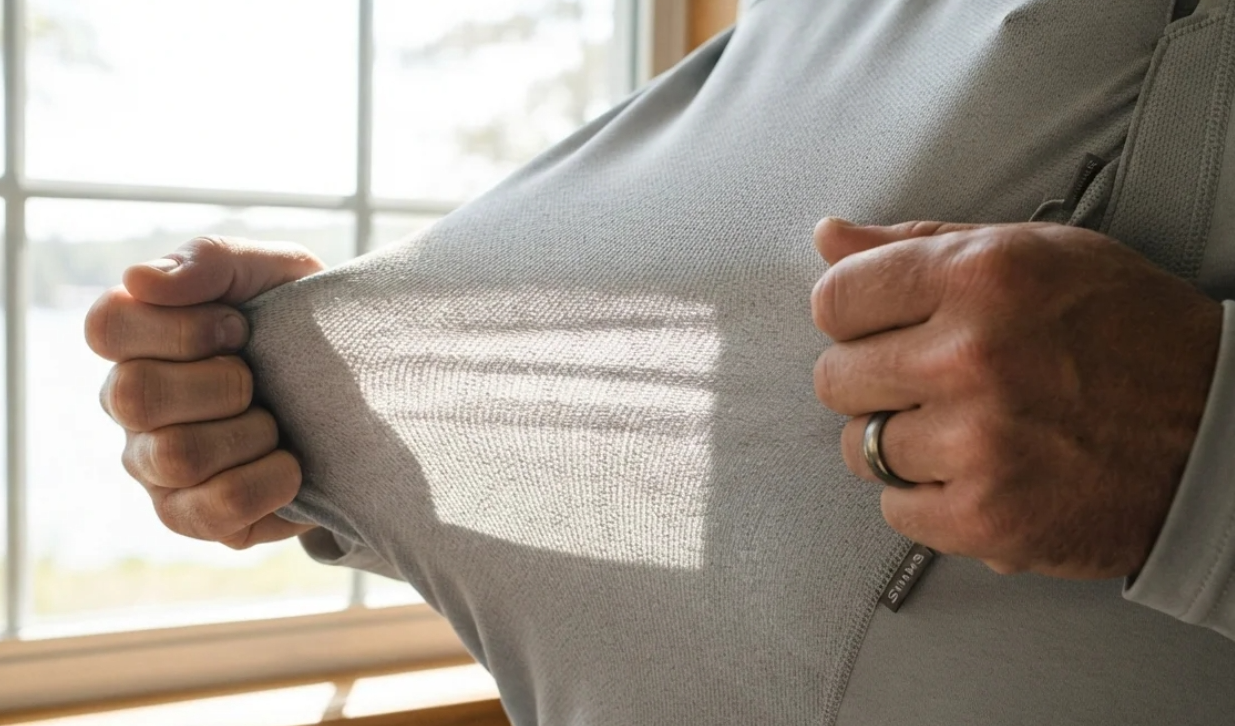
90-second test: Stretch the fabric 10–20% toward a window or phone light. Real UPF holders stay opaque, no whitening. Cheap weaves show visible light-grid patterning — that's your sun protection leaving through the gaps.
Anti-odor durability: Antibacterial technology and fabric anti-tangle grade
My buddy's "anti-odor" fishing shirt started smelling like a bait bucket after four trips. Mine, same brand tier, didn't. The difference wasn't luck. It was fiber technology, and almost nobody checks the label close enough to see it coming.
Pilling grade runs 1–5 under ISO 12945-2 (Martindale method) or ASTM D3512. 5 is flawless, 1 is a disaster. Most garment fabric needs to clear ≥3 . Anything calling itself performance apparel should sit at ≥4 , and high-end functional wear pushes for 4–5 . Under Martindale's 200-cycle test at roughly 415g load, a 5 shows zero visible change. A 4 shows light surface fuzz, barely any actual balls. A 3 already shows moderate pilling — that's your minimum, not your target.
Antibacterial durability follows its own ladder: A through AAAAA . Tested against Staph, E. coli, and Candida albicans, each grade ties a wash count to a required inhibition rate:
A : 10 washes, ≥70% inhibition (60% for Candida)
AA : 20 washes, ≥80%/70%
AAA : 50 washes, ≥85%/75%
AAAA : 100 washes, ≥90%/80%
AAAAA : 150 washes, ≥95%/85%
China's FZ/T 73023-2006 sets the durable-antibacterial bar at 50 washes with ≥70% inhibition against Staph and E. coli. Some consumer brands slap "7A" or "10A" on the tag, claiming 150 or even 300 washes at ≥90%. Those aren't national standards — they're proprietary marketing numbers. Ask for the third-party report before you believe them.
The real technology gap is melt-spun antibacterial masterbatch , which embeds the antimicrobial agent inside the fiber during spinning. It releases slowly as the fabric wears, holding performance past 50 washes. Surface-coating treatments just spray it on after weaving. Cheap, and gone in a fraction of the washes. Silver-ion fabric tested under ISO 6330 typically holds ≥90% inhibition even after 50 washes, which is why it's become the go-to for serious anti-odor fishing shirts.
Watch for labels that say "anti-odor treated" with zero wash-count number, zero inhibition rate, zero mention of the actual tech path (silver ion, masterbatch blend, or surface finish). No data means assume it's the cheap version — dead by wash 20.
You can run a 90-second test, no lab required. Grab a Velcro strap — your pack, your PFD, anything with a hook side. Rub it against the fabric fast, 20–30 passes. Heavy pilling immediately means you're looking at grade 1–2, unsuitable for anything you'll wear more than a season. Barely a fuzz means you're in 4–5 territory. Then open the packaging and smell it. A sharp chemical or acidic odor straight out of the bag signals heavy dye-finish residue that irritates skin and accelerates odor buildup once you sweat in it. Quality antibacterial fabric with low-residue processing smells like almost nothing.
One more data point: Merino wool sits at 14–18% moisture regain versus cotton's 8–10%, roughly 50–80% higher wicking capacity. That's part of why wool-blend base layers resist odor naturally, even without added antimicrobial treatment — moisture doesn't sit long enough for bacteria to build up.
Conclusion
After a decade of getting soaked, sunburned, and fooled by fancy hangtags, I'll tell you straight: fabric performance is math. GSM weight, denier count, UPF fiber density—those numbers don't lie the way marketing copy does. The eight factors we broke down are your defense against paying premium prices for polyester that pills after two trips or "sun protection" that's really just a thin coating wearing off in the wash.
Next time you're standing in a tackle shop or unboxing a fishing shirt, skip the brand story. Pinch the fabric. Check the label for actual GSM and Denier numbers. Run the 90-second test we outlined. No guesswork, no trusting a swing tag.
Your gear should work as hard as you do on the water.A reliable performance fishing apparel wholesaler helps brands deliver tested gear at scale. Now you've got the framework to make sure it actually does.