Last spring, a mid-sized fishing apparel brand got hit with a 12% return rate on their new performance tees. The culprit wasn't sizing or print quality—it was fabric. They'd switched to recycled polyester to land a sustainability-focused retail partner, but nobody on the sourcing team verified moisture-wicking performance before locking in 3,000 units. The GSM was off, the UPF rating didn't hold up under testing, and the "eco-friendly" claim nearly cost them the account entirely.
That 10-20% price premium for recycled PET fabric is not the real question. The real question is whether it delivers the performance your customers expect at the price point you're selling—and whether your Custom Fishing Apparel supplier's certifications actually back up what's on the invoice. Below is the exact cost and performance breakdown, tested side-by-side, that answers both.
Real Cost Breakdown: Recycled vs. Virgin Polyester per Yard and per Garment
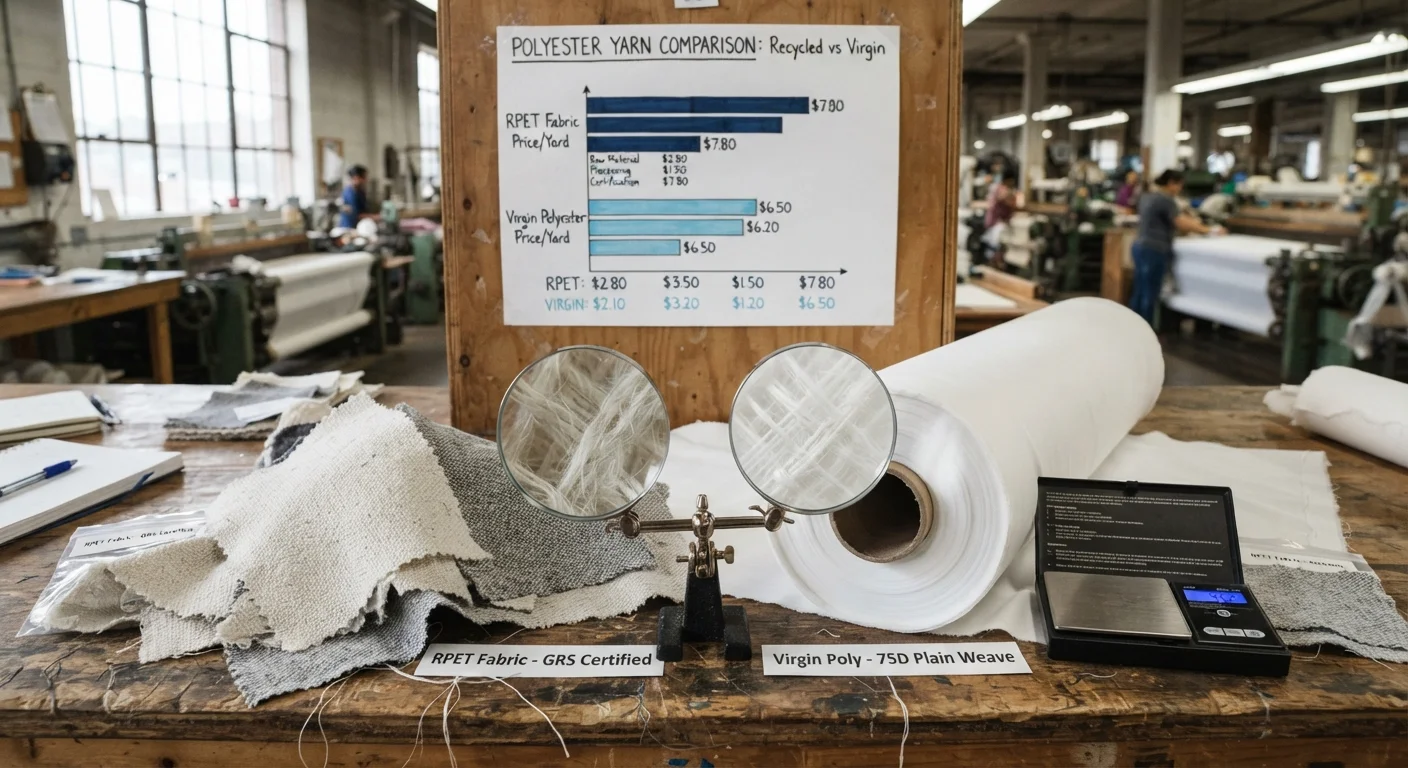
Numbers settle arguments faster than opinions. Here's what recycled polyester actually costs you, broken down to the yard and the garment, so you're not guessing at your next Custom Fishing Apparel supplier call.
The upfront premium varies more than most sourcing guides admit. At the fiber level, recycled polyester runs 5–20% above virgin , but real-world spreads are wider. One filament comparison showed a 13–18% premium on average. Push into higher recycled-content blends, and that premium jumps to 25–35% . Feedstock matters here too— post-consumer bottle rPET is cheaper than textile-to-textile (T2T) rPET , because T2T requires extra sorting and decontamination.
Extreme cases exist, and they're brutal. A Q2 2025 Europe T2T snapshot recorded rPET at €2,479/tonne versus virgin PET at €950/tonne —a +161% procurement gap . That's not a typo. That's what happens when high-purity textile-to-textile recycling meets tight supply.
But total cost of ownership tells a different story. The same source calculated a 3-year TCO of €2,969/tonne for rPET versus €2,740/tonne for virgin—only +8.3% . By year 5 , rPET dropped to €3,209/tonne while virgin climbed to €3,640/tonne , making recycled 12% cheaper long-term .
Per-Garment Math You Can Use Today
For U.S.-based fabric sourcing, virgin polyester averages $0.85–$1.05/kg , while rPET runs $1.10–$1.40/kg . Here's how that translates to a finished fishing shirt:
Item | Virgin | Recycled (rPET) |
|---|---|---|
Fabric cost/yard | $4.00 | $4.60 (+15%) |
Yards per shirt | 1.5 | 1.5 |
Raw material/garment | $6.00 | $6.90 |
GRS certification amortized (per yard) | — | $0.30–$0.80 |
Total delta per garment | — | +$1.35 to +$2.10 |
GRS certification itself costs the fishing apparel manufacturer $3,000–8,000/year before it's spread across production volume—which is exactly why MOQ custom fishing apparel fabric sourcing matters. Smaller runs absorb that overhead poorly. Expect 20–30% premiums on top of base rPET pricing if your order doesn't hit stable volume thresholds.
Quick reference for negotiations: 5–15% premium signals healthy supply and scale. 10–25% is the typical working range. Anything above 30% usually means constrained supply or high recycled-content demands—worth questioning before you sign.
Head-to-Head Performance Data: UV Protection, Moisture Wicking, Tear Strength, and Colorfastness
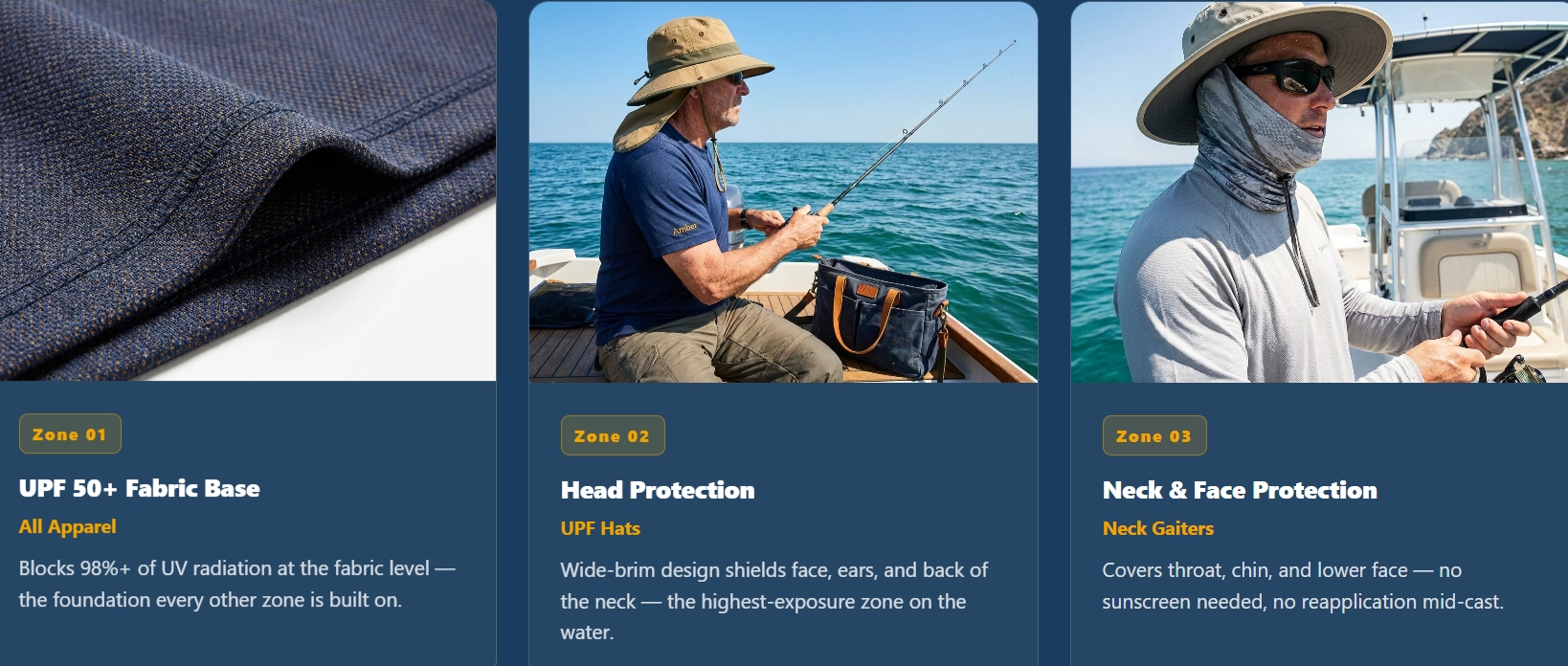
Custom Performance Fishing Apparel Suppliers don't volunteer this: when yarn quality and finishes are controlled, rPET and virgin polyester perform almost identically across every metric that matters for fishing apparel. The gap you're paying a premium to avoid mostly doesn't exist, except in one area.
UV Protection (UPF)
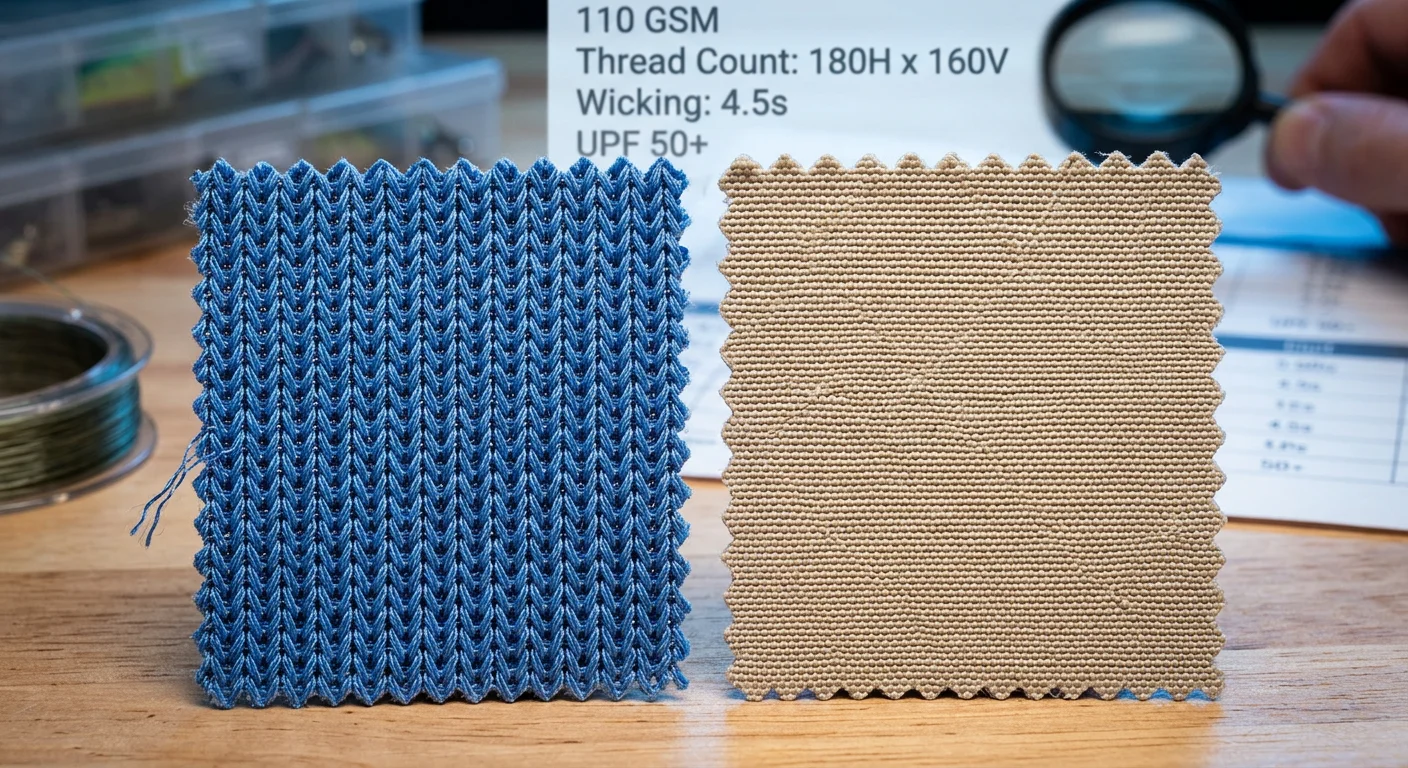
Both fabrics hit UPF 50+ in tight 150–180 gsm knits, blocking ≥97.5% of UV radiation (≤2.5% transmission) under AATCC 183 and ISO 13758 testing. That's the "excellent" tier. If your supplier's rPET sample tests below UPF 40, that's a knit density or finishing problem, not a fiber limitation. Don't accept "recycled fabric can't hit UPF 50" as an excuse.
Moisture Wicking / Quick-Dry
Standard polyester dries in 45–60 minutes. Branded tech versions cut that to 30–40 minutes. Advanced microporous constructions push it further, to 20–30 minutes, with wetting times around 2.7 seconds. Moisture transport (targeting >250 g/m²/hour) is dictated by knit structure and hydrophilic finish, not fiber origin. Under AATCC 79/195 testing, rPET and virgin polyester with matched finishes perform equivalently. A poorly-knitted virgin polyester shirt will underperform a well-engineered rPET one every time.
Tear Strength
Fishing shirts need to survive hooks, boat rails, and rod contact. Generic upholstery-grade polyester (30–70 N) won't cut it. Technical fishing apparel should target 250–350 N tear strength (ASTM D2261/D1424). When intrinsic viscosity (IV) is controlled, rPET and virgin show statistically equivalent results within ±5%. Ask your Custom Virgin Polyester Fishing Apparel supplier for their IV spec if tear strength numbers look inconsistent between fabric lots.
Colorfastness
Both fibers reach grade 4–5 (good to excellent) for wash fastness (AATCC 61) and crocking resistance, when disperse dyes and carrier systems are properly matched to the fiber. This matters for sublimation printing polyester fabric runs. If your rPET base fabric isn't dyed correctly before printing, you'll see fading or dye migration regardless of fiber source.
Where Virgin Actually Wins: DWR Retention
This is the one real gap. On rain shells and technical fishing outerwear using DWR finishes, virgin polyester retains ≈80% of its original spray rating (AATCC TM22) after 20+ home launderings. Comparable rPET constructions typically drop to ≈70% at the same finish level. It's a modest difference, but if you're building waterproof or heavily weather-exposed shells, not lightweight sun shirts, factor this in.
Quick Reference Table
Metric | Target | rPET vs. Virgin |
|---|---|---|
UPF | 50+ (≥97.5% blocked) | Equal |
Moisture wicking | >250 g/m²/h | Equal |
Tear strength | 250–350 N | Equal (±5%) |
Colorfastness | Grade 4–5 | Equal |
DWR retention (20+ washes) | ≥80% spray rating | Virgin: ~80% / rPET: ~70% |
GSM range | 130–200 gsm | Equal, no weight penalty |
Abrasion (Martindale) | >20,000 cycles | Equal |
For standard fishing shirts and sun-protection tees, performance parity is real. Reserve the virgin-only decision for technical shells where DWR longevity is non-negotiable.
When to Choose Recycled Polyester for Custom Fishing Apparel
Four conditions need to line up before rPET makes sense for your program. Miss two or more, and you're paying a premium for nothing.
Volume and Price Threshold
Below 500 pieces, expect the full 10–20% material premium. There's no scale to negotiate with. At 500+ units, push Recycled Polyester for Custom Fishing Apparel suppliers for price breaks; the gap typically compresses to 5–15%. At 5,000+ units, the incremental cost drops to roughly $1–2 per garment on tops in the $8–15 FOB range. That's a 5–10% uplift, not 20%. Use $2/pc as your hard ceiling for standard 120–150 gsm shirts.
Market and Positioning Fit
Recycled polyester earns its premium when your buyer actually cares. EU/UK retailers now filter by "recycled materials" tags. REI, Backcountry, and Patagonia let shoppers search specifically for 50-75%+ recycled content. If you're selling to eco-conscious clubs, green-marketing brands, or a retail price point of $60+, a $5–10 retail uplift justified by "GRS-certified, 100% recycled" labeling is realistic and defensible.
Product Spec Match
Use rPET for lightweight, quick-dry, UV-protective club shirts, not heavy-duty, abrasion-critical technical gear. At 120–160 gsm knits, performance matches virgin almost exactly, and DWR retention becomes irrelevant since sun shirts don't need it.
Certification Non-Negotiable
Only proceed if your mill is GRS-certified and can hand over transaction certificates tied to your specific PO. Target 80–100% recycled content—"made with recycled" claims sometimes hide as little as 20% actual rPET. No certificate, no order.
When Virgin Polyester Is the Better Choice for Custom Fishing Apparel
Flip the scenario, and virgin polyester wins on four fronts: raw cost, saltwater durability, QC consistency, and compliance simplicity.
Price and volume. Virgin runs 10–20% cheaper than rPET at similar specs. Alibaba B2B listings confirm this gap on jacket-weight fabrics. It still holds 60–70% of the fishing apparel market for a reason. Club and team uniform budgets typically sit under $15–20/garment; traceable rPET pushes that to $20–25. On 1,000–10,000 piece runs, that premium adds $2,000–10,000 per PO, and buyers won't spend it once performance parity is proven.
Saltwater durability. Smooth continuous-filament virgin polyester retains under 2% salt by weight after rinse-dry and loses only 1–2% tensile strength after 72 hours of simulated seawater exposure. For offshore shells needing permanent DWR or post-40-wash water repellency claims on the hangtag, virgin hits spec more reliably than most rPET inputs.
QC consistency. Recycled feedstock variability (flake quality, contamination, viscosity) means more lot-to-lot testing. Virgin mills hit fixed recipes off tighter tolerances. That matters when your tech pack demands exact 120–170 gsm windows or UPF 50+ wet-state performance across reorders.
MOQ reality. Specialty rPET shells often carry 500–1,000m minimums versus 300m or less for standard virgin poly. Pilot programs of 50–300 jackets get hit with inflated per-unit pricing and fewer stock colors when they try to run rPET at that scale.
Choose Virgin When | Threshold |
|---|---|
Order volume | Under 300 pcs/style |
Unit budget | Under $20/garment |
End use | Saltwater shells, offshore gear |
Supplier certs | GRS/RCS unavailable or unverified |
How to Verify Your Supplier’s Recycled Polyester Claims (GRS and Testing Checklist)
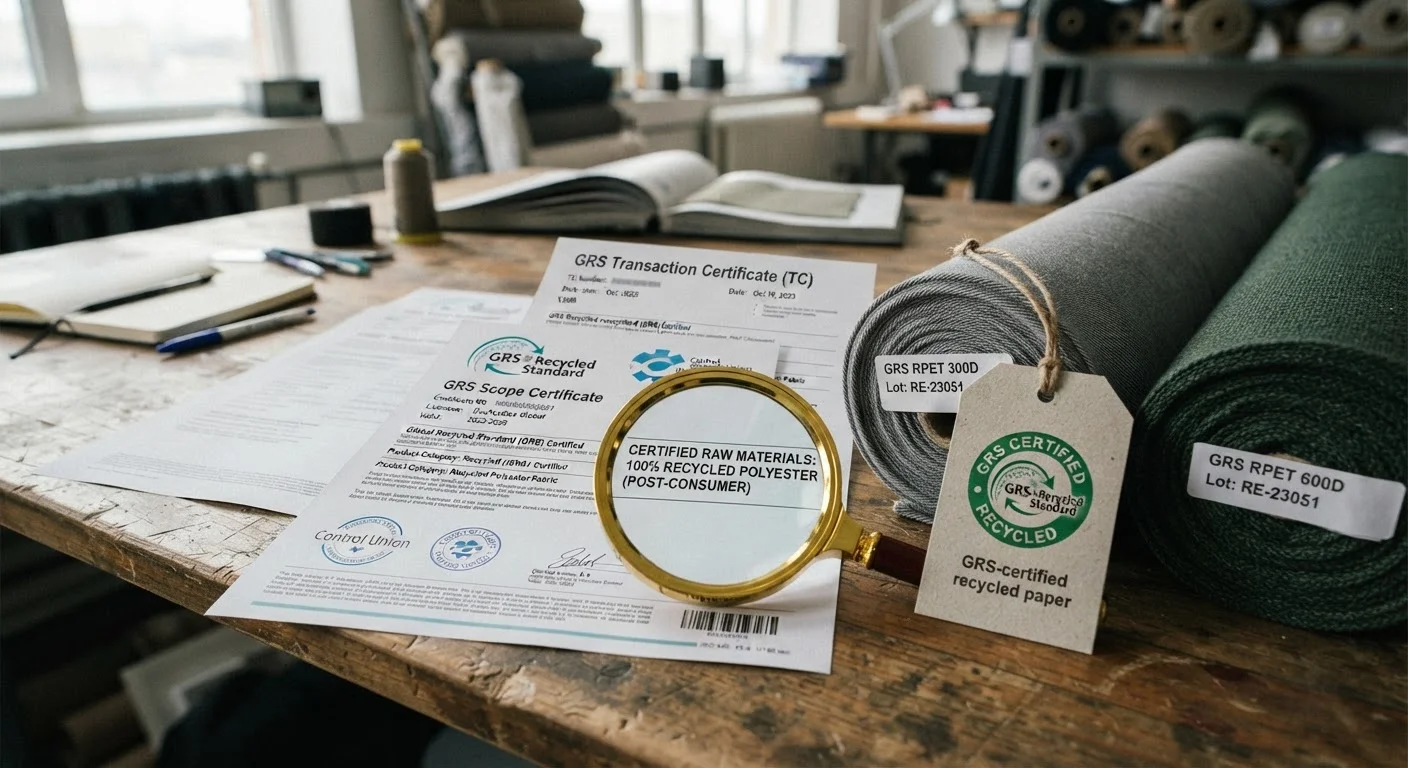
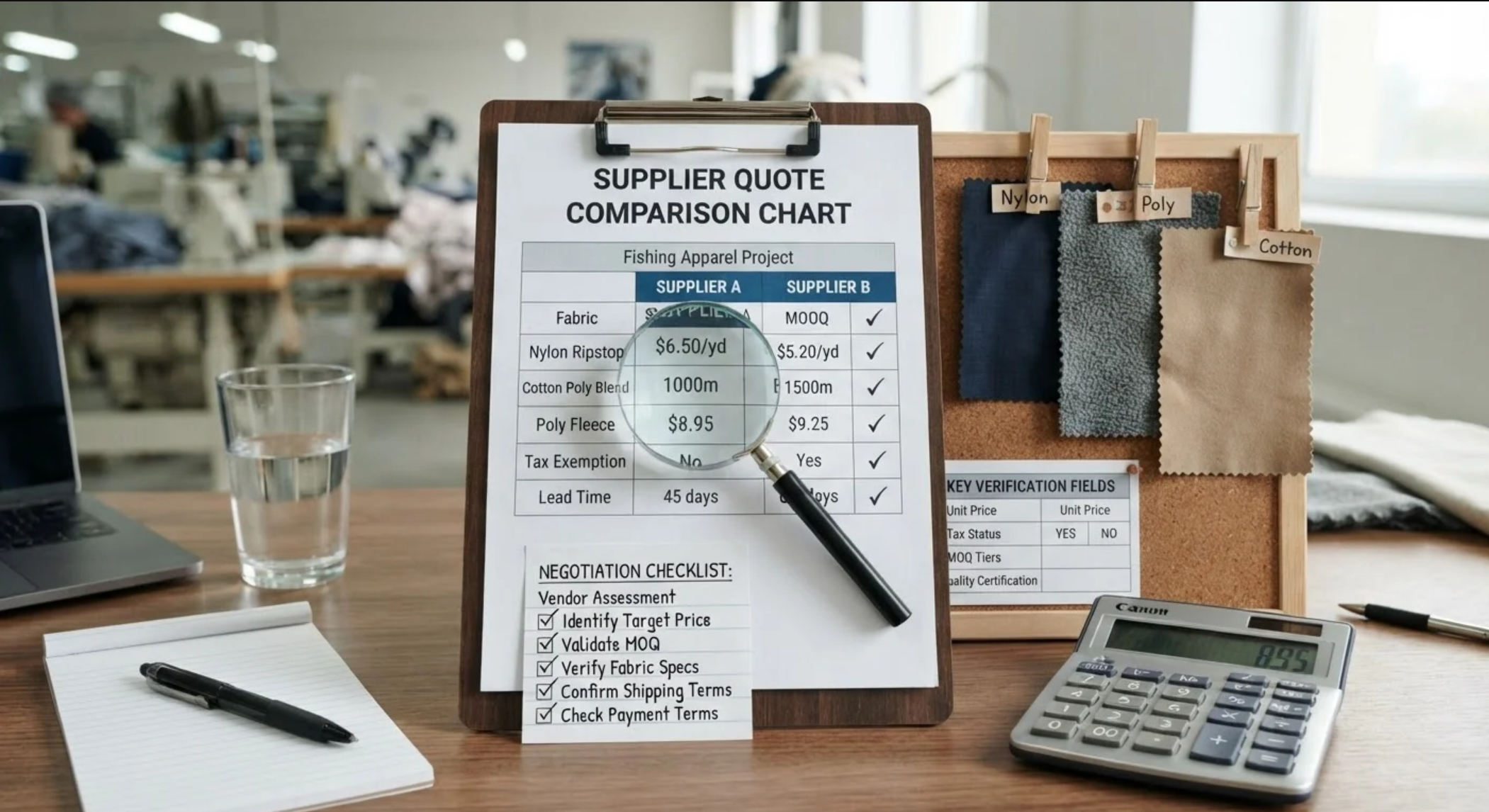
A GRS logo on a hangtag means nothing if the paperwork behind it doesn't hold up. Suppliers know most buyers never ask for the documents that actually prove recycled PET fabric production, so ask.
Documents to Request Before You Pay a Deposit
GRS Scope Certificate (SC) from every facility touching the fabric: spinner, knitter, dyehouse. Confirm the certification body is Textile Exchange-approved (Control Union, SGS, Ecocert, ICEA, SCS Global Services). SCs run 12 months. Check the shipment date falls inside that window.
Transaction Certificate (TC) per shipment. A general SC isn't proof for your PO. The TC must list recycled %, post- vs. pre-consumer split, quantity matching your invoice, and reference the SC number. Anything issued more than 90 days before shipment is worth questioning.
Recycled content declaration tied to your specific SKU, not a mill average. No percentage, no post/pre-consumer breakdown, no order.
Lab Tests Worth Paying For
Send samples to SGS, Intertek, or Bureau Veritas for:
Intrinsic Viscosity (IV) : 0.6–0.7 dL/g is the stable benchmark. Way off, and spinning consistency suffers.
DSC (Differential Scanning Calorimetry) : virgin PET melts sharply; rPET shows a broader peak, often 2–10°C lower. This is your hard evidence the fiber actually has a recycled heat history.
FTIR : confirms it's PET, not a nylon or PP substitute hiding in the blend.
Fabric colorfastness testing : grade 4+ on wash fastness per AATCC, plus OEKO-TEX Standard 100 for restricted substances.
Red Flags That Signal Fake or Inflated Claims
CB not on Textile Exchange's approved list, or an SC number that doesn't match standard format (CB-Code-GRS-######).
"Eco" language on packaging with zero GRS/RCS certificate behind it.
Vague feedstock answers, if they won't name the recycler or region, walk.
Build these checks into every supplier contract, with re-verification every 6–12 months. That's how you protect the sustainability positioning you're paying a premium for.
Cost Impact Calculation: Per-Unit Premium for Recycled Polyester in Your Order
Run the math before you run the production line. The premium you saw earlier drops hard once you factor in volume, and the formula below turns a vague “10-20% more expensive” into a number you can defend to finance.
Use this per-garment calculation:
Cost per garment (rPET) = (Fabric cost/yard × Yards used) + (Certification cost/yard × Yards used) + (Batch testing cost ÷ Units in batch)
Then: Per-unit premium = rPET cost − Virgin cost
Small Batch vs. Scaled Order: Same Fabric, Different Premium
At 1,000 units , fixed costs hit hard. A $4,000/year GRS audit spread across 10,000 yards adds $0.60/shirt. A $500 lot testing fee across 1,000 shirts adds another $0.50. Combined with the fabric delta, total rPET cost lands near $8.00/shirt versus a $6.00 virgin baseline —a 33% premium .
Scale to 10,000 units , and the same $4,000 cert fee spread over 100,000 yards drops to $0.06/shirt. Consolidated testing drops to $0.05/shirt. Total rPET cost falls to roughly $7.01/shirt —a 17% premium , nearly half.
Decision rule: if your calculated premium exceeds 20% and you can’t recover it through retail pricing or brand positioning, virgin stays the safer FOB-margin choice.
Conclusion
Recycled polyester earns its 10-20% premium only when your order clears 500 units and your buyer cares about the eco-label on the hangtag. Below that threshold, virgin polyester still wins on tear strength and per-yard cost, and no sustainability story changes that arithmetic.
Pull your current PO quantity Monday morning. Run it through the cost calculator in this guide, then match it against your target market's price sensitivity. Before you approve a single yard, demand the GRS certificate and lab-tested GSM, UPF, and colorfastness numbers. Suppliers who dodge that request are the ones about to sell you 60% recycled content at 100% recycled pricing.
Print the decision matrix, bring it to your next custom fishing apparel manufacturer call, and use the data to choose your fabric.