You've got three quotes on your desk, and the numbers don't match up. One supplier quotes fishing pants at $8.20/pc, another at $11.50/pc — same 180D nylon, same MOQ, same "custom" label. Is that a fair spread, or is someone padding margins on you?
Custom fishing pants and fishing shorts differ in fabric specs, moisture-wicking fishing fabric grades, cutting waste, and stitching hours. Each of these variables shifts cost by 15-25%. If you don't know which lever moved, you can't tell a legitimate quote from an inflated one.
This breakdown gives you the actual numbers — fabric-by-fabric pricing, MOQ tiers, and scenario-based selection logic. Your next negotiation starts from data.
Fabric Cost Breakdown: Unit Price Range Comparison of Three Main Fabric Types
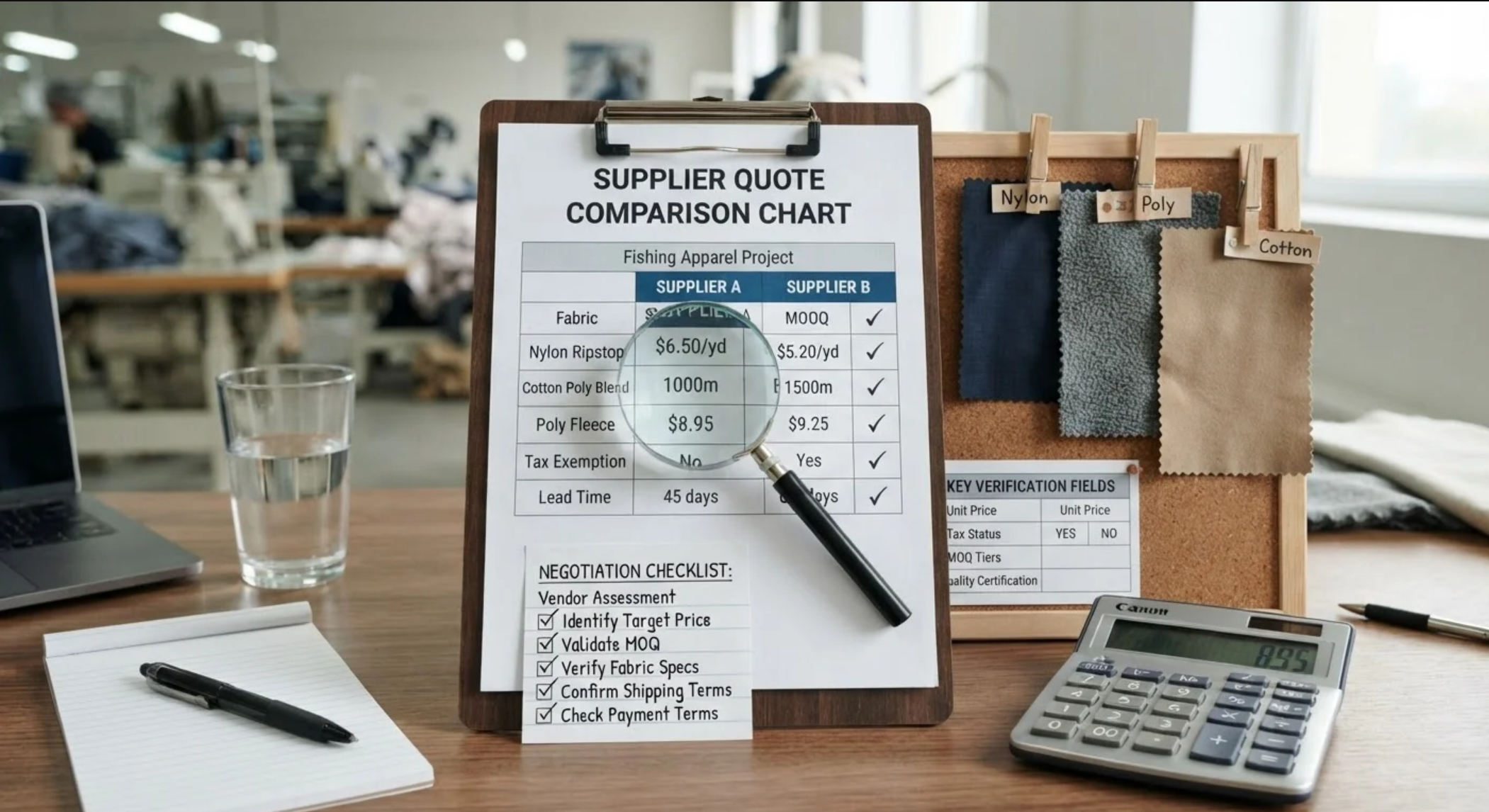
Every fabric quote breaks down into four cost blocks, no matter what the custom Fishing Pants and Fishing Shorts supplier tells you. Raw yarn accounts for 45–55% of the finished fabric price. Weaving, dyeing, and finishing take another 20–25%. Logistics adds 8–12%. Compliance, testing, and certification runs 5–8%. Once you know these ratios, you can reverse-engineer any quote and spot where the padding sits.
Those ratios break down differently across the three fabric families on a fishing apparel spec sheet: cotton-based wovens, full-polyester technical wovens, and cotton/poly knit blends.
Cotton Woven (Poplin-Type Base Fabric)
For a standard 40×40, 133×72 density cotton poplin:
Raw material cost : ¥1.0–1.9/meter ($0.14–0.26), based on yarn at ¥13,000–16,000/ton
Weaving fee : ¥2.5–3.2/meter, figured with the standard "one dime per pick" formula (weft density ÷ 2.54 × 0.1)
Dyeing : ¥1.5–2.8/meter depending on season and dye process
Finished fabric price (bulk) : ¥6–9/meter ($0.83–1.25) , solid color, no complex printing
This is your baseline. It's cheap, but it lacks the moisture-wicking performance most buyers demand for on-water use.
Full-Polyester Technical Fabric (Chunyafang-Type)
For 260T 75D×75D full-dull polyester, the closest structural cousin to nylon versus polyester in fishing fabric quotes, the costs are:
Raw material cost : ¥1.4–1.8/meter ($0.19–0.25), based on DTY yarn at ¥13,500/ton
Weaving fee : ¥2.0–2.8/meter
Dyeing (dye-vat process) : ¥1.0–2.0/meter
Finished fabric price (bulk) :
Solid color: ¥5–8/meter ($0.69–1.11)
Printed (sublimation printing fishing pants stock): ¥7–12/meter ($0.97–1.67) , depending on color count and width
Polyester runs cheaper than nylon at equivalent grades, which is why it dominates budget UV protection fishing apparel lines. If your quote shows polyester priced above ¥12/meter without printing, ask why.
Knit Cotton/Poly Blend (Moisture-Wicking Base)
Knit fabric pricing works by weight. The formula is (greige fabric price + dyeing/finishing fee) ÷ (1 − dye loss rate). Example: ¥16.42/lb greige plus ¥5.6/lb processing with a 12% loss gives a ¥25.02/lb cost and ¥28.76/lb sell price. At 180g/m² weight and 1.8m width, that comes out to ¥15–25/meter ($2.08–3.47) , or ¥45–70/kg ($6.25–9.72) .
This is your breathable fishing shorts material tier. The cost per meter is higher, but the stretch and airflow justify the premium for competition and shore fishing use.
Quick Reference Table
Fabric Type | Raw Material Cost | Finished Fabric Price (Bulk) | Main Cost Drivers |
|---|---|---|---|
Cotton woven (poplin) | ¥1.0–1.9/m | ¥6–9/m | Weft density, yarn count, dye process |
Full-polyester (chunyafang) | ¥1.4–1.8/m | ¥5–12/m (printed higher) | Yarn grade, print colors, width |
Knit cotton/poly blend | Priced by lb/kg | ¥15–25/m | Weight, dye loss rate, finishing |
If your supplier's per-meter number falls outside these ranges without a clear reason, like heavier GSM, added spandex, or UPF50+ coating, you're either overpaying or getting a fabric grade you didn't ask for.
MOQ Differences Between Custom Fishing Pants and Fishing Shorts: Production Logic and Cost Tiers
Most fishing pants OEM runs sit at 300–500+ pieces per style in Chinese factories. Fishing shorts done as ODM with an existing pattern plus color and logo changes routinely drop to 50–200 pieces. Some platform sellers take orders as small as 10–50 pieces. That gap comes from four production variables, and each one stacks on top of the last.
The complexity of the pattern determines whether the sample production cost can be spread out.
Fishing pants use 3D cutting, knee and crotch paneling, functional pockets, and sometimes a waterproof-breathable membrane with boot-cuff construction. Every added panel or seam pushes up sample-making and tooling costs. Factories offset this with volume — fully custom fishing apparel often needs 1,000+ pieces to cover R&D and pilot-run costs. Shorts skip most of this. A straight or slightly tapered leg with a basic waistband and simple pocket means lower pattern fees. That's why a 50–100 piece MOQ still works for an OEM fishing shorts factory.
The entire roll order quantity of the fabric has pushed the pants towards a higher minimum order quantity.
Technical fabric mills set roll minimums — typically 500–1,000 meters per batch. A single pair of fishing pants uses 1.2–1.5 meters. Shorts use 0.6–0.9 meters and can share cutting layouts with other short-style products. That raises fabric utilization and lets factories accept smaller orders.
Size structure and SKU allocation
Pants span S–3XL, sometimes with separate inseam lengths. Split 500 pieces across six sizes and each size gets 80–90 units — already tight for line changeovers. Shorts get managed as basic casualwear with simpler sizing, so a 100-piece total order runs with room for reorders.
The process level raises the MOQ by one additional level.
Standard printing MOQs sit around 20 pieces in group-apparel production. Add heat-transfer film, waterproof taping, or sublimation printing with multiple colors, and factories push the threshold to 50+ pieces to cover setup risk. Pants loaded with taped seams, reflective 3M strips, or complex digital prints often land in the 300–500 piece range.
MOQ Reference:
Product | Production Mode | Typical MOQ |
|---|---|---|
Fishing pants (waders, waterproof) | Full OEM | 300–800 pcs |
Fishing pants | ODM, color+logo | 100–300 pcs |
Fishing shorts (quick-dry, casual) | ODM/semi-custom | 50–200 pcs |
Fishing shorts (platform seller) | 10–50 pcs |
If a supplier quotes 50-piece MOQ of wholesale fishing apparel on a fully waterproof, taped-seam wader pant, that number doesn't match production math. Ask which structural elements they've simplified to hit that figure.
Application Scenario Guide: Matching Pants or Shorts by Fishing Scenario
A dealer in Florida and a dealer in Minnesota should never be ordering the same SKU mix. Match the product to the water, not the catalog page.
Wading and stream fishing (3–6 month cold season): Chest-high stockingfoot waders win here. They cover the torso for warmth and protection, pair with neoprene booties, and need felt-sole wading boots for grip on wet rock. Below a certain water temperature, full coverage is non-negotiable.
Hot-weather wading (July–September): Switch to wet wading pants plus shorts, or gaiters over neoprene socks. The goal shifts from warmth to heat dump — you're managing leeches, scrapes, and brush snags, not cold.
Freshwater river/lake casual fishing: Lightweight quick-dry fishing pants with mosquito resistance cover most day-trip use. Swap to quick-dry shorts once temps climb.
Offshore/rocky shore fishing: Windproof, waterproof pants with a 10,000mm waterproof rating are the industry baseline here — spray and wind exposure demand it, paired with high-traction non-slip boots.
Pond/reservoir fishing: A lighter 5,000mm waterproof rating covers long sit-down sessions in damp conditions without overpaying for offshore-grade fabric.
Winter long-session fishing: Heated pants with ±2°C temperature control and 6+ hour battery life justify the premium for anglers sitting still in the cold. Southern winter markets can go lighter: insulated pants that balance warmth against mobility for casting and walking.
Trout/wading-heavy techniques: Breathable stockingfoot waders with reinforced knees, lower legs, and seat panels handle squatting, kneeling, and rock-hopping better than any pant-short combo.
Hot, dry shore fishing (non-wading): Quick-dry pants or shorts paired with UPF50+ sun shirts. Pants win for sun and mosquito coverage on long exposure days.
Shorts territory: Hot weather, light-gear shore fishing, no deep wading. Prioritize quick-dry fabric, ample pockets, ergonomic cut. Never pair with bare feet, sandals, Crocs, or cotton; that combo means cuts, bites, slips, and fabric that won't dry.
Quick decision rule: Wading + cold → waders/pants. Wading + hot → wet pants/shorts+gaiters. Dry + rough water → waterproof pants. Dry + hot sun → quick-dry shorts or lightweight pants.
Negotiation Checklist: Supplier Quote Verification Parameters
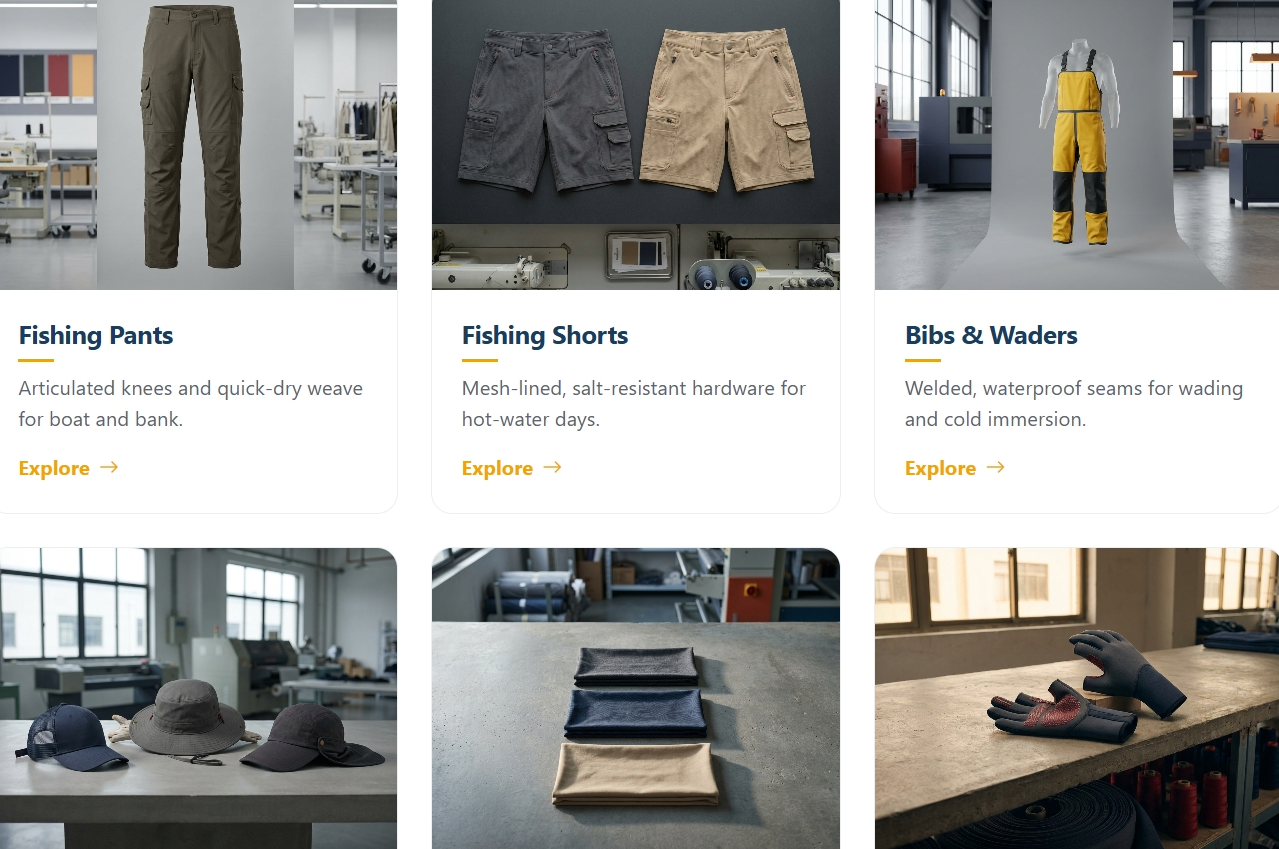
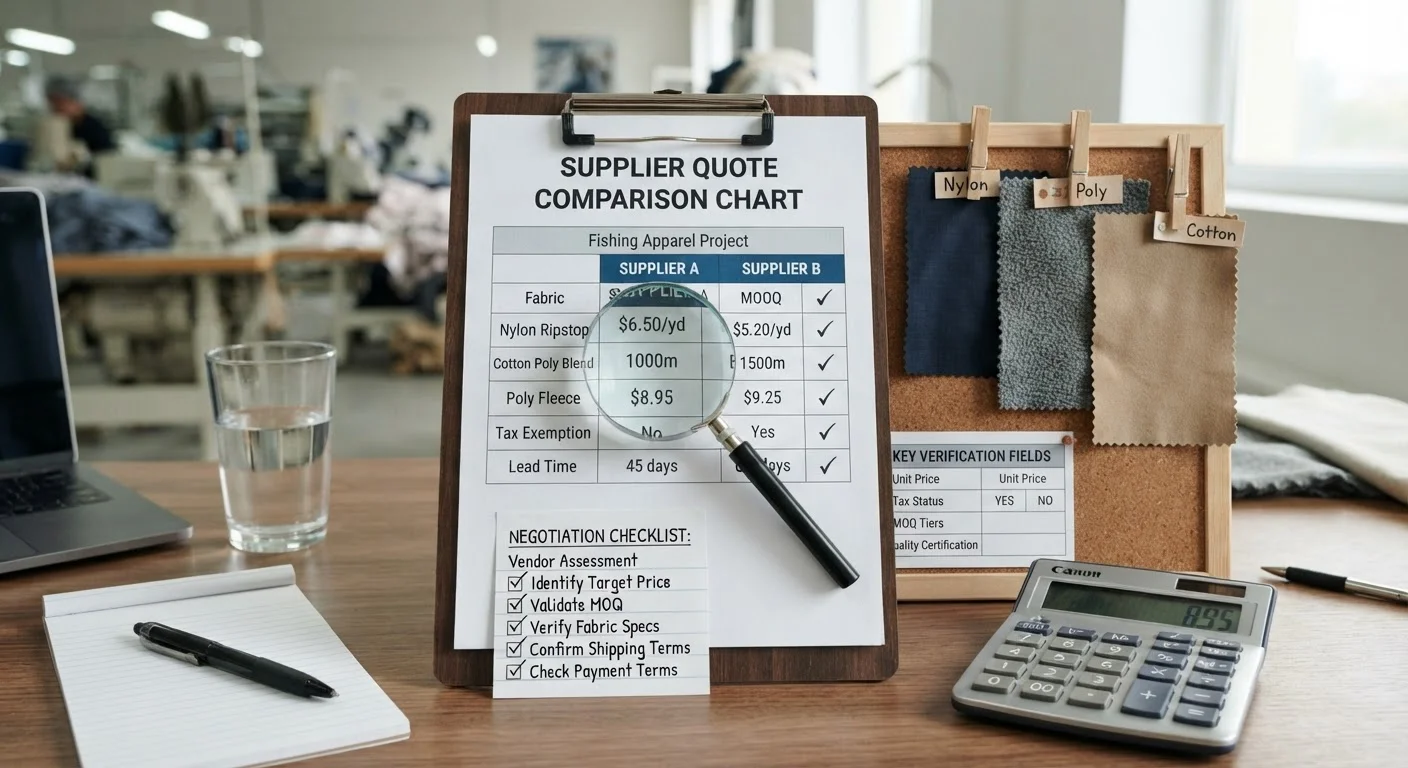
Nine fields separate a real quote from a guess. Miss any one of them, and you're comparing apples to oranges across three suppliers who all claim "same spec, same price."
Start with the basics that get skipped most often—unit consistency, tax basis, and delivery terms. A quote in ¥/piece looks nothing like ¥/kg once you convert it, and "含税到厂" versus "出厂未税" can swing your landed cost by 10-15% before you've touched fabric or MOQ math. If a supplier won't confirm whether packaging, freight, and setup fees are baked into the unit price, that's your first red flag.
The Verification Field Template
Field | What to Confirm |
|---|---|
Material/spec | Matches your BOM — fabric type, GSM, brand |
Unit | ¥/pc, ¥/kg, ¥/m — no mixing |
Tax status | 含税 or 未税, currency |
Delivery term | 出厂 / 到厂 / 现场交货 |
Cost breakdown | Material, labor, freight, margin listed separately |
MOQ tier | Price at 1,000pc, 2,000pc, 5,000pc |
Validity | Quote expiration, payment terms |
Three Moves That Actually Get You a Fair Price
Demand the cost breakdown. Raw material, processing fee, QC cost, freight, margin — listed separately, not lumped.
Demand tiered pricing. Ask for pricing at three volume points on your fishing apparel bulk order, with ±10-20% flex noted.
Demand a comparison benchmark. Last purchase price, market price, or raw material index — not just "trust me."
If a low MOQ custom fishing apparel offer skips the cost breakdown entirely, assume padding until proven otherwise.
Conclusion
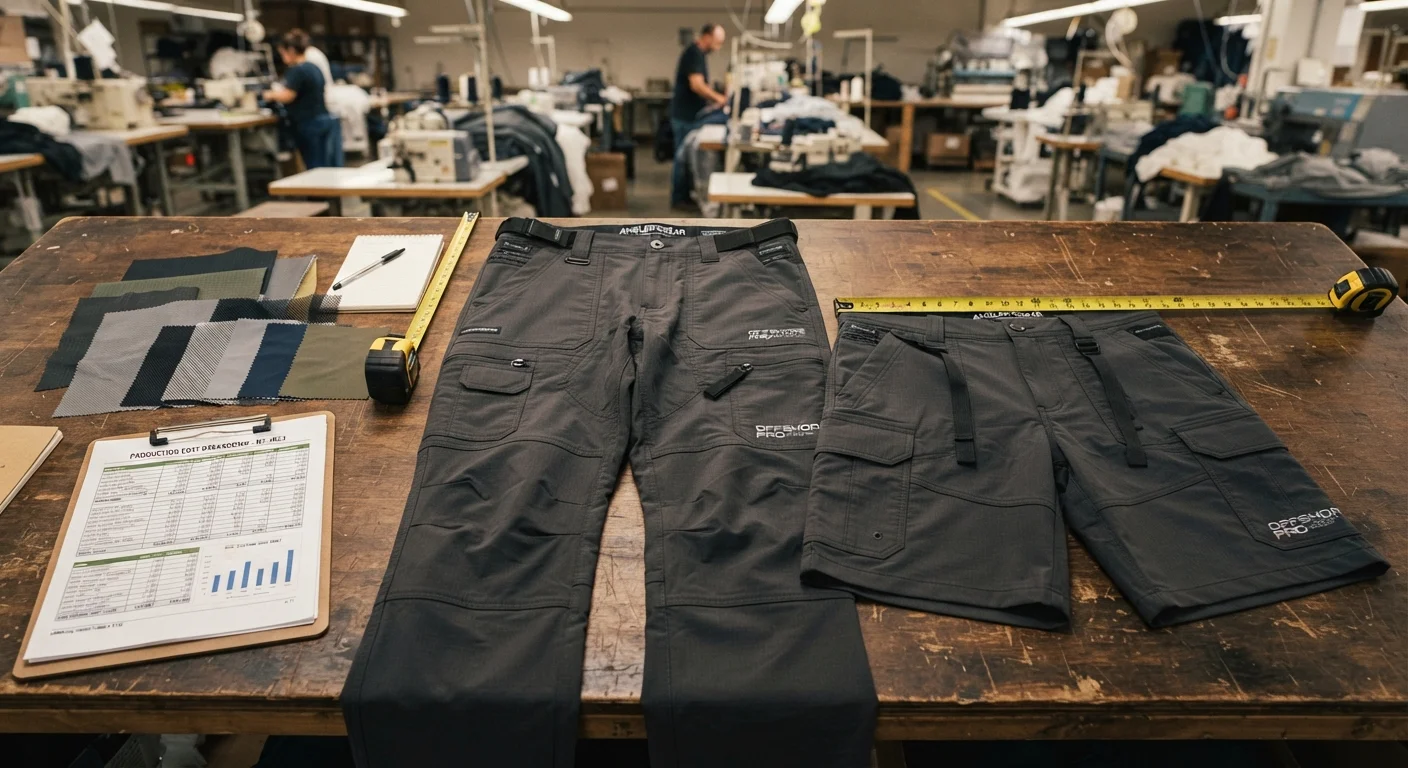
The numbers don't lie here: fabric choice and MOQ tier account for about 80% of the price difference between pants and shorts. When a factory quotes pants at 30% or more over shorts, ask how. If they can't point to cutting waste, additional seams, or higher-grade moisture-wicking fabrics, that's your leverage.
Before signing the next PO, run the checklist — fabric type, order quantity, fishing scenario — against every supplier's quote. A 100-piece pants MOQ should bring volume pricing that reflects lower per-unit tooling costs, not padded margins.
Don't accept vague quotes. Ask for line-item breakdowns. Request a small test batch before committing to bulk. Use these benchmarks to sort suppliers who know their production math from those guessing at prices. Your margins depend on it.