You've stood in that aisle before—one fishing shirt tagged at $24.99, another at $79.99, and nothing on either hangtag actually tells you why. Is the expensive one really going to survive a full season of boat rails and hook snags, or are you just paying for a logo? That $50+ gap isn't random. It's usually the difference between a basic UPF sun protection fishing shirt made from single-layer polyester and a moisture wicking fishing shirt built with nylon-spandex blends, laser-cut vents, and reinforced stitching. That one's designed for the guy fishing 40+ days a year. Below, we break down the fabric science, test both shirt types against real conditions like midday flats fishing, humid jungle trips, and choppy boat decks, and hand you a simple formula to figure out which Fishing Shirts price tier actually matches how (and how often) you fish.
Fabric Composition and Construction: Nylon vs Polyester vs Cotton Blends
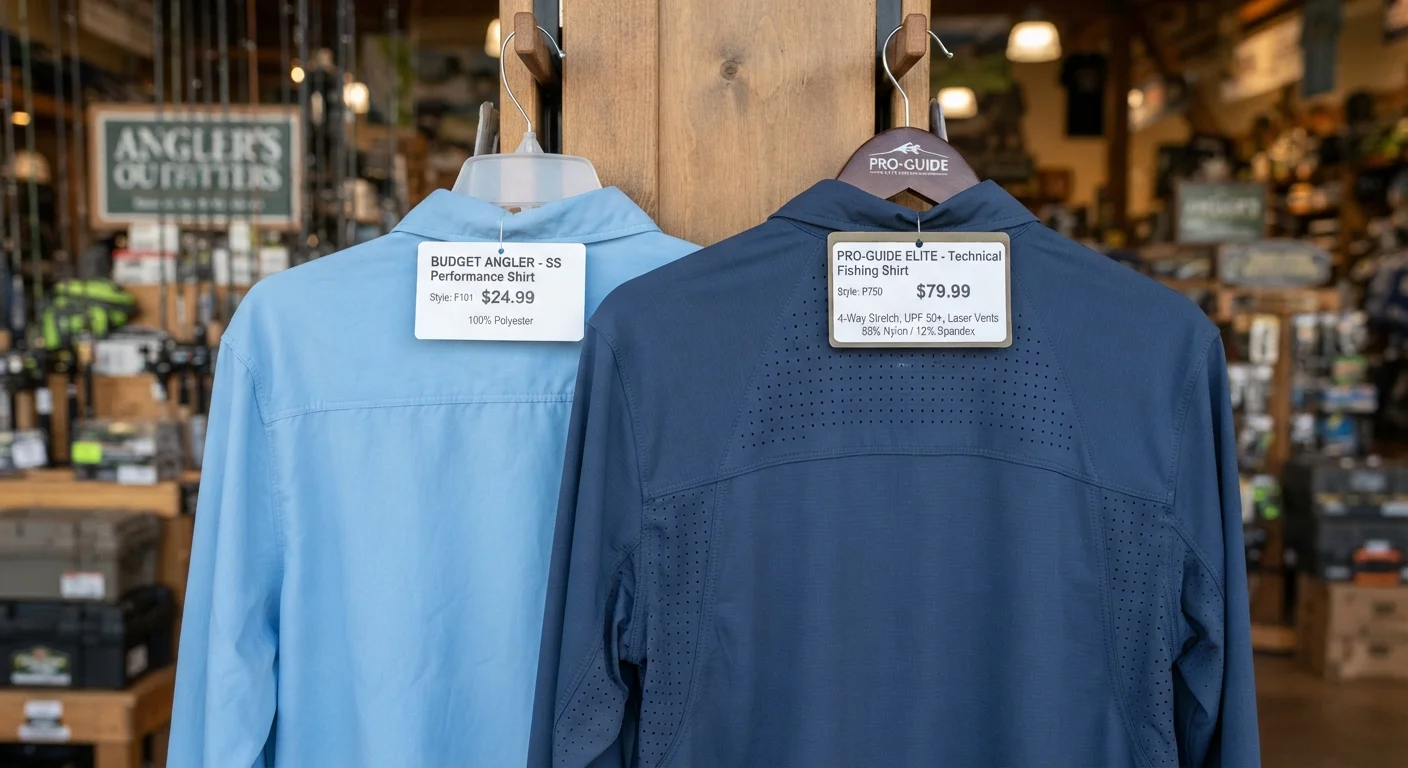
The fabric tag tells you almost everything about which Premium and Standard Fishing Shirts price bracket you're standing in. Standard fishing shirts use 100% polyester or basic poly-cotton blends like 65% polyester/35% cotton . Premium shirts move to nylon-spandex constructions , usually 80–90% nylon with 10–20% spandex woven into a four-way stretch panel. That single material swap explains most of the fishing shirts price gap before you even look at stitching or vent placement.
What the Fiber Data Shows
Nylon and polyester aren't interchangeable, even though both get lumped into the "quick dry fishing shirt fabric" category:
Water absorption : Polyester soaks up roughly 0.4% of its weight in moisture. Nylon absorbs about 4% . Cotton absorbs 7–8% . That's why a cotton-blend shirt feels like a wet towel by hour three of a jungle float trip.
Drying speed : Polyester dries 2–3× faster than cotton. Nylon dries fast too, but it holds slightly more moisture mid-cycle. That's part of why nylon-spandex blends get engineered with tighter knits to compensate.
Tensile strength : Nylon's ultimate tensile strength runs 50–90 MPa , giving it the edge in abrasion-heavy zones—boat rails, hook snags, gunwale rubs. Polyester's yield strength ( 55–260 MPa ) beats nylon in some ranges, which is why poly-rich fabrics resist stretching out of shape over a season.
Breathability Trade-Offs
Fiber | Breathability (1–10) | Why It Matters |
|---|---|---|
100% Cotton | 9/10 | Best airflow, but slow-drying and heavy when wet |
Polyester | 6/10 | Depends almost entirely on weave tightness |
Nylon | 5/10 | Denser knit, needs vents or mesh panels to compensate |
A budget 100% polyester shirt with a loose weave can out-breathe a poorly ventilated nylon-spandex shirt. But a premium nylon blend with laser-cut vents and mesh underarm panels fixes nylon's natural breathability deficit while keeping the stretch and durability.
Where the Cost Comes From
Poly-cotton blends (50/50 or 60/40 CVC): medium durability, decent comfort, cheapest to produce.
Nylon-spandex (80/20) : highest relative cost, but rated "high" durability and "very good" comfort in textile comparison data—because spandex adds recovery and four-way stretch that plain polyester can't replicate.
Nylon reinforcement zones stitched into cotton or poly bodies: common in tactical and heavy-abrasion garments, adding cost at wear points like elbows and shoulders. Premium fishing brands apply the same logic at cast-heavy shoulder seams.
The fabric composition alone won't tell you if a $79.99 shirt is worth it. But it tells you what you're paying extra for: faster recovery from stretch, better abrasion resistance, and construction that compensates for nylon's lower natural breathability.
Sun Protection: UPF Ratings and Real-World Effectiveness
A UPF 15 tag and a UPF 50+ tag look almost identical on the rack. In practice, they're two different sunburns waiting to happen. That single number determines how much UV radiation reaches your skin during a full day on the water, and the gap between custom upf fishing shirts price tiers usually maps directly onto this rating.
What the UPF Number Blocks
UPF math is simple fractions. UPF 15 blocks about 93.3% of UV radiation, letting 6.7% through. UPF 30 , often marketed as a baseline "good protection" number, blocks 96.7% . Push to UPF 50 , and you're blocking 98% , with 2% transmission. That last 2% sounds small, but after six hours of noon flats fishing, it's the difference between a light tan line and peeling shoulders.
Standard fishing shirts sit at UPF 15–30. Premium long sleeve fishing shirts with UV protection hit UPF 50+ , the threshold the Skin Cancer Foundation requires for its Seal of Recommendation.
Fabric Beats Sunscreen More Often Than You'd Think
Lab comparisons found UPF fabrics blocking over 99% of UVB and 96–98% of UVA , while tested sunscreens managed 76–94% UVB blockage . Real-world sunscreen performance drops to roughly 60–75% effectiveness —thin application, missed spots, and sweat washing it off mid-cast. A UPF sun protection fishing shirt doesn't rely on reapplication.
Why Real Conditions Change the Number
Lab ratings come from new, dry, unstretched fabric . On a boat, none of that holds. Stretching across your shoulders on a hookset opens fabric pores. Sweat-soaked fabric transmits more UV than dry samples. Repeated washing thins fibers and lowers protection over a season. Premium nylon-spandex blends hold their weave tighter under these exact stresses, which is part of what that custom fishing shirts price premium is buying.
Moisture Wicking and Breathability: Drying Speed and Ventilation Design
A wet shirt sticking to your back at 11 AM on a boat deck is a measurable engineering failure. Textile labs use the AATCC 197 vertical wicking test, where a fabric strip hangs in water and testers measure how high moisture climbs in five minutes. High-performance wicking fabrics hit 10 cm or more. Basic cotton and untreated blends reach 3–5 cm. That gap is why your $25 shirt feels swampy by hour two.
Drying Speed Numbers
In a 30-minute drying window with simulated sweat solution, a 100% combed cotton shirt loses 0.082 g/cm² of water. Premium moisture wicking fishing shirt fabrics using Coolmax-type synthetics lose 0.27–0.29 g/cm², roughly 3.5 times faster. Cotton takes 45+ minutes to noticeably dry under controlled airflow. Advanced synthetics do the same job in 8–10 minutes.
Fabric weight matters just as much as fiber type. Shirts in the 100–150 gsm range typically dry in 2–3 hours after a full soak. Push past 250 gsm, and you're waiting 4–5 hours. That's brutal on a multi-day flyfishing trip where you're rinsing sweat and rain gear nightly in a hotel sink.
Why Vent Placement Beats Fabric Alone
Same fiber, different knit gives wildly different airflow. Testing on identical polyester shows an open knit wicks 4 cm in 2 minutes, while an interlock knit hits 6 cm, a 50% jump from construction alone. That's the entire argument for vented fishing shirt design. Premium shirts add mesh panels and engineered knit zones at the underarms and back precisely because raw fabric chemistry only gets you halfway. Standard shirts skip this step, relying on loose weave alone. That's fine for a cool morning bite but insufficient for six hours of jungle humidity or a windless boat deck at noon.
Durability and Stitching: Abrasion Resistance and Service Life
A fabric rated for 100,000 double rubs isn't automatically twice as durable as one rated for 50,000. The Association for Contract Textiles flags this directly: abrasion cycles above 100,000 stop adding real-world value, and double the cycle count doesn't double the service life.
How Fabrics Get Tested
Two methods dominate this industry: Wyzenbeek (ASTM D4157), which rubs fabric back and forth until it visibly wears or a thread snaps, and Martindale, which drags a weighted sample in a figure-eight pattern until damage shows.
Real cycle benchmarks by fabric type: cotton canvas handles 15,000 to 20,000 Martindale rubs, solution-dyed polyester goes 20,000 to 40,000 cycles, and durable nylon often exceeds 50,000 cycles. That's why nylon-heavy premium shirts survive boat rails, cooler edges, and hook snags longer than standard polyester. The fiber itself resists surface wear better under repeated friction.
Stitching Tells the Real Story
Abrasion numbers matter less than construction at stress points. Look for flat-felled seams with two stitch lines at shoulders and side seams; this is stronger than single-pass construction. You want 8 to 12 stitches per inch, the density range that separates durable garments from cheap ones. Reinforcement at elbows and shoulders is key, exactly where casting and gear friction concentrate wear. And serged seams at high-stress zones are a cost-cutting shortcut, not a durability feature.
The most reliable predictor of service life is how seams hold up, how much tensile strength the fabric retains after repeated washing and sun exposure, and where the first real failure shows up on the water.
Functional Features: Pockets, Odor Control, and Mobility
Zippers separate from fabric before fabric wears out. That's the real test for pockets, odor treatments, and range-of-motion design. Three details buried in the spec sheet decide whether a shirt survives a season or falls apart at the seams.
Pocket Construction
Standard shirts get one flat chest pocket with no closure. Premium designs add exterior zippered pockets for phones and hook files, plus interior mesh pockets that improve visibility without trapping heat. Some go further with hidden pockets using zipper or magnetic closures, built to a minimum 5.5-inch depth. That's deep enough to hold a phone or license without it bouncing out on a hookset. The difference that actually matters is stitching: double-stitched stress points and reinforced corners stop pocket seams from tearing when you're jamming pliers in wet.
Odor Control Chemistry
Fishy smell isn't just embarrassing on the drive home. It's bacteria breeding in damp fabric. Standard shirts rely on topical antimicrobial sprays that wash out in 5–10 cycles. Premium shirts embed antimicrobial treatment directly into the fiber matrix, lasting the life of the garment. Some premium lines borrow activated carbon lining technology from smell-proof gear to trap odor at the source. Fabric coating matters too. A TPU- or PU-coated barrier shows 92% lower vapor permeability than standard nylon, keeping sweat-trapped odor from lingering after a humid day.
Mobility for Casting
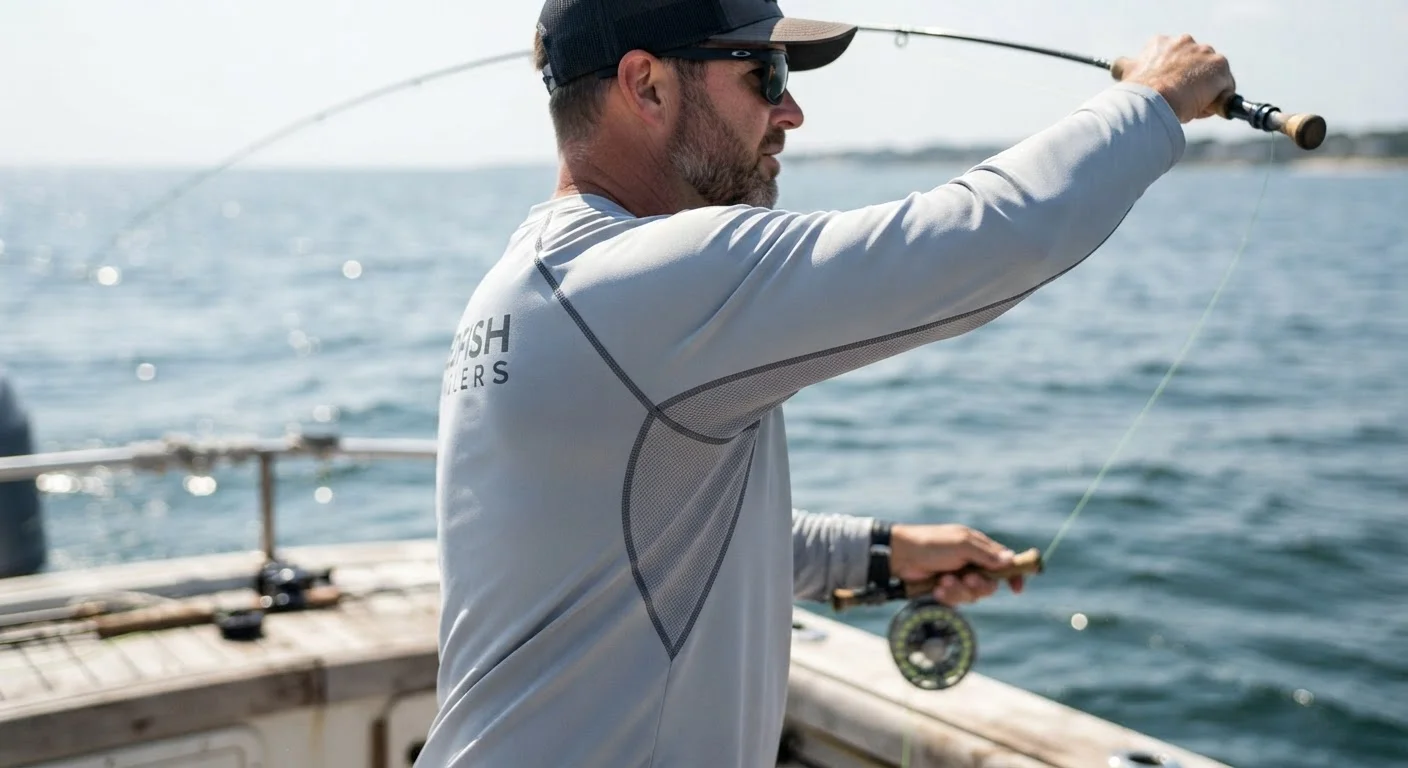
Gusseted underarms and articulated shoulder seams let premium shirts flex through a full overhead cast without pulling across the back. Standard cuts bind at the shoulder on repetitive casting days. Fine for an afternoon, brutal by day three.
Cost Breakdown: What the Price Range Buys You
The price gap between a $79.99 fishing shirt and a $24.99 one comes down to cost structure, not fabric volume. The math explains it better than marketing copy.
Apparel manufacturing follows a predictable cost breakdown. Raw materials run 20–50% of total cost , transformation (labor and machine time) adds another chunk, overhead sits at 20–40% of transformation costs , and gross margin layers on 5–15% for standard manufacturing sectors. Push any one variable up – fabric grade, stitch density, or laser-cut vents – and the final price shifts fast.
Where Your Money Goes by Tier
$20–$35 (Standard tier)
Basic 100% polyester or poly-cotton blend. Single-pass stitching, no reinforcement zones, topical antimicrobial spray that washes out in 5–10 cycles. Raw material cost sits near the low end of that 20–50% range because polyester is the cheapest performance fiber on the market.
$40–$65 (Mid-tier)
Nylon-poly blends start appearing. Some vent construction, tighter knit density, UPF 30–40 ratings. You pay for better transformation costs – more cutting precision and added seam reinforcement at the shoulders.
$70–$100+ (Premium tier)
Nylon-spandex four-way stretch, UPF 50+, fiber-embedded antimicrobial treatment, laser-cut vents, flat-felled double-stitched seams at 8–12 stitches per inch. Raw materials alone push toward the top of that cost range, and transformation costs climb with every added construction step.
The durable fishing apparel fabric premium isn’t arbitrary. It comes from stacked labor, tighter tolerances, and material grade compounding line by line – the same way a €120 manufactured component breaks down into materials, labor, overhead, and margin. Fishing shirts follow that same logic, with sun protection and stitch counts instead of CNC machine hours.
Conclusion
That 2-3x fishing shirts price gap between premium and standard fishing shirts comes down to engineering. Premium shirts use laser-cut vents, UPF 50+ certified fabric, and four-way stretch nylon blends. They hold up when you're grinding through a 6-hour midday bite or sweating on a humid river float. Standard polyester shirts block UV and wick moisture fine, but leave you clammy and chafed on longer, harsher trips.
Run your own math. If you fish 20+ days a year in brutal sun or wet climates, the premium tier pays for itself in comfort and gear longevity. Weekend warriors can save the cash—a solid moisture-wicking shirt in the $30-40 range will cover your needs.
Before you buy, check the fabric tag, UPF rating, and vent placement against your actual fishing conditions, not the brand name. That's the only spec sheet that matters.