Six hours into a saltwater jig session, the storm finally caught up with me. Rain came in sideways, the kind that finds every gap in cheap gear. My buddy's $50 PU-coated shell turned into a soaked, clammy sauna by hour three—he was fighting hypothermia more than fish. Mine, a GORE-TEX setup I'd debated buying for months, was still dry and breathable. Same storm, wildly different outcomes.
That gap is what this comparison covers. The actual materials science, cost breakdowns, and hydrostatic head numbers separate a jacket that survives one rough season from one that's still performing three years later. You'll get a data-backed answer to whether a $300 waterproof fishing jacket is genuinely engineered better than a $50 one, or just priced for the logo. And you'll also get a simple framework to figure out exactly what you should spend based on how and where you fish.
The Six-Hour Storm Test: When Budget Jackets Fail and Premiums Shine
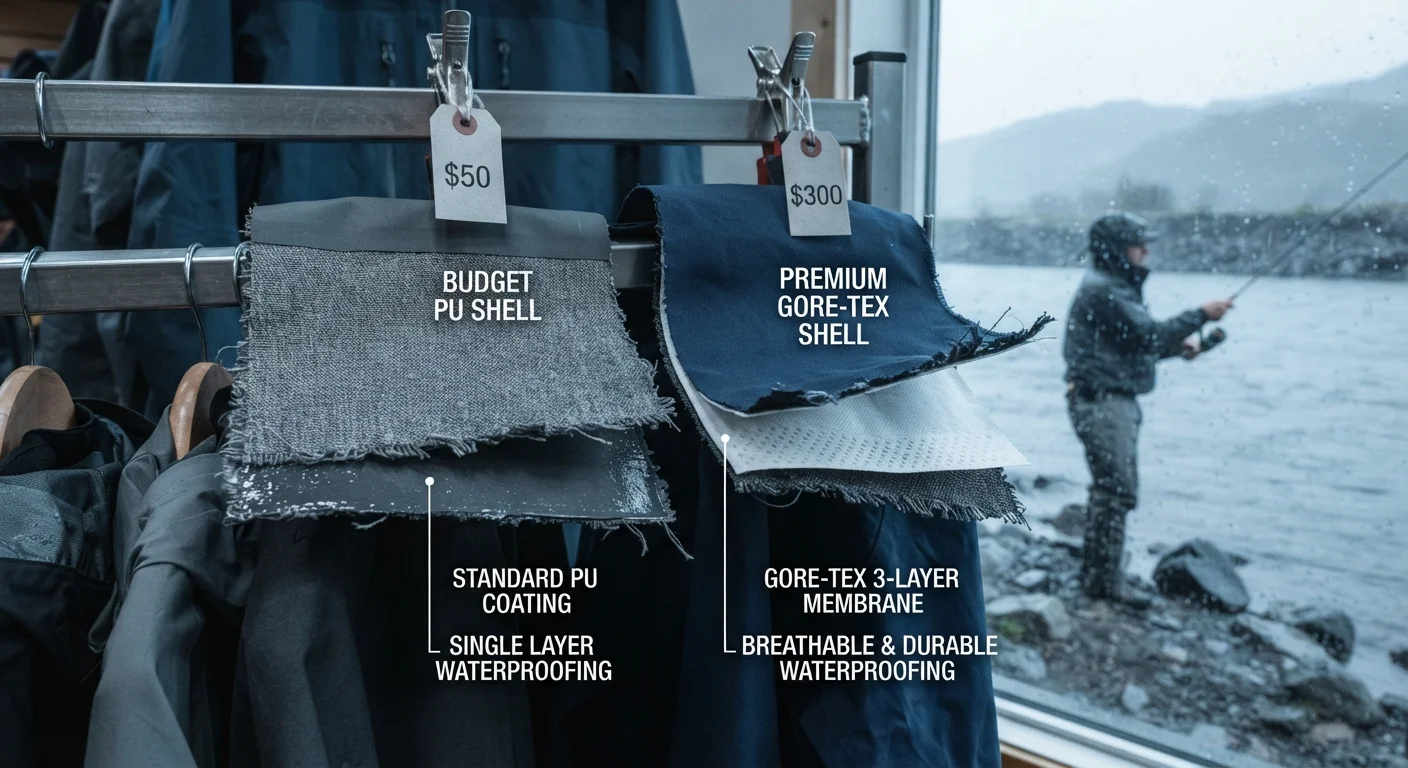
Most Waterproof Fishing Jackets factory DWR (durable water repellent) coatings stop beading water and start wetting out within 30 minutes of hard rain—even on a jacket you bought last week. That's the physics of cheap PU-coated fishing jackets doing exactly what they were built to do, which isn't much.
Why Budget Jackets Wet Out So Fast
A typical 2.5-layer budget shell (the kind you'll find on Amazon for $40-60) exposes its waterproof membrane directly against your skin or base layer, with a hydrostatic head rating around 10,000mm. That sounds fine on paper. In practice, once the DWR coating fails, the fabric saturates, breathability collapses, and you get internal condensation that feels like a leak. The soaked sauna feeling at hour three is wet-out, not failure of the waterproof barrier. After enough hours, actual failure follows.
Real-world lifespan data backs this up. Budget 2.5-layer shells show visible wear after 200-400 hard-use miles and hit functional waterproof failure (delamination, seam issues, persistent wet-out) between 500-800 miles. In continuous heavy rain with any kind of gear strap or harness load (think a wading belt or stripping basket), these jackets are built for emergency backup use, not six hours of sustained saltwater exposure.
What Premium Materials Actually Withstand
Contrast that with a 3-layer GORE-TEX fishing jacket, which has a face fabric, waterproof breathable membrane, and a protective tricot backer, typically rated at 20,000mm hydrostatic head or higher. That inner scrim shields the membrane from abrasion, which is why premium shells resist the shoulder and lumbar delamination that kills budget jackets fast. They maintain beading and structural waterproofness through multi-hour downpours, as long as DWR is maintained and taped seams stay intact.
The Failure Points That Matter Most
Independent testing (Stiftung Warentest ran 17 two-layer jackets up to €300) found only 2 rated "good" overall, most either failed in rain or weren't breathable enough. Only one model kept the test dummy fully dry in an intensified rain simulation. For mid-tier jackets, price alone doesn't guarantee storm performance. Construction quality (taped seams, membrane layers, hydrostatic head) does.
Material Science Showdown: GORE-TEX vs PU Coating – Performance Data
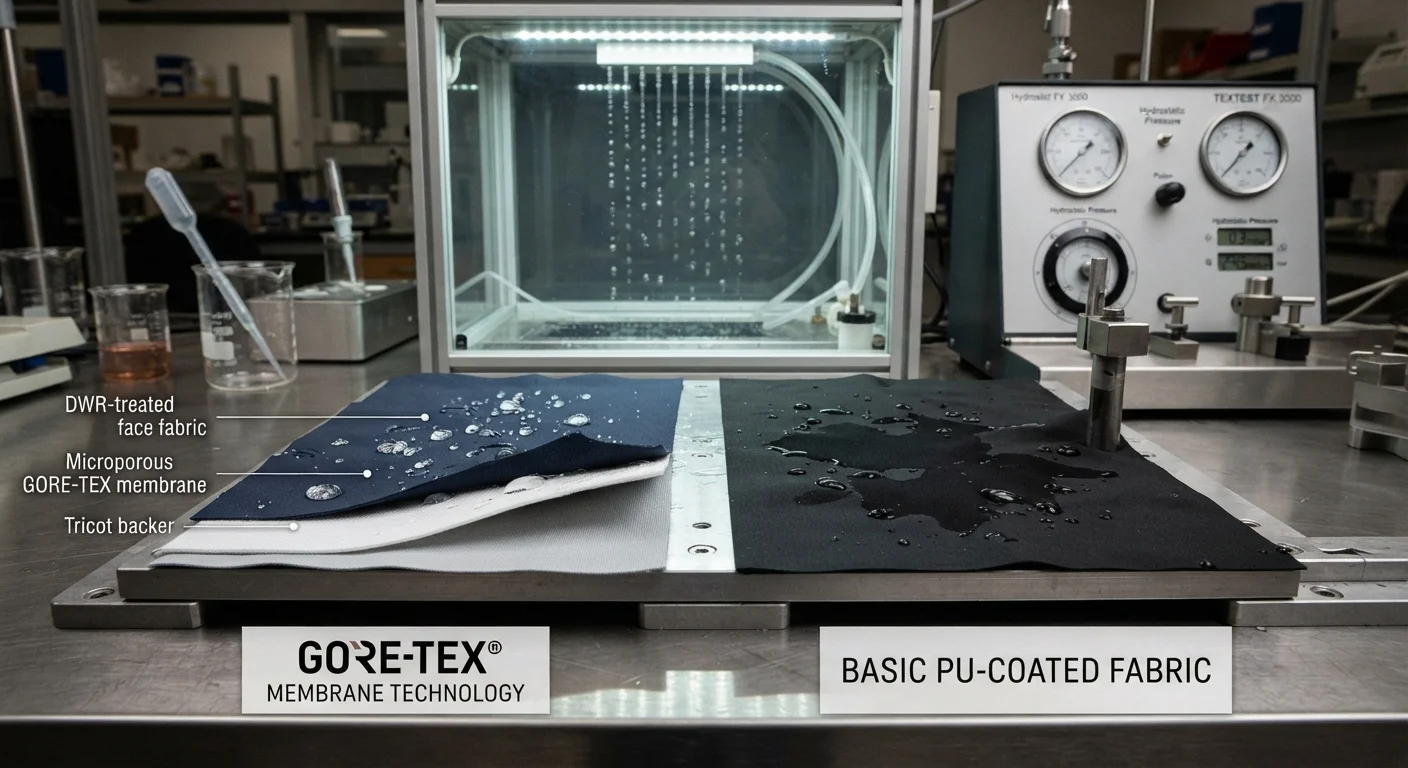
The gap in performance between GORE-TEX and PU coatings is bigger than most anglers realize until they’ve fished both fabrics side by side. Beyond hydrostatic head, the key differences are how each material breathes, ages, and holds up to years of hard fishing.
Breathability: Where PU Coating Falls Apart
Waterproofness only tells half the story. A waterproof breathable fishing jacket has to move sweat vapor out, or you’re just trading rain for internal moisture. That’s measured in MVTR (grams of moisture per square meter per 24 hours):
Basic PU coating : 1,000–3,000 g/m²/24h – this is why a $50 PU coated jacket feels like a sauna after an hour of hard casting.
PU microporous membranes : 5,000–15,000 g/m²/24h – better, but inconsistent across brands.
Standard GORE-TEX : 10,000–20,000 g/m²/24h
GORE-TEX Pro 3L : up to 28,000+ g/m²/24h
RET (Resistance to Evaporative Transfer, lower is better) confirms the gap. Generic PU membranes sit at RET 15–30+; anything above 20 is considered poor breathability. Premium 3-layer GORE-TEX drops below RET 6, which is the difference between “damp but comfortable” and “clammy and cold” six hours into a trip.
Wash Durability and Aging: The Silent Jacket Killer
Standard PU coatings lose about 50% of their hydrostatic head after just 5 machine washes. Even unworn, PU coatings hydrolyze and can delaminate within 2–3 years sitting in a closet. That puts a hard ceiling on a fishing jacket’s lifespan, regardless of how carefully you treat the durable water repellent (DWR) finish.
ePTFE membranes (the GORE-TEX type) hold under 10% hydrostatic head loss after 20 washes and are rated for 500+ wash cycles. Abrasion resistance follows the same pattern: GORE-TEX handles 30,000+ Martindale cycles versus 5,000–10,000 for generic PU membranes. That’s roughly 3–6x more abrasion tolerance, which matters when your jacket is rubbing against a stripping basket or boat rail all day.
The Full Comparison Table
System | Waterproof (mm) | Breathability (g/m²/24h) | Durability |
|---|---|---|---|
Budget PU coating | 3,000–8,000 | 1,000–3,000 | 50% HH loss after 5 washes |
Budget generic membrane | 5,000–10,000 | 3,000–8,000 | Hydrolysis in 2–3 years |
Mid-range PU microporous | 8,000–20,000 | 5,000–15,000 | 100–200 washes |
Standard GORE-TEX | 15,000–28,000 | 10,000–20,000 | 30,000+ abrasion cycles |
GORE-TEX Pro 3L | 28,000+ | 25,000–28,000+ | 500+ washes |
Even the ePTFE membrane material itself is lighter (5–25 g/m² vs 30–50 g/m² for PU) and far more temperature-stable, functioning from -200°C to 260°C versus PU’s -30°C to 80°C range. On the water, that translates to a jacket that performs the same in a cold spring rain as it does in humid summer heat, something budget PU shells can’t promise.
The $300 vs $50 Cost Breakdown: Where Your Money Goes
Staring at a $250 price gap between two jackets that look nearly identical on a rack, most of that money isn't going where you think.
Break down a $50 PU-coated fishing jacket and the math is blunt. Fabric and membrane account for maybe 15-20% of retail price—call it $8-10 worth of material. Hardware (zippers, snaps, storm flaps) is cheap, often non-waterproof YKK knockoffs instead of sealed marine-grade zippers. Labor and construction, including seam taping (if it's taped at all), eat another chunk. After manufacturing, shipping, and retail markup, the margin is razor-thin. There's no room in that budget for a laminated membrane or a tricot backer. You're paying for a shell.
A $300 GORE-TEX fishing jacket flips that ratio. The membrane and laminate alone can run $30-50 in raw material cost—3-5x the entire fabric budget of the budget jacket. Add fully taped seams (not just critical seams), YKK AquaGuard or equivalent marine-grade zippers, reinforced stress points at the shoulders and cuffs, and you're looking at construction costs that rival the entire retail price of the cheap option.
Where the Premium Concentrates
The biggest cost categories in a premium fishing jacket, in order:
Membrane and laminate technology – the single largest line item, often 20-30% of retail
Construction and seam sealing – taped seams, reinforced stitching, articulated cuts
Hardware – waterproof zippers, YKK components, storm flaps with actual sealing
Brand and R&D overhead – testing, warranty support, design iteration
That last one is real, but it's not where most of your $300 goes. Roughly 60-70% of premium fishing jacket pricing traces back to material and construction quality you can measure in hydrostatic head and MVTR numbers, not logo markup. The $50 jacket isn't badly made for its price point. It's built to a different spec, and the corners cut are exactly the ones that matter most in a six-hour storm.
Real-World Performance Decay: What Happens After 1 Year vs 3 Years
A rain shell doesn't fail all at once. It fails on a curve, and the difference between a $50 fishing jacket and a $300 one shows up most clearly when you track that curve across calendar time, not just wash cycles.
Year One: Small Losses, Different Trajectories
At the one-year mark, a budget PU-coated fishing jacket has already lost 15-20% of its DWR beading effectiveness, even with light use. Salt exposure, UV, and body oils degrade the coating faster than a washing machine ever could. Anglers fishing 1-2 times a week typically notice the first "clammy" days inside 6-9 months, well before any visible tearing or delamination.
A GORE-TEX shell at one year shows almost no measurable change. Hydrostatic head stays near its rated spec, DWR still beads with a quick wash-and-reproof, and taped seams show no lifting. The 1-year gap looks modest on paper, but it sets up what happens next.
Year Three: The Compounding Gap
By year three, the two jackets aren't in the same category anymore. Budget shells hit functional waterproof failure around 500-800 hard-use miles, which for a weekend angler lands somewhere between 18 and 30 months. Most people fishing regularly have already replaced a $50 Waterproof fishing jacket once, sometimes twice, by the three-year mark. Non-marine zippers on cheap jackets typically show sticking or corrosion within 6 months of saltwater exposure and are often non-functional by year two.
Premium jackets follow a flatter curve. GORE-TEX membranes maintain structural waterproofness through 500+ wash cycles and 30,000+ abrasion cycles, which for most anglers translates to 5-7 years of regular use before performance drops meaningfully. Marine-grade YKK AquaGuard zippers hold up through years of saltwater without the corrosion issues that kill budget hardware early.
What This Means in Real Dollars
Run the math over three years and the "premium is overpriced" argument gets shaky:
Jacket Type | Cost | Realistic Lifespan | Cost Per Year (3-yr window) |
|---|---|---|---|
Budget PU shell | $50 | 1.5-2 years | ~$75-100 (2 replacements) |
Premium GORE-TEX | $300 | 5-7 years | ~$50-60 |
The budget jacket doesn't just perform worse in year three. It's often already gone, replaced by another $50 jacket that starts the same decay curve over again.
Match Your Fishing Frequency, Environment, and Budget
How often you fish, where you fish, and what a soaked six-hour trip actually costs you in lost days or gear replacement – those three variables decide whether you overspend or end up under-protected. Run them against the data above and the right price tier gets obvious fast.
Low-Frequency Casual Anglers (1-2 trips/month, freshwater, shore or small lake)
A budget fishing gear shell in the $50-100 range covers this. You're not putting 500-800 hard-use miles on it fast enough to hit failure territory, and freshwater skips the corrosion issues that kill cheap zippers. Look for at least 5,000mm hydrostatic head and don't worry about premium MVTR numbers—short exposure windows mean wet-out risk stays low.
Mid-Frequency Weekend Anglers (1x/week, mixed freshwater/inshore)
For $100-200, you get mid-range PU microporous membranes or entry GORE-TEX. Target 15,000mm+ hydrostatic head and 8,000+ g/m²/24h breathability. Any saltwater exposure pushes your durability weight to critical. Non-marine zippers won't survive.
High-Frequency/Saltwater/Professional (multiple trips/week, offshore or extended exposure)
$300+ GORE-TEX Pro territory. You need 25,000mm+ waterproof rating, sub-6 RET breathability, and 500+ wash-cycle durability. At this frequency, a budget jacket's 18-30 month lifespan means multiple replacements before a premium shell even shows wear.
Frequency/Environment | Budget Tier | Hydrostatic Head | Breathability | Lifespan |
|---|---|---|---|---|
Casual, freshwater | <$100 | 5,000-10,000mm | 3,000-8,000 g/m²/24h | 1.5-2 years |
Weekend, mixed | $100-200 | 15,000-20,000mm | 8,000-15,000 g/m²/24h | 3-4 years |
Frequent, saltwater | $300+ | 25,000mm+ | 15,000-28,000+ g/m²/24h | 5-7 years |
Conclusion
After six hours in that storm, the $50 Waterproof Fishing jacket failed because PU coating can't move moisture like a real waterproof breathable fishing membrane. That's the whole story. GORE-TEX and eVent have a higher hydrostatic head rating and better breathability, and that gap widens every season your jacket sees saltwater and abrasion.
So skip the brand debate. Pull out your fishing log, count your trips per month, be honest about your environment, then run those numbers against the decision matrix above. If you're fishing four times a year off a calm dock, save your money. If you're out weekly in real weather, that $300 jacket pays for itself by year two—your $50 jacket won't even survive that long.