Two fishing polos can look identical on a spec sheet, yet one survives 150 wash cycles in saltwater and sun while the other pills and loses shape after a single charter season. That gap almost always comes down to choosing between Interlock and Mesh Knit, and most suppliers will not walk you through the difference unless you ask the right questions.
After a decade sourcing and testing fabrics for custom team fishing jerseys and polos, I've learned that moisture wicking performance, UPF sun protection, and sunscreen and saltwater resistance behave differently across these two knit structures. Below are the real gsm ranges, breathability numbers, and wash-durability data broken down by fishing scenario, so you can walk into your next supplier call knowing which fabric to specify.
Interlock vs Mesh Knit: Comparing Knit Structure, Weight, and Shape Stability
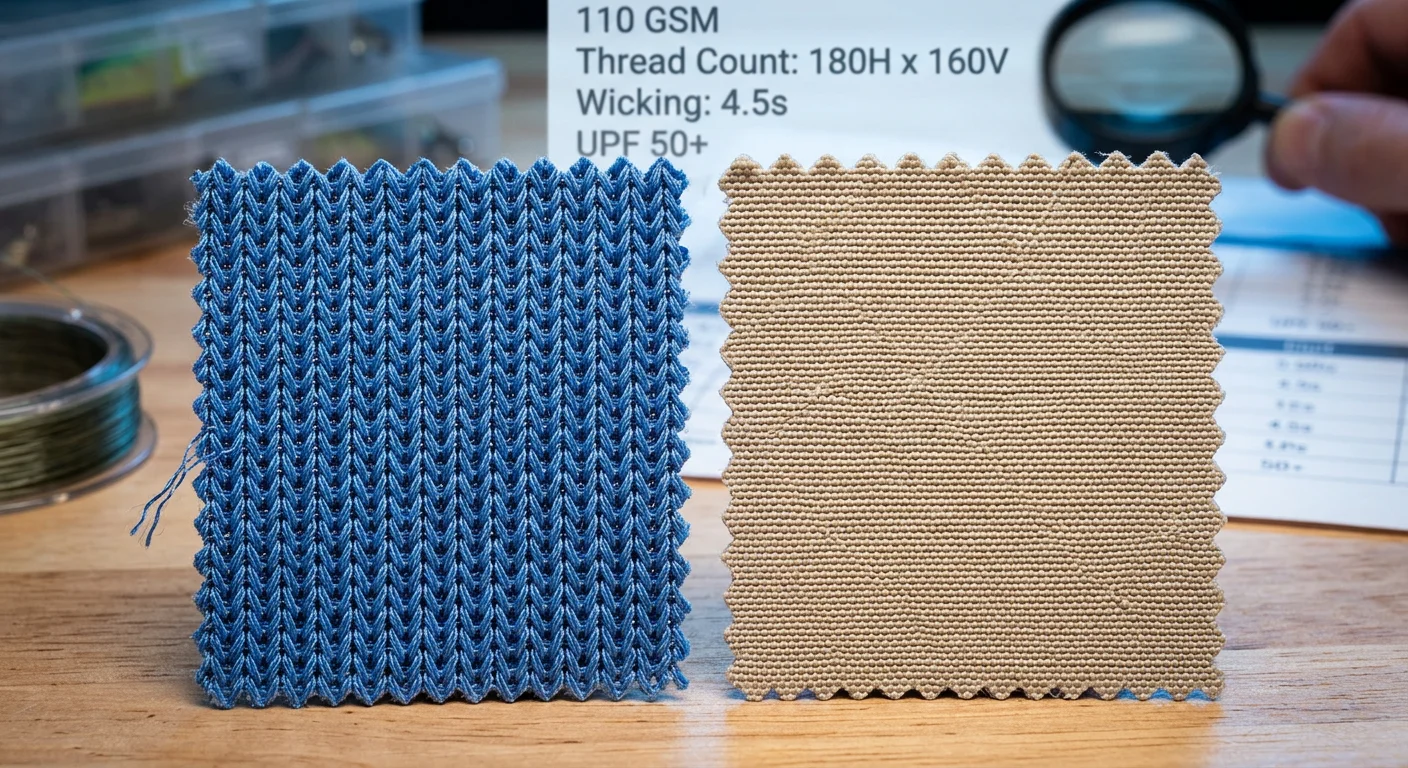
Structure tells you what to expect before you even touch the fabric. Interlock uses a double-needle bed, where two sets of needles lock two layers of loops together. Because of that build, both sides look identical and the cut edges lie flat without curling. Mesh knit is a single-layer open knit. Its breathability comes down to hole size, spacing, and HPI (courses per inch), so ask your supplier for both GSM and HPI instead of relying on weight alone.
Weight comparison:
- Interlock: 180–280 gsm, with 180–260 gsm being standard for bulk apparel orders
- Mesh: under 150 gsm for lightweight versions, 150–250 gsm for athletic tops
At the same yarn count, Interlock runs 30%–40% heavier than single jersey. A 30/1 Ne cotton yarn that makes a 140 gsm single jersey yields roughly 200–240 gsm in Interlock.
Interlock holds its shape significantly better. Its elongation sits around 30%–50% compared to 50%–80% for single jersey, which makes it much easier to control during cutting and sewing. Mesh distorts more easily at the collar, shoulders, and cuffs, particularly in lighter weights with larger holes. It generally needs rib trim or elastic reinforcement to keep its shape through repeated wash cycles.
For acceptance testing, aim for shrinkage of ≤3% for Interlock and ±3%–5% for mesh, verified with ISO 5077/6330 or AATCC 135.
Moisture-Wicking, Quick-Dry, and High-Intensity Sweat Performance: Comparing the Real Test Data
Marketing copy loves the word "moisture-wicking." Lab data tells you if it's true. For custom team fishing polos and jerseys, the standards to check are GB/T 21655.1 (water absorption, drip spread time, wicking height) and GB/T 21655.2-2019 , which uses dynamic moisture management testing (MMT) to measure wetting time, max wetted radius, spreading speed, and one-way transport capacity (OWTC). International suppliers cite AATCC TM195, TM199, and TM200 for the same metrics.
Drying time benchmarks under 22°C/65%RH:
- Standard polyester (closer to dense Interlock): surface-dry in ~45 minutes, dry in ~90 minutes
- Microporous, open-structure fabric (closer to Mesh knit): surface-dry in 8–10 minutes, with far lower residual moisture against the skin
That gap matters on a charter deck. Mesh's open structure yields higher OWTC and OMMC (overall moisture management capacity), which helps when a deckhand sweats through hour six of a tournament. Interlock's tighter double-layer structure slows evaporation, but it buffers sudden sweat bursts better.
For acceptance testing, ask suppliers for:
- 0–60 second drip spread time and max wetted radius
- 1–5 minute wicking height and OWTC
- 5–30 minute evaporation rate and wet-weight loss %
- 30–120 minute full-dry time
Use a 20×20cm sample loaded at 30% of dry weight to simulate heavy sweat, and compare pre-wash against post-wash results rather than testing new fabric alone.
UPF Sun Protection vs. Seawater and Sunscreen Tolerance
Saltwater alone rarely degrades the UPF rating on a quality fabric. In a 108-hour soak test using 35 g/L simulated seawater (roughly equivalent to a full holiday of ocean exposure), most qualified swimwear-grade fabrics maintained their UPF, UVA/UVB transmission, and stretch. Protection drops because of wetting, stretching, abrasion, and repeated washing.
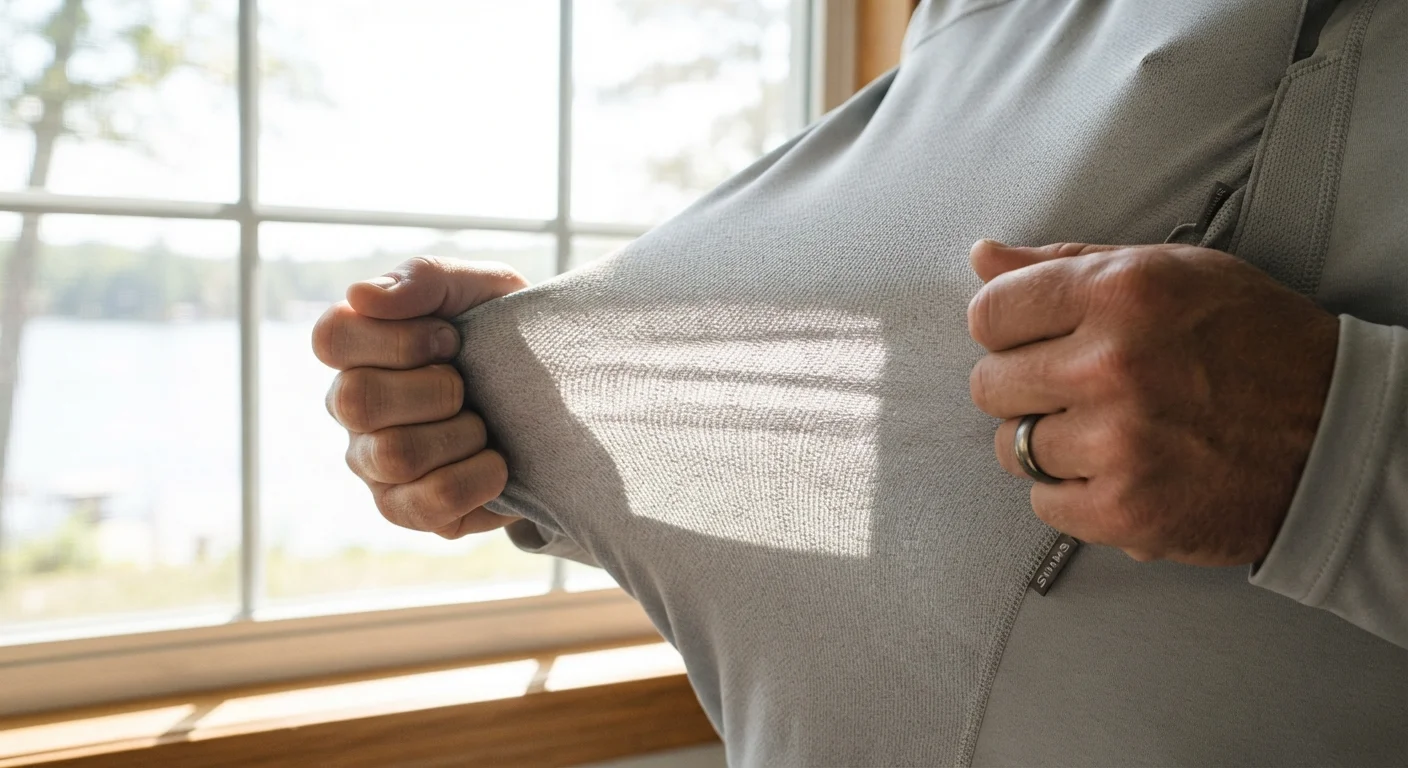
Knit structure matters more here than fiber content. Interlock has a dense double-layer construction that leaves fewer gaps for UV rays, so it holds its dry UPF rating better when stretched over shoulders and elbows. Mesh knit features open holes for airflow, meaning UV transmission and UPF fluctuate based on hole density and HPI.
Key numbers to request from any supplier:
- UPF 50 blocks about 98% of UV; treat UPF 40–50+ as your acceptance floor.
- Wet fabric can lose up to 50% of dry-state UV protection, particularly in cotton blends. Synthetic Interlock and tightly woven Mesh hold up better.
- ASTM D6544 benchmarks UPF after 40 wash cycles alongside simulated sun and chlorinated water exposure, approximating two seasons of real use.
Condition | What Happens | What to Ask Suppliers For |
|---|---|---|
Dry, unstretched | Matches label UPF | Baseline lab data only |
Saltwater-soaked | Minimal change for qualified fabric; some drop | Wet-state UPF data |
Wet + stretched | Pores widen, protection drops faster | Test at shoulders, elbows, lower back |
Sunscreen contact | Not a standard UPF test item; oils and emulsifiers can stain or degrade fiber | Post-sunscreen UPF retest, rather than general water-resistance claims |
40+ washes | Dye and finish degrade over time | Post-wash UPF after simulated sun + chlorinated water |
On a sunscreen bottle, "water-resistant" only describes how long the lotion stays on skin. It provides no information on how the fabric's UPF holds up after repeated lotion contact. To get an accurate comparison, test fabrics with standard sunscreen application, followed by saltwater immersion, drying, stretching, and 10, 20, and 40 wash cycles before and after. If a supplier cannot provide sunscreen-contact UPF data, require two minimum standards: no noticeable UPF drop after saltwater immersion, and UPF 40 or 50+ retained after 40 wash cycles.
For custom team fishing jerseys used in deep-sea trolling or all-day sun exposure, specify fabrics tested to AATCC 183, ASTM D6603, ASTM D6544, or AS/NZS 4399. Request dry UPF, wet UPF, post-saltwater UPF, and post-wash UPF as four separate line items instead of accepting a single UPF 50+ claim on the hangtag.
Long-Term Wear, Abrasion Resistance, and Machine-Wash Lifespan Compared
A deckhand washing a jersey twice a week racks up 104 wash cycles a year , which retires fabric rated for 30 to 50 washes before the second season even starts. That wear rate is the practical benchmark for custom team fishing jerseys, and it is where interlock consistently outlasts mesh knit.
Martindale abrasion thresholds by use case:
Garment Type | Martindale Cycles | Buying Takeaway |
|---|---|---|
Lightweight shirts/linings | 5,000–10,000 | Low-frequency wear only |
Everyday apparel | 10,000–20,000 | Suitable for T-shirts, casual tops |
Denim/workwear/outerwear | 20,000–40,000 | High-friction zones (knees, hips) |
Heavy-duty/outdoor gear | 50,000+ | Rated for charter decks, boats, gear bags |
WRAP's Longevity Protocol puts the average T-shirt lifespan at 56 washes and jeans at 30 . Most lab testing runs 20, 40, or 50-wash cycles to simulate lifecycle performance. Polyester/spandex sportswear with a knit structure similar to mesh loses 37% of warp elongation after 500 standard washes , meaning stretch recovery at the collar and cuffs fails well before the surface wears through.
As a rule of thumb, target 1.5–2x your expected friction exposure. For interlock team jerseys, look for Martindale ratings of ≥30,000 cycles and at least 50 wash cycles with no visible pilling or shrinkage. For mesh knit used in high-sweat, high-stretch conditions, ask for elasticity-retention data at 500 washes. Washing in cold water on a gentle cycle and air-drying preserves over 95% of original abrasion resistance compared to hot-water laundering.
Embroidery, Sublimation, and Screen Printing: Which Decoration Method Fits Your Fabric
Teams often pick their fabric before deciding on logo placement, but the two choices work best when made together. Mesh knit's open structure and Interlock's dense double-layer react differently to needles, heat, and ink.
Factor | Embroidery | Sublimation | Screen Printing |
|---|---|---|---|
Look & Feel | Raised, textured, and premium with a clean uniform finish | Vivid, photo-quality print with zero hand-feel | Bold flat color blocks, with specialty inks available |
Best Fabric Match | Cotton, polyester, canvas, knits; works on both Interlock and Mesh | White or light polyester only; pairs best with Mesh knit tops | Cotton, poly-cotton, polyester; requires a white underbase for dark fabrics |
Wash Durability | 100+ home washes; thread may snag on mesh holes | Dye bonds directly into the polyester fiber, so it will not crack or peel | ~50+ washes with proper curing; slight fading over time |
Cost Per Piece | $5,000–15,000 stitches for left-chest logo; better for small runs | ~$8–24/piece for full-coverage garments | $1.50–6/piece at 100+ units; $35–120/color setup fee |
Setup Fee | $50–150 one-time digitizing fee | $10–30 digital file prep | $20–50 per color |
Sweet Spot Order Size | 1–24 pieces, corporate logos | 1–100 pieces, full-color or photo designs | 25+ pieces, simpler multi-color graphics |
Practical takeaways for custom team fishing jerseys:
Interlock + embroidery is the standard pairing for charter crews and tournament staff who need a durable, dimensional chest logo that survives industrial laundering.
Mesh knit + sublimation works best for all-over graphics, gradients, or sponsor logos across the front and back without adding extra weight or stiffness.
Dark-colored cotton-blend polos cannot take sublimation; screen printing with a white underbase is the only reliable option.
A mixed approach pairing left-chest embroidery with a back-panel screen print keeps the gear looking high-end while controlling costs on large graphics for team orders over 50 pieces.
Interlock vs Mesh Knit Selection Guide for 5 Fishing Scenarios
The right fabric choice comes down to where your crew fishes and how hard they sweat.
Fishing Scenario | Interlock Role | Mesh Knit Role | Recommended Spec |
|---|---|---|---|
All-day sun on open water | Main body fabric; dense, stable, UPF 50+ capable | Underarm and back panels only | 130–160 gsm, 100% polyester or 92/8 poly-spandex |
Tropical heat, low wind | Chest and shoulders for snag resistance | Back, underarm, and side panels for airflow (100–150 gsm) | 130–150 gsm Interlock body + 100–140 gsm Mesh, 15–30% mesh coverage |
Heavy casting, wading, friction | Primary fabric; stable, abrasion-resistant at elbows and shoulders | Keep clear of hooks, Velcro, and straps | 140–160 gsm poly-spandex Interlock with small mesh vents only |
Hot, humid, high-sweat inshore/stream | Body fabric with wicking finish | Back and underarms; dries 50–70% faster than standard knit | 130–150 gsm Interlock body + 110–140 gsm Mesh |
Cold mornings/nights, windy conditions | Full body for warmth and wind protection | Minimal use; large mesh zones bleed heat | 150–180 gsm Interlock, or 140–160 gsm with 110–120 gsm mesh spot panels |
For most custom fishing polos, the standard build runs a 70–85% Interlock body paired with 15–30% Mesh Knit venting. Interlock handles UPF protection, durability, and shape retention, while mesh vents dump heat at the back and underarms. Most charter and tournament brands settle on this ratio after testing both extremes.
The Fabric Decision Tree: Nail Your Fabric Choice in Five Minutes
Forget flipping through fabric swatches. Four questions get you to a spec sheet faster than a supplier call.
Question 1: Does elasticity matter for your crew's movement?
- High-mobility casting and wading: 3%–8% spandex
- Comfort stretch: 2%–4% spandex
- No stretch needed: skip spandex to cut cost and prevent long-term fiber fatigue
Question 2: What drives the purchase: cost, comfort, or abrasion resistance?
- Cost-first: polyester or poly-cotton Interlock
- Comfort-first: moisture-wicking knit with a higher cotton or modal blend
- Durability-first: tight-knit, high-tenacity polyester or nylon Interlock
Question 3: Do you need certification? Ask for OEKO-TEX or GRS documentation if sustainability claims matter to your buyers or sponsors.
Question 4: What's your MOQ and timeline? Most suppliers quote against 500 pieces per color as a baseline. They adjust for your actual order volume, sampling lead time, and quote validity window before you commit to bulk Fishing Polos production.
Spec, Cost, and MOQ Checklist for Bulk Custom Orders
Most order disputes trace back to a single missing line on the spec sheet. Before signing off on Interlock or Mesh Knit for custom team fishing jerseys, lock down every parameter in writing: yarn composition and grade, GSM, dimensional tolerance, Pantone color codes, UPF rating, and wash-cycle durability targets. Request 2D/3D tech packs and a BOM with version control, and confirm whether your supplier runs OEM, ODM, or private-label pass-through, as each setup carries different design and remold obligations.
Apparel MOQ benchmarks run 500–1,000 pieces, with 30–90 day lead times. Confirm whether that MOQ applies per order, per style, per color, or per SKU; mixed-color mesh panels often reset the threshold. Ask about tiered pricing at 500/1,000/5,000 units, since orders above 5,000 pieces unlock a 10%–15% discount.
Quotes should separate:
- Unit price by volume tier
- Mold/die tooling fees (ownership and lifespan)
- Sampling fees ($200–500 per sample)
- Testing/certification costs (UPF, saltwater resistance, AATCC compliance)
- Logistics terms (EXW, FOB, DDP) quoted independently
Calculate landed cost per unit using qualified units received, factoring in defect rates, rework, and freight insurance.
Verify compliance documents matching the exact fabric batch: OEKO-TEX, GRS, ISO 9001, and third-party inspection reports. Send identical specs to every supplier you evaluate; apples-to-apples RFQs are the only way to get quotes you can trust.
Supplier Verification Process Before Sampling and Placing Orders
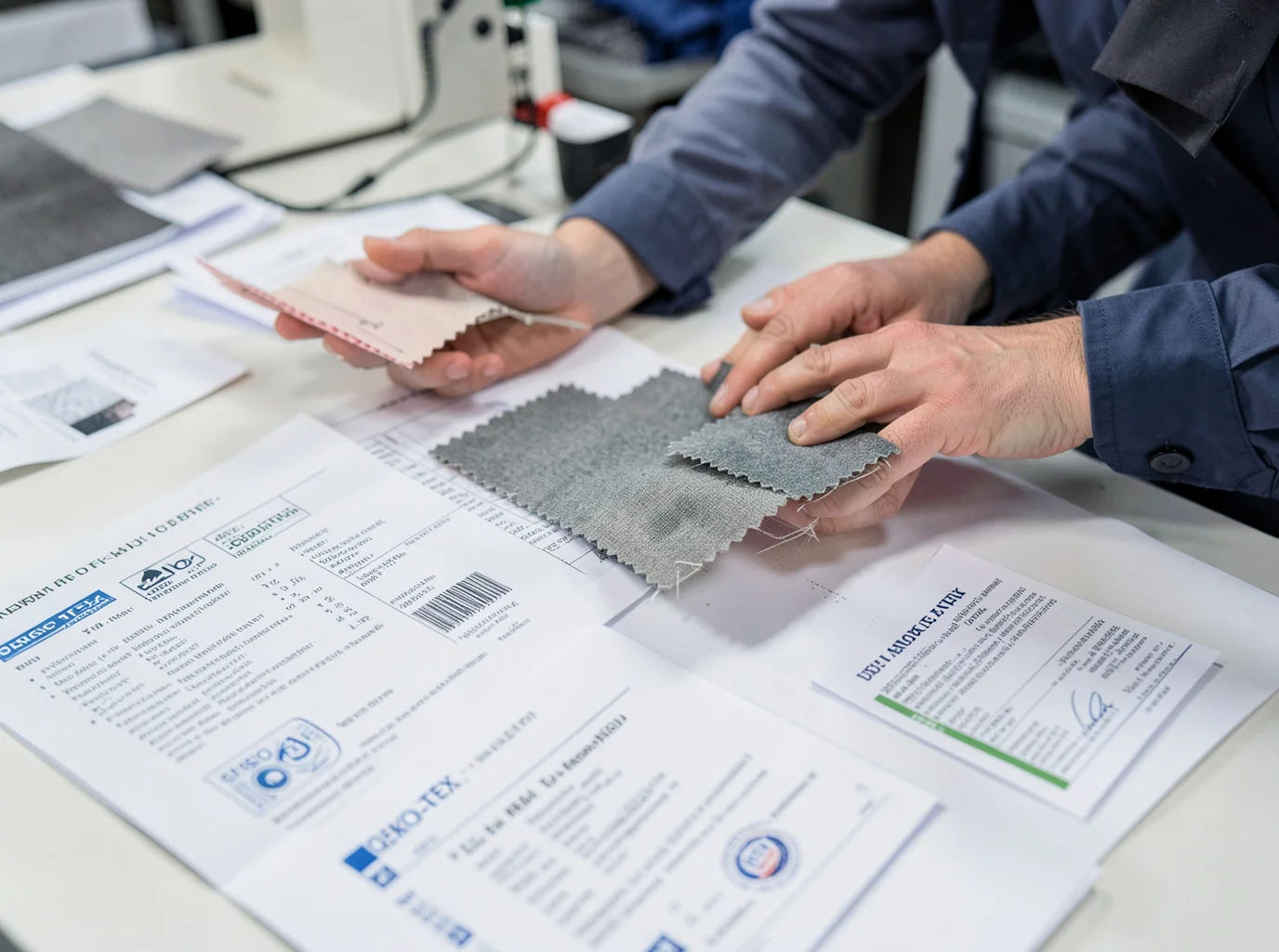
A spec sheet means nothing if the factory behind it can't execute. Before you commit budget to custom embroidered fishing polo production, run every supplier through a three-tier sample process.
Three sample stages to require, in order:
Engineering sample (ES) confirms structure, fabric, and manufacturability before tooling costs hit.
Pre-production sample (PPS) is built on actual molds with production-grade Interlock or Mesh Knit yardage on the line.
Golden sample (GS) is signed by both parties as the single reference point for mass production, inspection, and dispute resolution.
Check every GS against dimensions, weight, color, GSM, and assembly gaps. For critical specs like UPF rating or elasticity retention, ask for Cpk/Ppk process capability data. One compliant sample does not prove the factory can repeat that result across 5,000 units.
Before placing a bulk order:
Run a limited trial order first to verify real lead times, packaging consistency, and documentation accuracy at small scale.
Increase your inspection ratio or run 100% inspection on the first batch, and send critical dimensions and safety items for third-party testing.
Track defect rate, rework rate, shortages, and delay days on a scorecard weighted 40% quality, 20% delivery, 15% technical capacity, 15% compliance documentation, and 10% responsiveness.
Only move a supplier onto your Approved Supplier List once the trial order clears your acceptance threshold.
Conclusion
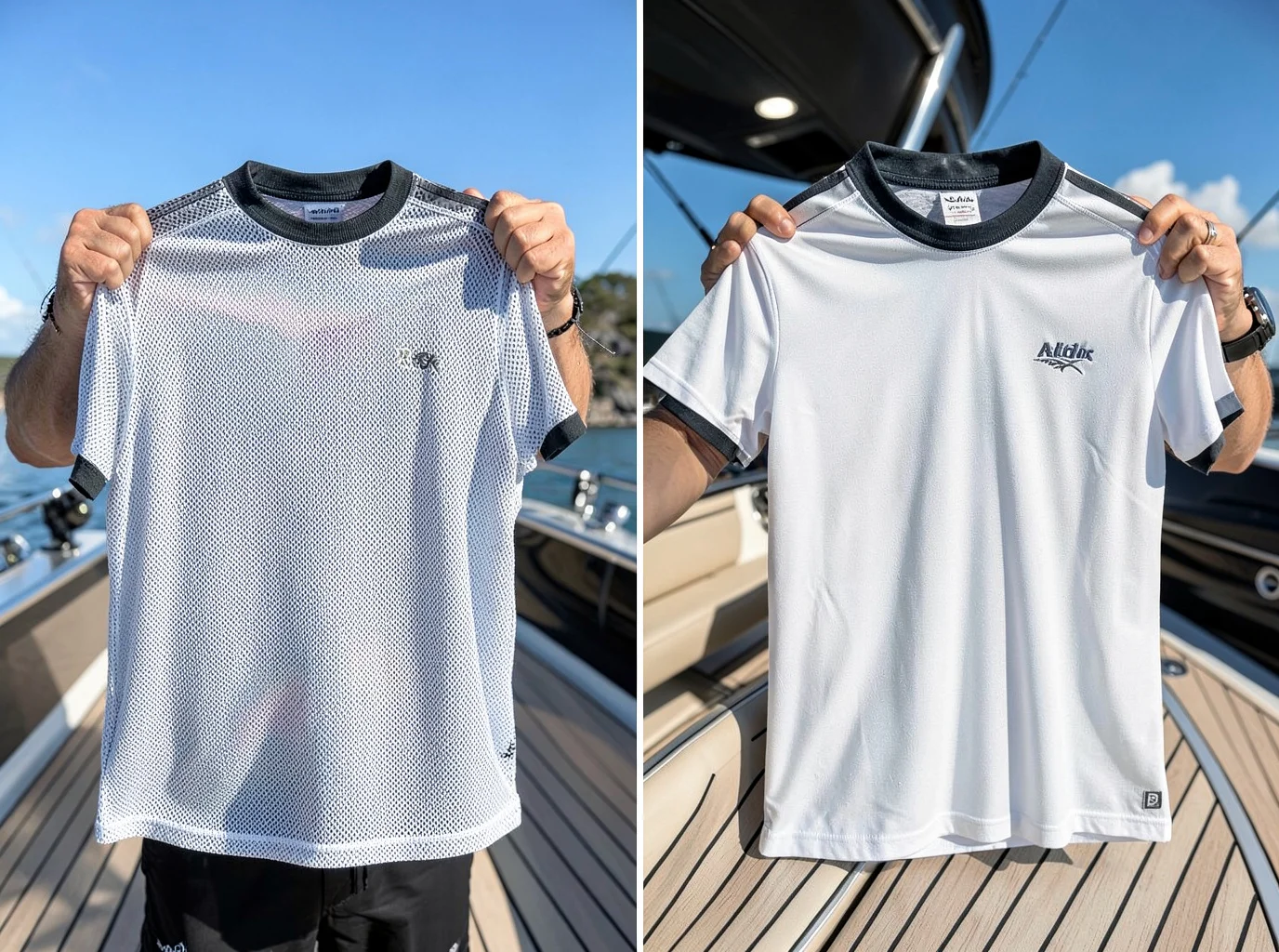
After a decade of running fabric through salt water, sweat, and sunscreen, the right choice between Interlock and Mesh Knit comes down to your fleet's conditions. If your crew battles open-water heat and needs max airflow, Mesh Knit's ventilation wins every time. If you want a premium moisture-wicking fishing shirt fabric with UPF 50+ protection and a cleaner embroidery canvas for custom team fishing jerseys, Interlock earns its weight in gsm.
Match the fabric to your needs using the scenario table above, then confirm your choice with a physical sample before committing to bulk production. A $15 fishing polo sample run beats a 500-unit mistake. Reach out for a free swatch kit and MOQ quote; we'll help you nail the spec sheet before you spend a dollar on tooling.