Your club ordered 30 tournament fishing shirts last season. By June, half the logos were cracking, peeling, or fading into ghost versions of themselves after a few trips through saltwater and sun. Sound familiar?
Most fishing clubs pick their printing method backward. They choose based on price-per-fishing-shirt quotes, then discover durability problems three months in, once the damage—and the reorder bill—is already done.
This guide flips that order. We break down heat transfer vs screen printing for custom fishing club apparel with real cost tables across order sizes (10, 50, 100+), actual weathering results on moisture-wicking and cotton blends, and a simple decision matrix based on your club's size and budget. Order once, and get it right.
Cost-per-Unit Comparison by Order Volume (10, 50, 100+ pieces)
Here's the math nobody explains before you sign the invoice: cost per unit = (total fixed costs + total variable costs) ÷ total units. Simple formula. Huge consequences for your club's budget.
Screen printing carries heavy fixed costs upfront — screen burning, color separation, setup time. Heat transfer (including vinyl and DTF) skips most of that, but charges you more per piece in material and press time. That single difference flips the winner depending on how many jerseys you're ordering.
The Real Numbers, Order Size by Order Size
10 pieces:
- Heat transfer: $13–16/shirt
- Screen printing: $19–24/shirt
At this volume, screen printing's setup fee (often $20–30 fishing club apparel per color, per screen) gets divided across just 10 shirts. That's brutal math. Heat transfer wins here — no screens, no color-separation fees, just a design file and a press.
50 pieces:
- Heat transfer: $9–11/shirt
- Screen printing: $8–11/shirt
This is the crossover zone. Fixed costs from screen printing now spread across enough units to compete with — sometimes beat — heat transfer pricing. Most print shops quote screen printing's break-even point somewhere between 24 and 50 pieces. Fifty is right in that window. Get quotes from both before assuming either wins.
100+ pieces:
- Heat transfer: $8–9/shirt
- Screen printing: $5–7/shirt
Once you cross 100 units, screen printing pulls ahead and stays there. The setup cost that felt painful at 10 pieces now barely registers. Multi-color club logos benefit especially — each additional color on a heat transfer often adds cost, while screen printing handles multi-color designs with marginal cost increases once screens are burned.
Why the Curve Bends This Way
The volume effect isn't unique to apparel — it shows up everywhere from custom packaging to circuit boards. A 100-unit apparel run typically lands around $15–30/unit; push that to 1,000 units and per-unit cost can drop to $8–12. That's a 60–70% reduction just from spreading fixed costs.
Screen printing rides that curve hard because its fixed costs (screens, setup, color separation) dominate small runs but shrink to almost nothing at scale. Heat transfer's cost structure is flatter — less painful at 10 pieces, less rewarding at 1,000.
What This Means for Your Order
If your fishing club is ordering 10–30 jerseys for a single tournament, heat transfer keeps your total spend lower and avoids paying for screens you'll only use once. If you're ordering 50 pieces , get quotes from both — the gap narrows enough that fabric type, turnaround time, or color count might decide it instead of price alone. Once you're placing 100+ piece orders for a full club roster across multiple teams, screen printing's economics become hard to ignore.
One caution: none of this accounts for how each method survives saltwater, sun, and repeated washing — which we'll get into next, because a cheaper shirt that cracks by August isn't actually cheaper.
Durability and Weathering Test Data for Fishing Apparel
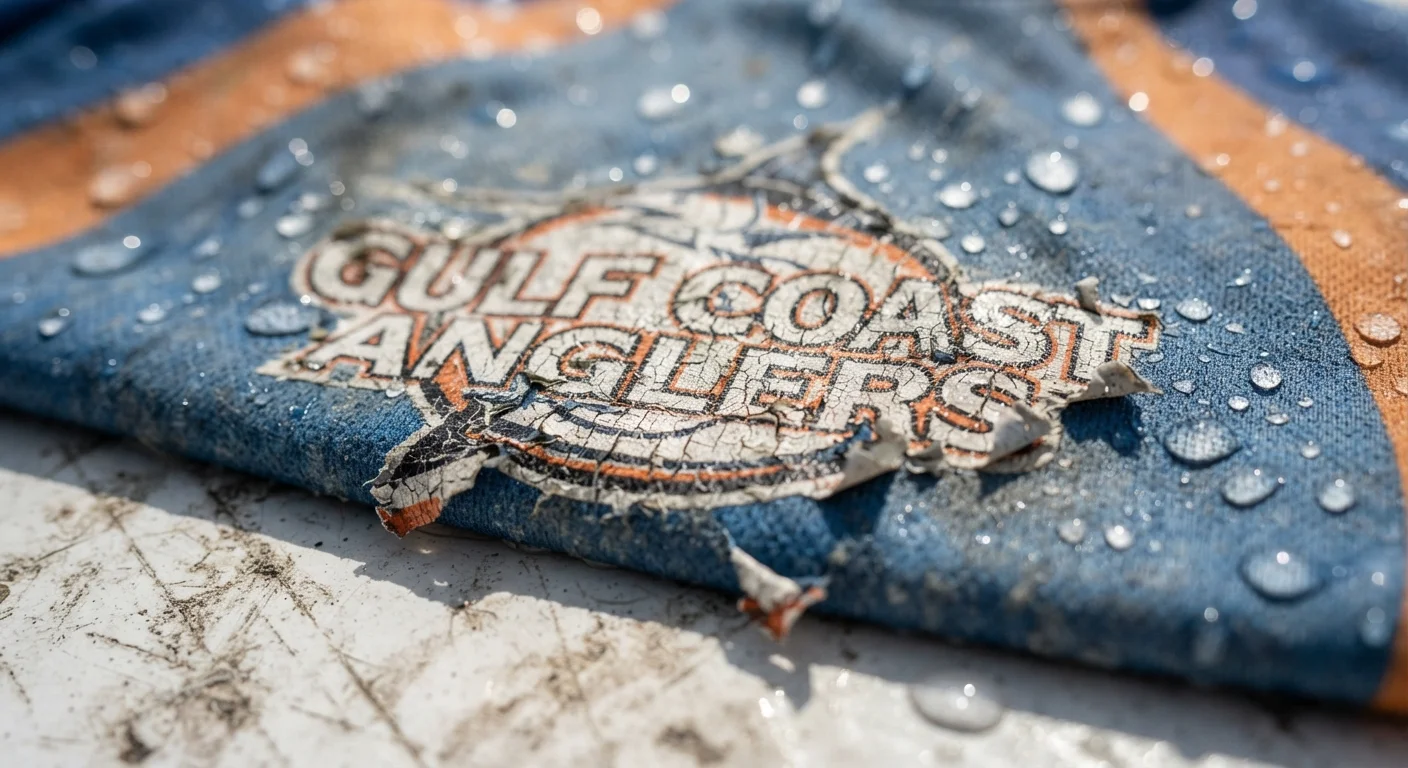
Saltwater doesn't care about your logo. It just wants in — under the ink, into the fabric, straight to the fibers holding your print together. And once it's there, the countdown starts.
What Saltwater and Sun Actually Do to Fabric
Marine-grade textile testing uses a 4-hour saltwater immersion followed by 24 hours at 70°C heat cycling to simulate repeated dunking and drying, exactly what happens to a jersey on a boat deck in July. That heat-and-salt combo is brutal on adhesion. It's the same mechanism that causes screen print ink to crack at the edges and heat transfer vinyl to lift at the corners.
UV exposure compounds the damage. AATCC TM111, the standard method for weather resistance of textiles exposed to daylight, measures color change and physical degradation over time. Polyester performance shirts with UPF coatings block up to 98% of UV rays (UPF 50), which protects skin. But UV still attacks pigment. Screen printing inks, especially plastisol, tend to hold color longer under UV than vinyl transfers, which can yellow or crack after repeated sun cycles.
Fabric Type Changes Everything
Moisture-wicking fabric printing has its own physics problem. Polyester fishing fabrics dry in about 40 seconds after saturation. Cotton takes roughly 8 minutes, about 12 times slower. That matters for prints because fabric that stays wet longer stays vulnerable longer, softening adhesive bonds and accelerating peel.
Abrasion tells a similar story. Quality polyester withstands 500+ abrasion cycles without failure in standard tests, relevant every time a jersey rubs against a rod holder, boat rail, or tackle box edge. Screen printing ink sits embedded in the fabric weave, giving it a slight edge in raw scrape resistance. Heat transfer and vinyl sit on top of the fabric, more exposed to direct friction.
Wash Cycles Reveal the Real Winner
Wash-cycle retention data on YKK AquaGuard® components, while built for zippers, not prints, shows that high-quality bonded components retained 94–95% of original performance after 20 wash cycles. That's the standard your print job should be measured against. Cheap heat transfer vinyl often falls well below that after 20 washes, especially on moisture-wicking blends where flex and stretch pull at the vinyl's edges.
If your club's uniforms see saltwater, sun, and a washing machine every week for a season, print durability outdoor apparel is the whole decision. Screen printing with plastisol ink generally survives UV and saltwater cycling better long-term. DTF printing custom fishing shirts and sublimation printing fishing apparel close some of that gap on synthetic fabrics, but standard vinyl heat transfer is the most likely to crack, peel, or fade within a single season if your club fishes hard and washes often.
Fabric Surface Compatibility: Cotton, Polyester, and Moisture-Wicking
Cotton and polyester don't just feel different. They behave like chemically opposite materials when ink meets fiber — and that difference decides whether your logo survives the season.
Cotton is hydrophilic. It pulls water into the fiber, absorbing up to 27 times its own weight, with a moisture regain of 6.5–8.5%. Polyester does the opposite. It's hydrophobic, with moisture regain under 0.4%, and instead of soaking water in, it moves it along the fiber surface through capillary action. That's the entire mechanism behind "moisture-wicking" — surface transport, not absorption.
Why does this matter for your print job? Ink adhesion depends on how the fabric surface behaves under stress, heat, and repeated wetting.
Drying Speed Tells You Everything
Test panel data makes the gap obvious:
Fabric | Dry Time | Wicking Height (30 min) | Moisture Regain |
|---|---|---|---|
100% Cotton (180 gsm) | 145–186 min | 1.8 cm | 6.5–8.5% |
60/40 Cotton/Poly | 132 min | 4.3 cm | ~4–5% |
100% Microfilament Polyester | 57–75 min | 12.7 cm | ≤0.4% |
Dual-knit Poly/Cotton | 79 min | 9.1 cm | ~0.4–1% |
Polyester dries 50–70% faster than cotton. That's a print-durability stat, not a comfort stat. Fabric that stays saturated longer keeps adhesive bonds softer, longer. Screen printing inks like plastisol embed into the weave and tolerate that slower-drying cotton surface reasonably well. Heat transfer vinyl sits on top of the fiber rather than in it, and struggles more on fabric that stays damp.
Blends Change the Print Math
Most fishing club jerseys aren't pure cotton or pure poly — they're blends. A 60/40 cotton-poly blend cuts dry time by roughly 30% versus straight cotton (132 vs. 186 minutes), which gives ink a shorter window of vulnerability.
Dual-knit construction — polyester against the skin, cotton on the outer face — splits the difference. You get quick-drying performance where sweat hits first, and cotton feel where the logo actually sits. For DTF printing custom shirts or custom sublimation printing fishing apparel, that outer cotton face still needs ink formulated for natural fibers, not just synthetic-friendly transfers.
Match your printing method to the fabric's drying behavior, not just its feel on the rack.
Decision Matrix: Small Club (Under 20 Members) vs Large Club (Over 50 Members)
Club size drives your printing decision more than any other factor—it determines your budget, your risk, and what methods actually make sense.
Small groups have high per-member cost sensitivity and thin margins. Large groups spread costs, absorb risk, and can justify more complex setups. The math is the same whether you're talking membership fees or printing costs.
Small Club (Under 20 Members): Choose Heat Transfer
A 15-member club on tight fixed costs resembles a small flying club with 1–2 planes: limited assets, high per-unit exposure, low tolerance for waste. One bad order wipes out the season's gear budget.
That's why vinyl heat transfer beats screen print here. Heat transfer gives you flexibility, no screen setup, and no per-color penalty for small multi-color logos. At 10–20 shirts, heat press costs consistently come out ahead—you're not paying for screens you'll use once.
Small club checklist:
- Order size: 10–20 shirts
- Printing method: Heat transfer or DTF
- Budget flexibility: Low — every dollar matters
- Risk tolerance: Low — no room for reorders
- Admin complexity you can handle: Minimal
Large Club (Over 50 Members): Choose Screen Printing
Fifty-plus members changes the equation. Fixed costs—screens, color separation, setup fees—get divided across enough units that they nearly disappear. The same logic lets large clubs offer 4–7 membership tiers instead of 2–3: scale absorbs complexity.
For Custom Fishing Club Apparel bulk orders, screen printing's marginal cost per additional shirt is lower, and it handles multi-color logos without per-color penalties eating your margin.
Large club checklist:
- Order size: 50–100+ shirts
- Printing method: Screen printing (plastisol ink for durability)
- Budget flexibility: Higher — cost per shirt drops significantly
- Risk tolerance: Moderate — reorders are cheaper per unit
- Admin complexity you can handle: Screens, color proofs, longer turnaround
Match your printing decision to your club's size profile, not just the quote in front of you. The right choice at 15 members is often the wrong choice at 75.
Conclusion
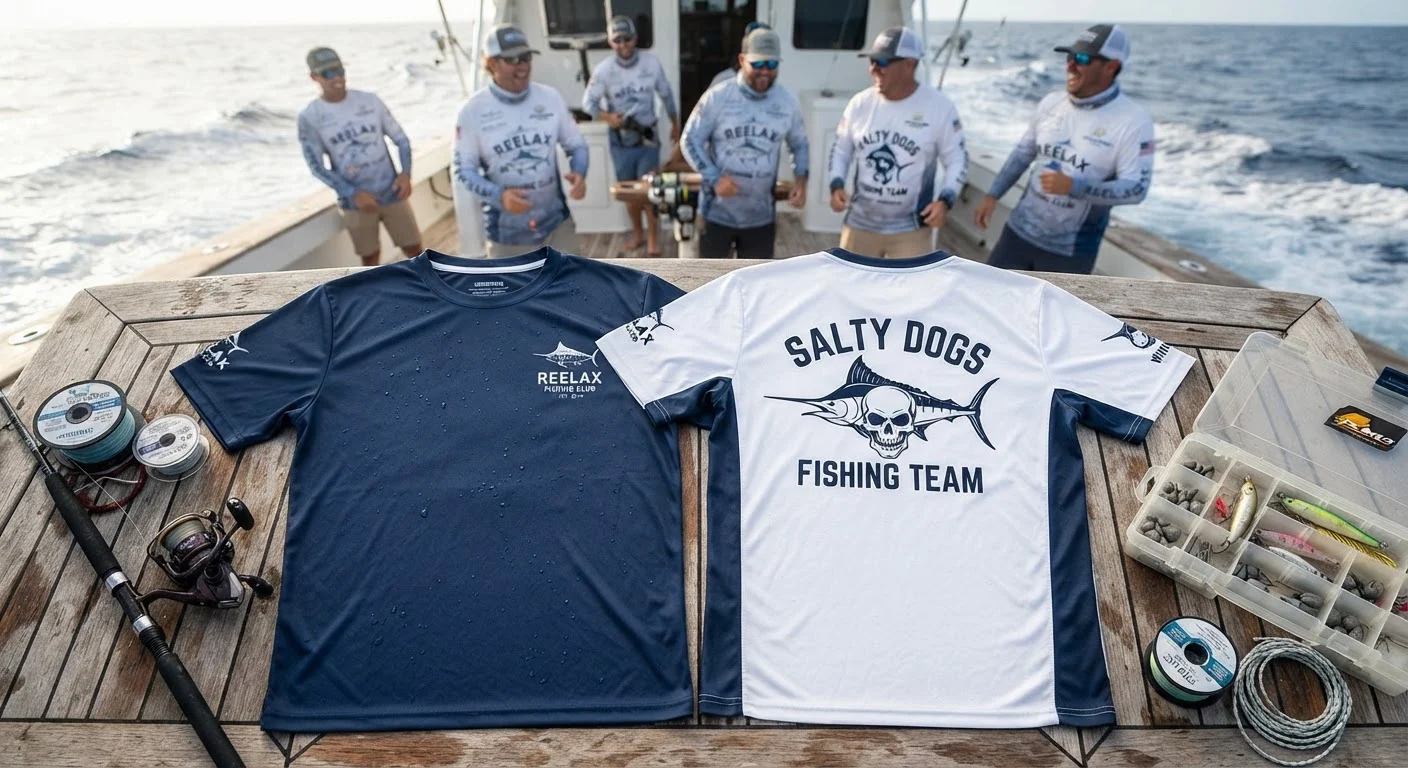
The best printing method matches your headcount and your fishing conditions, not the one with better reviews. Under 20 members, vinyl heat transfer beats screen print almost every time—lower setup costs, faster turnaround, zero minimums. Cross 50 members, especially on moisture-wicking fabric for tournament gear, and screen printing’s per-unit economics start winning by a mile. The ink also holds up better against saltwater.
Don’t guess. Pull out your roster count, budget ceiling, and fabric type, then run them against the decision matrix above before you place a single order. That’s the difference between apparel that survives a full season of sun, salt, and washer cycles—and a reorder you didn’t budget for in June. Your gear should outlast the fish stories. Print smart the first time.